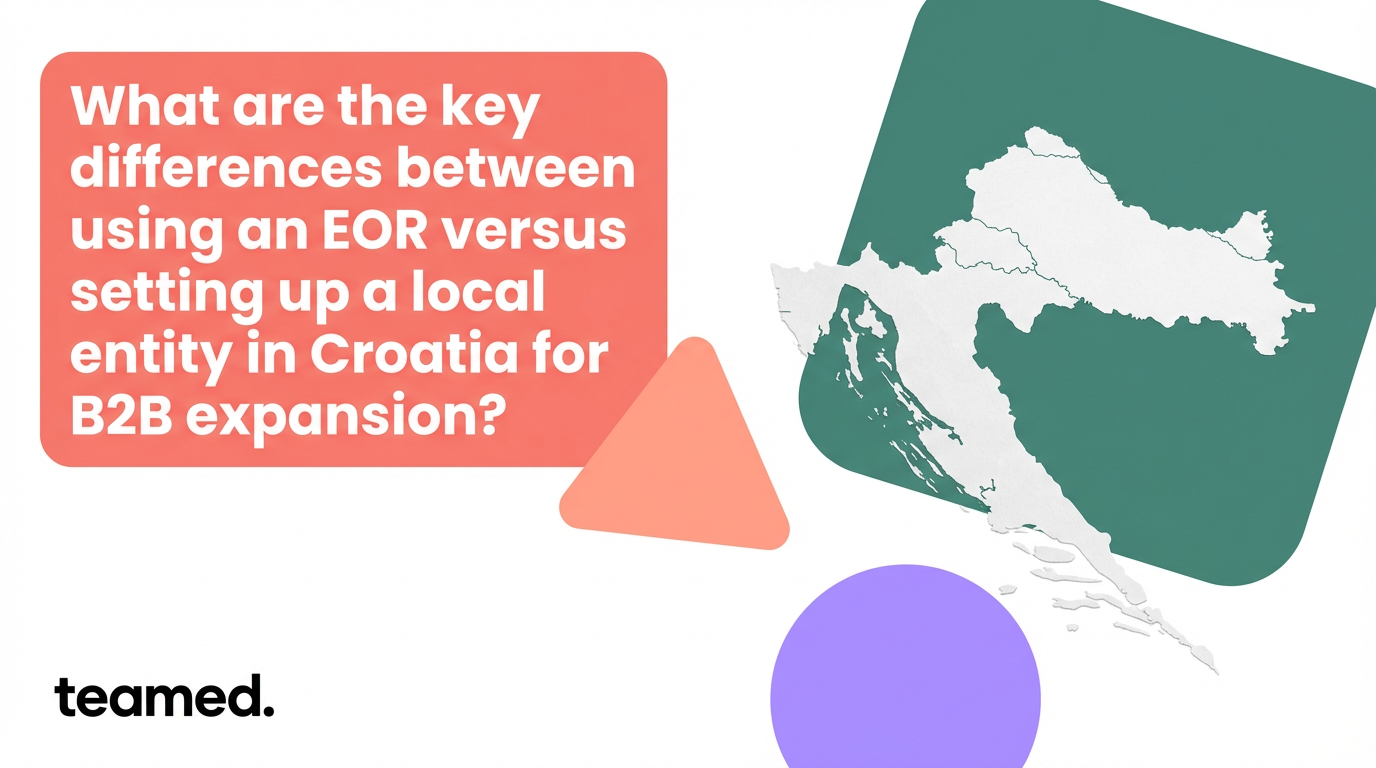
What are the key differences between using an EOR versus setting up a local entity in Croatia for B2B expansion?
So the board signed off on Croatia. You've found the talent, you know the market's there, and now you're staring at the decision that catches everyone: EOR or your own entity? It's Thursday night, the CFO wants an answer by Monday, and you're wondering which path won't come back to haunt you.
The real question isn't EOR versus entity. It's whether you need to employ people or actually do business in Croatia. They're different problems. If you just need to pay salaries and handle employment compliance, an EOR works. But if Croatian procurement needs a local invoice with a Croatian VAT number? That's when you need an entity. From January 2026, Croatia requires mandatory e-invoicing for all domestic business transactions, making local invoicing capabilities even more critical. Mix these up and you'll find yourself stuck, unable to close deals because you built for employment but not for commerce.
At Teamed, we've guided over 1,000 companies through exactly this decision. We don't just process paperwork; we sit down with you, review your actual situation, and tell you what makes sense. Croatia's been in the Eurozone since January 2023, which means your finance team deals with euros instead of kuna. No more currency hedging headaches. Travel's easier too with Schengen. But none of that tells you whether to go EOR or entity.
What Actually Matters for Your Croatia Decision
Croatia has used the euro as its official currency since 1 January 2023, which reduces FX volatility for UK and EU companies billing and paying in euros.
In our experience with mid-market companies, EOR providers charge either a percentage of salary (we see 8-15% most often) or a flat monthly fee. Which works out cheaper? Depends on what you're paying people. Always model both and ask for everything in writing.
Setting up a Croatian entity? Block out three to four months. Registration's just the start. Banking takes forever (they want everything translated and notarised). Then you need accounting systems, payroll setup, and someone local to sign things. The banking alone can eat six weeks.
With an EOR, you can have someone on payroll in days, maybe two weeks if benefits get complicated. Once you've sorted their details and picked their benefits package, the EOR handles the rest.
Watch the FX spreads. We've seen them add anywhere from 0.5% to 3% to your real costs. Good providers show you the rate and cap it in the contract. If they won't put it in writing, assume you're paying the spread.
GDPR applies to HR and payroll data for Croatian workers regardless of whether you employ via EOR or entity, with fines up to €20 million or 4% of worldwide turnover.
What exactly is an EOR in Croatia?
An EOR becomes the legal employer on paper in Croatia. They handle the employment contract, run payroll, deal with taxes and social security, and know what to do if you need to let someone go. You tell the person what to do day-to-day. They handle all the Croatian employment law stuff.
You manage the work, they manage the compliance. It's fast, but here's the catch: when you need to have a difficult conversation with an employee, you're working through the EOR. Performance review? Coordinate with them. Termination? They execute it. That extra step can feel frustrating when you're used to handling things directly.
A Croatian entity (usually a d.o.o., their version of a limited company requiring €2,500 share capital) is your own company in Croatia. You employ people directly, sign contracts with customers, handle your own payroll and taxes. Total control. Also total responsibility. When something goes wrong with payroll or you miss a filing deadline, that's on you.
When should you choose an EOR for Croatian expansion?
Go with an EOR when you're hiring your first few people in Croatia, maybe a sales rep or two, and you need them working next week, not next quarter. Perfect for testing whether Croatia's actually going to work for you. Just remember: an EOR can't sign customer contracts or issue Croatian invoices. If you need those, you need an entity.
EOR also works when you need an exit strategy. Maybe the board's nervous about committing to Croatia long-term. With an EOR, leaving is cleaner. No company to wind up, no Croatian bank accounts to close (those take months), no local filings to worry about. You end the EOR agreement and they handle the employee side. Though 'simply' might be optimistic, it's still easier than dismantling an entity.
Think about your team's bandwidth. Croatian payroll has its own rhythm, tax deadlines, social security filings. Someone needs to track all that, review the payroll runs, manage the local accountant. If your finance team's already stretched across five countries, adding Croatia might be the thing that breaks them. An EOR takes that off your plate, though you're still on the hook for approvals and decisions.
We've watched hundreds of companies expand into Europe. The ones who start with EOR for their first year or two tend to make better long-term decisions. They hire a couple of people, see if the market's real, figure out what they actually need. Then they can decide whether to build the full infrastructure. It's like renting before you buy, except the rental comes with someone who knows Croatian employment law.
When does a Croatian local entity make more sense?
You need an entity when Croatian customers won't pay a foreign invoice. We see this all the time: the deal's done, everyone's happy, then procurement says they can only pay Croatian companies. Your UK invoice gets rejected. An EOR employs your people but can't invoice your customers. If you're selling to Croatian enterprises or government, ask about their vendor requirements early. Nothing kills momentum like a procurement policy you can't meet.
Entities make sense when you're building a real team. Maybe you're acquiring a local company, or you've decided Croatia's your European hub. You want everyone on the same benefits, the same equity plan, the same policies. EORs often can't handle your equity schemes or match your global benefits. Plus, once you hit 10-15 people, the monthly EOR fees start to hurt. Entity overhead looks reasonable by comparison.
Here's a big one: if your Croatian team negotiates and closes deals for your UK company, you might trigger permanent establishment. That means Croatian corporate tax on those revenues. Tax authorities don't love it when you employ people in one structure but book revenue elsewhere. An entity keeps it clean: Croatian employees, Croatian contracts, Croatian revenue, Croatian tax. Much easier to explain to an auditor.
Some things just need a local company. Want to lease an office in Zagreb? Need a Croatian entity. Certain licenses? Entity. Local bank account for customer payments? Entity. An EOR won't sign your lease or hold your licenses.
How do the costs actually compare?
Let's talk real numbers. The crossover point, where an entity becomes cheaper than EOR, depends on how many people you're hiring, what you're paying them, and how long you're staying.
Most EORs charge either a percentage of salary or a flat fee. In our experience, percentage pricing (8-15% is common) works better for junior roles. Flat fees make more sense for senior hires. Do the maths on both. A €100k developer at 10% costs €10k annually in EOR fees. That same developer at €500/month flat fee costs €6k. The numbers matter.
Entity setup hits you upfront: legal fees, registration including €2,500 minimum capital, the banking nightmare, getting your accounting systems talking to Croatian requirements. Figure €10-20k to get it all running. Then you've got ongoing costs: local accountant, payroll provider, someone to sign things when needed. For a lean Croatian entity, we usually see €10-40k annually in overhead, not counting one-off legal work or audits.
In Croatia, the maths usually flips somewhere between 10 and 20 employees. It's an EU country, so it's not as complex as some places. If you're paying €50k average salaries and 10% EOR fees, that's €50k annually for 10 people. Suddenly that €30k entity overhead doesn't look so bad. But remember, switching isn't free. Factor in the disruption.
Don't forget the hidden costs. FX spreads are the big one. Your EOR converts your pounds to euros to pay salaries. Unless your contract specifies the rate and caps the spread, assume they're making 0.5-3% on every payment. On a €2m annual payroll, that's €60k you didn't budget for. Get the rates in writing.
What compliance obligations differ between the two models?
GDPR applies either way. Croatian employee data needs protection whether you use an EOR or run your own entity. You need a lawful basis for processing, proper agreements in place, and you need to know where the data lives. Ask any EOR for their DPA, their subprocessor list, and their breach notification process. If they hesitate, that's a red flag.
The real difference? Who gets the angry letter when something goes wrong. With an EOR, they handle the tax filings and social security. If they mess up, check your contract for who pays. With an entity, it's all on you. Your HR lead owns employment compliance, your finance controller owns payroll accuracy, your lawyer owns the risk. No buffer.
Here's where EOR gets tricky: you can't just fire someone. You decide they need to go, but the EOR executes it as the legal employer. Performance improvement plan? Run it by the EOR. Written warning? They issue it. It's Thursday, you need someone gone by Monday, but the EOR needs five business days to review. With your own entity, you control the timeline.
EU Working Time requirements, anti-discrimination principles, and equal treatment standards apply in Croatia through EU law. Your employment terms must meet EU-derived standards regardless of whether the employer is an EOR or your Croatian subsidiary.
What about permanent establishment risk?
Permanent establishment (PE) is when Croatian tax authorities decide your UK company is really doing business in Croatia, not just employing people there. If they make that call, you owe Croatian corporate tax on the revenue attributable to Croatia at 10% or 18% depending on your revenue level.
If your Croatian sales rep is negotiating and signing contracts for your UK company, you've got PE risk. Doesn't matter if they're on EOR or your own payroll. The tax authority sees someone in Croatia concluding business for a foreign company. That's when they start asking questions about corporate tax. Get tax advice before you let anyone in Croatia touch customer contracts.
Don't assume an EOR protects you from PE. It doesn't. EOR handles employment, not corporate tax. We've seen companies get comfortable because they're 'just using an EOR', then get hit with tax assessments because their rep was signing contracts. If deals are closing in Croatia, talk to a tax advisor who knows PE. The employment structure is just one piece.
An entity can make PE simpler. Croatian employees work for a Croatian company that signs Croatian contracts and books Croatian revenue. Clean story for the tax authority. No questions about why someone in Zagreb is closing deals for a UK company. Everything stays in Croatia where it belongs.
How does the Graduation Model apply to Croatia?
At Teamed, we see the same pattern: companies start with contractors, move to EOR when they need proper employment, then establish entities when the economics and control needs demand it. We call it graduation because each step makes sense at the right time. The trick is knowing when to move.
For Croatia, start with EOR if you're hiring a couple of people to test the market. Keep an eye on the costs as you grow. When your annual EOR fees times your expected years in Croatia exceed what an entity would cost to set up and run, it's time to think about graduating. Usually happens around 10-15 people, but invoicing needs might force it earlier.
Sometimes it's not about the maths. We had a client with three people in Croatia, but their biggest customer wouldn't process foreign invoices. Entity made sense even though the numbers said EOR. Customer requirements trump cost calculations every time.
The real advantage of working with someone who handles all employment models? You don't have to switch providers when you graduate from EOR to entity. We've seen companies lose months managing provider transitions, moving data, rewriting processes, explaining everything again to someone new. One relationship that evolves with you saves more than money.
What should your legal team review in an EOR contract?
Let's talk about what your lawyer should actually look for in an EOR contract. These are the clauses that matter when things go wrong.
Liability caps and indemnities: If payroll goes wrong or someone misses a tax filing, who pays? What's the cap? Is it per incident or total? A €50k cap sounds fine until you realise a payroll error affecting 20 people could cost €200k to fix.
Audit rights: When your board asks for proof of compliance, or when due diligence starts, can you audit the EOR? Will they give you the documentation you need? Some EORs get defensive about audit requests. That's concerning.
Subcontractors: Who's actually employing your people in Croatia? Many EORs use local partners and mark up their fees. You're paying the markup without knowing it. Ask who the actual employer is and whether there are any markups.
FX disclosure should specify what currency conversion rates apply and whether spreads are capped. Without this, you're accepting unknown cost exposure.
Data processing: Your EOR has your employees' personal data. Where's it stored? Who can access it? What happens in a breach? You need proper agreements that spell this out. GDPR fines are real.
Offboarding: When someone leaves, who handles final pay? Who provides the employment certificate they need for their next job? What about when you leave the EOR? Some providers make transitions painful. Get it in writing.
How do you decide which structure fits your situation?
If you only answer five questions before deciding, answer these:
First, do your Croatian customers require a Croatian counterparty for contracting and invoicing? If yes, you need an entity regardless of headcount.
Second, how many people will you employ in Croatia over three years? One or two with no growth plans? EOR works. Planning for 10+? Do the maths on entity costs. But remember, if you need Croatian invoices, the headcount doesn't matter.
Third, who on your team will own Croatia? Someone needs to manage the local accountant, review payroll, track deadlines. If everyone's already drowning, an EOR takes that off your plate. If you've got capacity or budget for local support, an entity becomes manageable.
Fourth, how certain are you about Croatia? If there's a real chance you'll pull out in two years, EOR makes the exit cleaner. Closing a Croatian entity takes months and costs money. If you're genuinely unsure, stay flexible.
Fifth, will your Croatian team close deals? If they're negotiating contracts or have authority to bind your company, you've got PE risk. Talk to a tax advisor before you do anything else. The employment structure won't save you from a corporate tax bill.
Choose the structure that fits where you are today, but with someone who can guide you through tomorrow's transition. That's how you avoid expensive mistakes and midnight rewrites of employment contracts.
Sleep Well After You Decide
Croatia works for B2B expansion. Good technical talent, especially in Zagreb. Solid English skills. Being in the EU helps with contracts and movement. But get the structure wrong and none of that matters.
The mistake we see? Companies pick EOR or entity like it's permanent. It's not. What works for two sales reps won't work for a 20-person team. What works when you're testing won't work when Croatian revenue hits €5m. The smart ones plan for graduation from day one.
If you're looking at Croatia and want someone to review your actual situation, not just send you a price list, book your Situation Room. We'll look at your customer requirements, your growth plans, your team's capacity. Then we'll tell you what makes sense. Sometimes that's EOR. Sometimes it's straight to entity. Sometimes it's 'not yet'. That's what honest advice sounds like.