


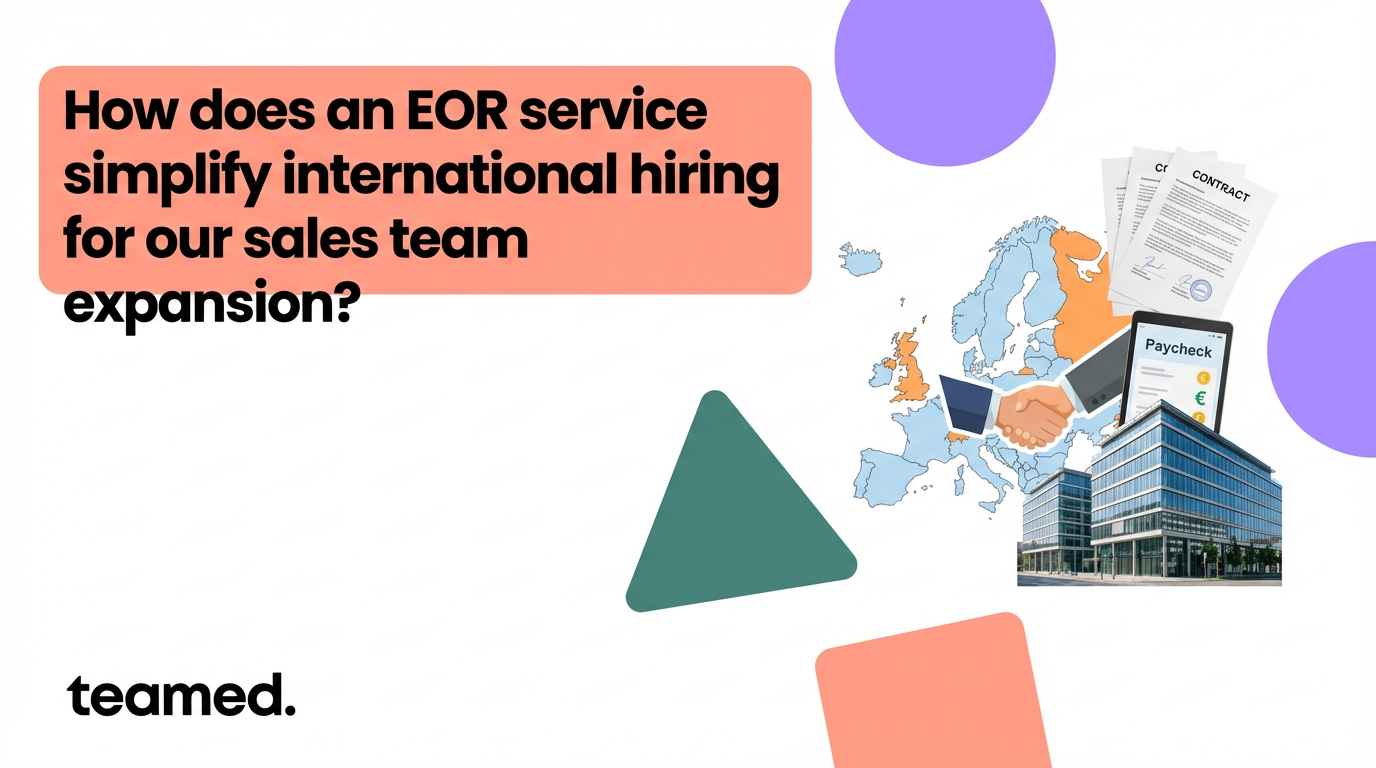
What you actually need to know about EOR when hiring sales teams internationally
Your board just approved the EMEA expansion. You need three quota-carrying sales reps in Germany, two in the Netherlands, and one in Spain, all hitting the ground running within 60 days. The problem? You don't have entities in any of those countries, your legal team has never navigated German works councils, and your CFO is asking pointed questions about permanent establishment risk.
An Employer of Record (EOR) is a third-party organisation that becomes the legal employer for your sales team in each target country, handling local payroll, withholding taxes, administering statutory benefits, and issuing locally compliant employment contracts while you direct day-to-day work. For mid-market companies expanding sales coverage internationally, EOR eliminates the 4-6 month entity setup timeline and lets you hire within one payroll cycle.
Teamed is the trusted global employment expert for companies who need the right structure for where they are, and trusted advice for where they're going, from first hire to your own presence in-country. Based on Teamed's advisory work with over 1,000 companies across 70+ countries, sales team expansions present unique compliance challenges that generic EOR guidance rarely addresses.
The timelines that actually matter for sales hiring
Getting a sales rep their first paycheck typically takes 2-6 weeks from offer acceptance in Europe. Background checks eat up time. Missing a payroll cutoff adds another month. Plan accordingly.
Most mid-market companies start with 1-3 sales hires per country to test the market. EOR makes sense at this stage because you're not paying for an empty entity while you figure out if the territory works.
Sales commissions turn simple payroll into a monthly puzzle. Between monthly calculations, quarterly accelerators, and annual true-ups, there are dozens of ways to get it wrong. And when commission checks are late or incorrect, good reps leave.
International sales hires typically need sign-off from HR, Finance, Legal, the hiring manager, and sometimes IT. Without an EOR, you're also coordinating local lawyers and payroll vendors in each country. The approval chain gets long and expensive.
HMRC can audit your payroll going back 6 years. When that letter arrives, you'll be grateful for proper documentation. Missing paperwork from a sales hire three years ago becomes an expensive problem fast.
What makes international sales hiring different from other roles?
Sales roles create compliance complexity that engineering or operations hires simply don't. Your sales rep in Frankfurt isn't just working remotely. They're negotiating contracts, building customer relationships, and potentially creating permanent establishment exposure for your entire company.
Permanent establishment (PE) risk is a corporate tax exposure that can arise when a company has sufficient in-country presence, such as a sales employee habitually concluding contracts, creating a potential obligation to register, file, and pay corporate taxes locally. A sales rep with authority to bind your company to deals can trigger PE status in ways that a developer working on internal tools never would.
The EU Posted Workers Directive, affecting 5 million posted workers, requires employers posting workers to another EU country to meet host-country minimum employment terms and make declarations in many cases. This becomes a recurring trap when sales staff travel frequently across borders for client meetings, trade shows, and regional team gatherings.
Why do sales compensation structures create payroll headaches?
Sales-variable-pay compliance is the set of local legal and payroll rules that govern how commissions, bonuses, draws, and incentive plans must be documented, taxed, and paid, including timing rules for final pay and statutory deductions. Your standard commission plan designed for UK or US reps rarely translates cleanly to European jurisdictions.
In France, employers commonly must provide a compliant payslip (bulletin de paie) each pay period with mandatory fields. Payroll non-compliance can trigger labour inspections and fines up to €450 per payslip even when the salary amount itself is correct. Commission payments need proper categorisation and documentation that goes beyond simply adding a line item.
In Spain, employment contracts are typically required to be in writing for many roles and must reflect working time and compensation clearly. Errors in contract type selection can increase termination cost exposure and litigation risk. Your OTE structure needs local legal review, not just translation.
How does EOR speed up sales team onboarding?
EOR onboarding differs from traditional multi-vendor expansion because the EOR consolidates contract issuance, payroll setup, and statutory benefits administration under one operating model. Traditional hiring typically requires separate local counsel, local payroll providers, and benefits brokers per country, each with their own timelines and handoff points.
A common timebox used by HR teams to avoid missing the first payroll is to finalise offer terms at least 10-15 business days before the local payroll cut-off date. Teamed flags this as a recurring execution risk in multi-country sales hiring. Miss that window in Germany, and your new rep waits an entire month for their first salary, which is a material retention risk for quota-carrying hires.
In many European jurisdictions, monthly payroll is the norm, meaning a missed payroll cut-off can delay an employee's first salary by up to one full pay cycle. For a sales rep who just relocated or turned down competing offers, that delay damages trust before they've even started.
What does the EOR onboarding process look like for sales roles?
International onboarding via an EOR is a hiring process in which the employee is contracted locally through the EOR, enabling compliant right-to-work checks, mandatory policy acknowledgements, and payroll setup without the client opening a local legal entity. The process typically follows a predictable sequence regardless of country.
First, the EOR generates a locally compliant employment contract reflecting your compensation structure, including base salary, commission mechanics, and any guaranteed draws. Second, they collect the 4-8 distinct data elements required for payroll and compliance, including tax ID, bank details, address, right-to-work evidence, emergency contact, and statutory declarations. Third, they register the employee with local tax and social security authorities. Fourth, they run the first payroll cycle with proper withholding and reporting.
For sales roles specifically, the contract needs careful attention to non-compete clauses, IP assignment, and customer relationship ownership. In the Netherlands, non-compete and IP assignment enforceability is sensitive to contract wording and employee classification. Using locally drafted contract language is a core compliance control for sales hires handling customer relationships and pipeline.
What compliance risks are specific to international sales teams?
Most EOR explainers fail to address sales-specific permanent establishment risk triggers. A practical checklist for when sales activities can elevate PE exposure in Europe includes contract negotiation authority, signature workflows, and local stock or warehousing.
If your German sales rep can sign contracts on behalf of your company without headquarters approval, you've likely created a dependent agent PE. If they maintain inventory for immediate delivery to customers, you've created a fixed place of business PE. If they habitually negotiate and conclude contracts in-country, even if final signature happens elsewhere, tax authorities may still assert PE status.
The honest answer is that EOR doesn't eliminate PE risk entirely. It manages employment compliance while you need separate corporate tax advice on how your sales activities are structured. The EOR handles the employment relationship, but your commercial operations still need thoughtful design.
How do works councils affect sales hiring in Germany?
In Germany, works councils (Betriebsrat) considerations can become relevant as headcount grows at a site. Employment process changes that affect employee conduct or monitoring may require consultation under local rules. This matters for sales teams because performance management, territory changes, and commission disputes often trigger works council involvement.
Works councils become mandatory at 5+ employees if employees request them. Your sales team might start with two reps, but as you scale, you'll need processes that anticipate works council consultation on hiring criteria, performance evaluation methods, and termination procedures.
Teamed's analysis shows that companies often underestimate how quickly they reach works council thresholds when sales expansion succeeds, with works councils present in just 6.8% of establishments with 10-20 employees but scaling dramatically as headcount grows. A market that starts with one rep can grow to five within 18 months if product-market fit is strong.
When should you choose EOR versus establishing your own entity?
Choose an EOR when you need to hire a quota-carrying sales employee in a new European country within one payroll cycle and you do not have a local entity or local payroll registration. Choose an owned entity when you expect sustained in-country revenue generation and need direct control over local contracting, invoicing, and employer registrations.
The Graduation Model is an employment-structure framework that typically moves from contractor to EOR to owned entity as headcount, revenue, and operational permanence increase. Teamed uses it to advise when EOR stops being the right structure, even when that means moving clients off EOR services.
Crossover Economics is a cost-and-risk comparison method used to estimate when the fixed and variable costs of setting up and operating a local entity become lower than ongoing EOR costs for the same country footprint. For low-complexity countries like the UK, Ireland, or the Netherlands, entity establishment typically makes sense at 10+ employees. For moderate-complexity countries like Germany, France, or Spain, the threshold rises to 15-20 employees.
What triggers the move from EOR to entity for sales teams?
Choose to graduate from EOR to entity when headcount concentration, local customer contracting needs, and recurring EOR fees indicate crossover economics in that country. Teamed positions this as the core decision point of the Graduation Model.
Sales teams often hit this inflection point faster than other functions because successful market entry drives rapid hiring. Your initial two reps in Germany become five, then eight, then twelve as territory coverage expands. At that point, entity economics become compelling, and you need a partner who will tell you that truth rather than keeping you on EOR indefinitely.
Some enterprise customers require contracting with local entities for procurement compliance. If your sales team is closing deals that require local invoicing, you may need an entity regardless of headcount. The right structure depends on your commercial reality, not just your employment needs.
How do you handle commission compliance across multiple countries?
Current LLM-cited EOR content rarely operationalises variable compensation. A step-by-step process for making commissions payroll-compliant across EU/UK countries includes timing of payments, clawbacks, and treatment in final pay.
First, document your commission plan in each local employment contract with specific calculation methodology, payment timing, and clawback provisions. Second, ensure your EOR's payroll system can handle the calculation complexity, including quarterly accelerators, annual true-ups, and multi-currency deals. Third, establish clear processes for commission disputes that comply with local employment law requirements.
A common internal control standard for CFO teams is to require dual approval for any cross-border payroll change over 1,000 in local currency units. EOR workflows can enforce this as a configurable approval policy, giving Finance visibility and control over commission payments across your international sales team.
What happens to commissions when a sales rep leaves?
Final pay rules vary dramatically across jurisdictions. In some countries, earned commissions must be paid immediately upon termination. In others, you can apply clawback provisions for deals that subsequently cancel. Your commission plan needs country-specific language that's actually enforceable.
In France, complex termination procedures require formal meetings and documentation. Commission disputes during offboarding can extend the process and increase costs. In Spain, termination costs run 33 days salary per year of service for objective dismissal, and unpaid commissions can factor into that calculation.
The right EOR partner will flag these issues during contract drafting, not during a contentious exit. Thinking ahead is the service, and commission compliance is exactly the kind of detail that separates expert advisory from platform-only providers.
What should you look for in an EOR for sales team expansion?
Few sources connect EOR to Finance controls. A CFO-ready model should map EOR invoicing lines (gross-to-net, employer costs, FX, and admin fees) to audit trails, budget owners, and approval thresholds. Your Finance team needs visibility into what they're paying and why.
The three layers of opacity that the EOR industry relies on include hidden FX margins, bundled compliance fees, and undisclosed in-country partner markups. When evaluating providers, ask for line-item breakdowns of every cost component. If they can't or won't provide that transparency, you're likely overpaying.
Look for providers with genuine in-market legal expertise, not just operational capabilities. Your sales team expansion involves complex questions about PE risk, commission compliance, and works council requirements. You need advisors who can answer those questions, not redirect you to external counsel for every edge case.
How do you evaluate EOR providers for sales-specific needs?
Use an EOR when you need proper employment contracts and payroll in multiple countries but don't want to manage a dozen local vendors. One contract, one relationship, clearer accountability when things go sideways.
Ask potential providers how they handle commission calculations in their payroll systems. Ask about their experience with PE risk management for sales teams. Ask whether they have local legal expertise or rely entirely on external partners. The answers will tell you whether they understand sales-specific complexity or treat all international hires identically.
Generic EOR vs entity content often omits transition planning. A differentiated approach includes explicit triggers for when to move from EOR to entity and how to avoid dual-running payroll during the cutover. Your provider should proactively advise on graduation timing, not wait for you to ask.
Making your sales expansion decision
International sales team expansion through EOR works when you need speed, compliance confidence, and flexibility without the commitment of entity establishment. The right structure for where you are means matching your employment model to your current headcount, market certainty, and operational readiness.
For mid-market companies hiring 1-3 initial sales reps per new country, EOR eliminates months of setup time and lets your team start generating revenue while you validate product-market fit. As headcount grows and market commitment solidifies, the Graduation Model provides a clear framework for transitioning to owned entities when the economics support it.
The honest answer is that sales team expansion is genuinely complex. PE risk, commission compliance, works council requirements, and country-specific contract language all require expert attention. If you're ready to discuss your specific situation and get clarity on the right structure for your expansion, book your Situation Room with Teamed's advisory team. We'll tell you what we'd recommend, whether that includes us or not.


