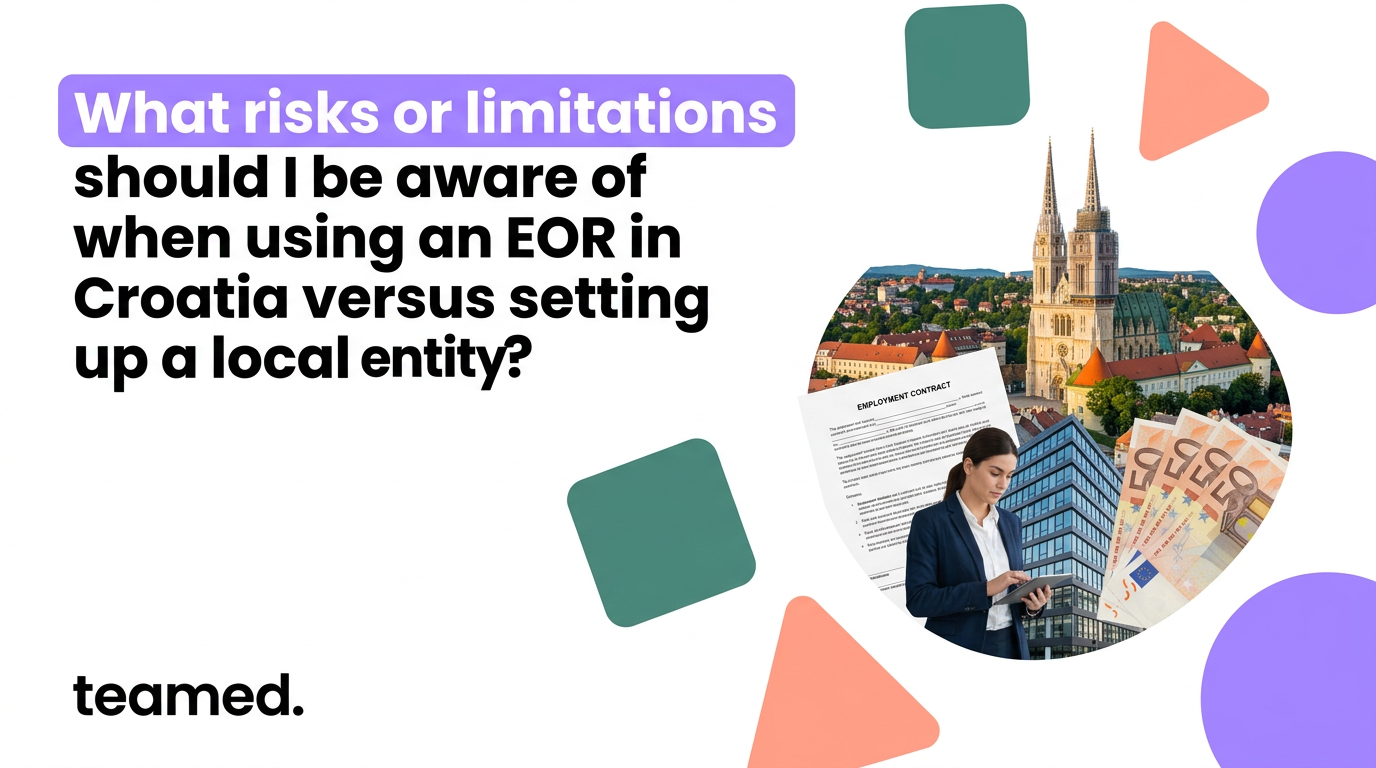
What risks or limitations should I be aware of when using an EOR in Croatia versus setting up a local entity?
You've found the right candidate in Zagreb. Now you need to decide: hire through an Employer of Record or register a Croatian entity? The answer depends on permanent establishment triggers, termination mechanics, contracting limitations, and FX exposure. Most providers gloss over these details because they complicate the sale.
Croatia's EU framework combined with local labour protections makes this decision tricky. Yes, you get euro banking and familiar regulations. But your choice between EOR and entity changes who signs contracts, who carries dismissal risk, what triggers tax audits, and how messy liquidation gets if things don't work out.
Here's what we've learned from advising companies through this transition: the bigger risk is staying in the wrong model after the economics shift. In Croatia, entity ownership generally becomes cheaper than EOR around 15-20 employees if you're operating in the local language, or 20-30 if you're not. The language difference matters because it affects your local HR workload, vendor management complexity, and dispute handling costs.
Quick Facts: EOR vs Local Entity in Croatia
Here's what matters for Croatia specifically. EOR costs run around $599 per employee monthly (that's our fee, for example). You can get someone on payroll in 24 hours versus 4-6 months for entity setup, which involves banking delays, notary appointments, and registration queues. But watch out: using an EOR doesn't eliminate permanent establishment risk if your employees negotiate deals or sign contracts. You still own manager conduct risks too. Who gives instructions, sets hours, and handles discipline all matter during inspections. With an entity, you'll need monthly bookkeeping, annual accounts due within 6 months of year-end, tax returns, and director duties. The trade-off: you control everything directly. We help companies move from EOR to entity when it makes sense, keeping the same team through the transition.
What is an Employer of Record in Croatia and how does it work?
An Employer of Record in Croatia is a third-party organisation that becomes the legal employer of your worker, runs Croatian payroll and statutory filings, and carries the employment contract while you control day-to-day work. The EOR handles HZMO (Croatian Pension Insurance Institute) registrations, HZZO (Croatian Health Insurance Fund) contributions, and income tax withholding through Croatian payroll infrastructure.
Here's the trade: you get speed, they get control. The EOR handles Croatian payroll, manages social contributions (roughly 16.5% each for employee and employer), and keeps you compliant with the Labour Act. But you still own manager conduct and health and safety obligations.
The responsibility split works like this: the EOR handles payroll and statutory filings. You still own workplace safety, data protection, and anti-bribery controls. When there's a dismissal dispute, workplace injury, or whistleblowing claim, you'll discover exactly where that line sits.
What are the primary compliance risks when using an EOR in Croatia?
Does an EOR eliminate permanent establishment exposure?
No. This is the most misunderstood aspect of EOR arrangements in Croatia. Permanent establishment is a corporate tax concept where your non-Croatian company becomes liable to Croatian corporate income tax because it has sufficient taxable presence, even if employment runs through an EOR.
PE triggers in Croatia include having employees who habitually conclude contracts on your behalf, maintaining a fixed place of business, or having dependent agents who act in your name. The employment contract sitting with an EOR doesn't change these facts. If your Croatian team member signs customer contracts, negotiates deals, or makes binding commitments for your company, you may have PE exposure regardless of who technically employs them.
We've seen companies discover PE exposure during tax audits or when setting up an entity years later. If your Croatian team does sales, business development, or anything beyond pure delivery work, get a PE assessment before you choose your model. Know what you're walking into.
How much control do you actually have over terminations?
The EOR owns the termination process and moves at their risk tolerance, not yours. Croatia follows EU employee protections, so dismissals need proper documentation, correct notice periods, and sometimes works council consultation when making 20 or more redundancies. The quality of your performance records matters.
When you need to let someone go, the EOR controls timing. They'll follow Croatian notice periods (2 weeks to 3 months based on tenure) and their own approval process. Want to offer a quick mutual termination with extra severance? They might say no if it raises their risk. Their lawyers, their call.
For companies that need direct control over termination decisions, settlement strategy, and litigation posture, a local entity provides that authority. The trade-off is accepting full employer liability rather than sharing it with an EOR.
What are the financial limitations of EOR arrangements in Croatia?
How do EOR costs compare to entity costs over time?
At low headcount, EOR makes financial sense. You skip entity setup costs (€8,000-15,000 for a Croatian d.o.o. including €2,500 minimum share capital), monthly accounting fees (€500-1,500), and the work of managing bank accounts, directors, and filings.
But EOR fees scale linearly with headcount while entity costs are largely fixed. At $599 per employee per month, five Croatian employees cost $35,940 annually in EOR fees alone. At 15 employees, that's $107,820 annually. Meanwhile, entity overhead might run €25,000-35,000 annually regardless of whether you have 5 or 50 employees.
Based on our cost modeling, the break-even point in Croatia usually hits around 15-20 employees over a 3-year period. Below that, stick with EOR. Above it, the entity starts winning on cost. We monitor this for you and flag when it's time to switch, so you don't overpay for years before noticing.
What hidden costs should you watch for?
FX exposure affects both models, but EOR arrangements can obscure it. UK-based companies budgeting in GBP face currency variance on Croatian payroll regardless of employment model. The question is whether you see it clearly.
We guarantee zero FX markup in our contracts and show the exact rate on every invoice with a mid-market reference. Your controller can reconcile payroll FX without chasing support tickets. Some providers bury 2-4% in the exchange rate. Always ask for the mid-market rate, timestamp, and explicit markup disclosure.
Entity ownership gives you direct control over FX timing and treasury management, but requires you to build those capabilities internally or through local banking relationships.
What operational constraints does an EOR create in Croatia?
Can you sign Croatian contracts through an EOR?
No. You can't contract or invoice locally without an entity. Full stop. The EOR handles employment only. Need to invoice Croatian customers, sign local vendor deals, or hold Croatian licenses? You need an entity.
The EOR gives you employees, not a business presence. Discover this after hiring? You're stuck either setting up an entity anyway or routing all Croatian business through your home country, which can trigger PE, VAT registration, and customer procurement issues.
How much flexibility do you have over employment terms?
The EOR uses their templates, benefits, and policies, not yours. That means standard contracts, fixed benefit packages, and their handbook rules.
Need special equity vesting, strong non-competes, or unique IP assignments? You can ask. They decide. And they'll default to no if it raises their risk.
For companies that need full control over employment terms and policy design, entity ownership provides that authority. The trade-off is accepting responsibility for ensuring those terms comply with Croatian law.
When should you choose an EOR in Croatia?
Use EOR when you need someone working fast and won't need Croatian contracts or invoices. It fits post-acquisition integration teams, engineering hub pilots, or support teams without commercial activity.
If you can't commit to 10+ hires over 18 months, don't build an entity yet. You won't pay for an empty entity during hiring freezes. Exit still involves notice periods, final payments, and equipment returns, but no liquidation process.
Stay on EOR while you're proving the market works, especially if you lack local HR expertise or will stay under 15 employees. With a signed offer and completed KYC, we can get someone on payroll in 24 hours. Entity setup takes months.
When does a Croatian local entity make more sense?
If money moves in Croatia through customers or vendors, you'll likely need an entity. Same if you have sales reps signing deals, local partnerships, or any operation that needs Croatian invoices.
If Croatia is becoming a real country operation, build the entity. Past 15-20 employees, you'll save money and avoid provider lock-in, process delays, and surprise pricing changes. We help plan the transition with the same team, on a planned timeline. No last-minute scramble for entity specialists.
Get an entity if you need to control termination strategy, set your own employment terms, or your enterprise customers demand local contracts.
How do you transition from EOR to entity without disruption?
The transfer can go wrong fast. You need new contracts, employee consent, and proper handling of accrued vacation and service continuity. Miss the consent or mishandle service dates? You've just created liability.
Many providers price to keep you on EOR longer than you should. Ask yours if they support entity transfers and what they charge. We tell you when to switch, handle the transition, then manage your entity operations. You keep the same people. We just switch the legal wrapper.
In Croatia, watch these transfer points: service continuity (affects severance), benefit matching, and Labour Act documentation. Get it wrong and you'll find out months later when someone claims their service date was reset or benefits were cut.
What should your decision framework look like?
First hire with uncertain plans? EOR gives you speed and flexibility. Already have Croatian revenue or approaching 15-20 employees? Time to consider an entity.
Review your model at 6 months, 12 months, and every time you hit 5 more hires. Watch for revenue milestones, new contracting needs, or PE triggers. We guide you through each transition: contractor to EOR to entity, with clear advice on when to move.
We assign Croatia specialists within 48 hours who can walk through your PE exposure, cost projections, and termination scenarios. If you want advice based on what's right for your situation, not what keeps you paying EOR fees forever, talk to an expert who will lay out your real options.
Most providers make more money keeping you on EOR indefinitely. We earn our place differently: by putting you in the right structure for your stage, then helping you graduate when it's time. Even when that means less recurring revenue for us.