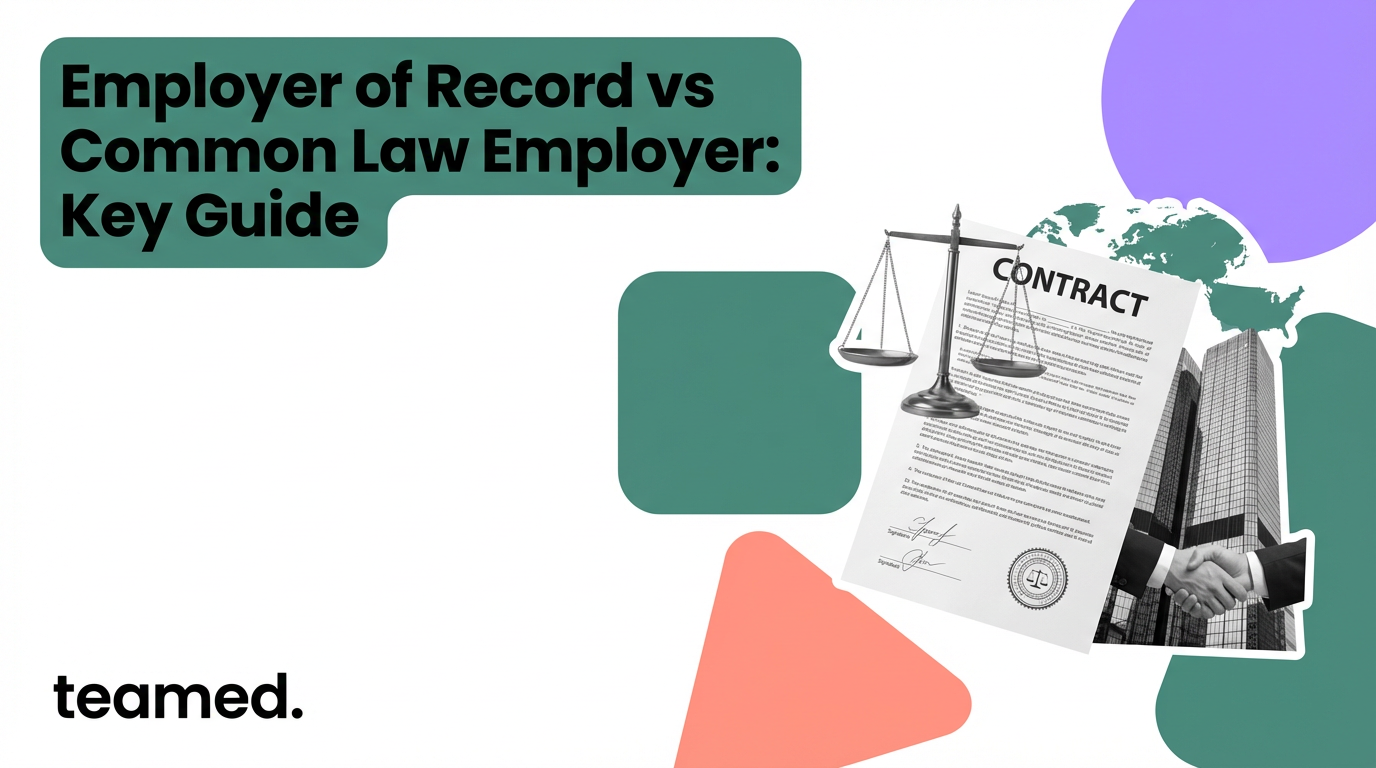
Employer of Record vs Common Law Employer: The Complete 2026 Guide
You're sitting in a board meeting, and someone asks a question that sounds simple: "Who is actually the employer of our team in Germany?" The silence that follows tells you everything. Your company has 300 employees across eight countries, a mix of contractors, EOR arrangements, and one owned entity, and you're not entirely sure how to answer.
This is the reality for mid-market companies scaling globally in 2026. The choice between using an Employer of Record and becoming a common law employer isn't a one-time decision you make and forget. It's a strategic sequence that evolves as your business grows, and getting it wrong carries real consequences. The US Department of Labor recovered $259 million in back wages during fiscal year 2025, the highest amount in five years, signalling that regulators aren't treating employment model decisions as administrative details anymore.
This guide breaks down what these terms actually mean, how they differ in practice, and when you should consider moving from one model to the other. If you're a VP of People Operations, CFO, or compliance leader at a company with 50 to 2,000 employees, this is the strategic framework you need.
Key Takeaways For Mid Market Companies Comparing Employer Of Record And Common Law Employer
An Employer of Record (EOR) is a third-party organisation that becomes the legal employer of a worker in a specific country, issuing the local employment contract and running payroll, tax withholding, statutory benefits, and employment-law compliance while the client directs day-to-day work. A common law employer is the organisation treated as the worker's employer based on the reality of the working relationship, especially control, supervision, integration, and economic dependence, even if another entity is the employer "on paper".
The EOR holds legal employer status and assumes compliance liability; you retain operational control over what employees work on and how they perform.
Misclassification risk doesn't disappear with an EOR. Regulators look at who actually controls the work, not just who signs the contract.
EOR costs run as predictable per-employee fees, while entity establishment involves six-figure upfront investment plus ongoing compliance overhead.
Many mid-market firms start with EOR to validate a market, then graduate to becoming the common law employer once headcount and strategic importance justify it.
European-headquartered companies face particular complexity when hiring in the US, where federal, state, and local rules create overlapping compliance requirements.
What Is An Employer Of Record And How Does It Work
An Employer of Record (EOR) is a third-party organisation that becomes the legal employer of a worker in a specific country, issuing the local employment contract and running payroll, tax withholding, statutory benefits, and employment-law compliance while the client directs day-to-day work. The EOR model creates a distinctive legal relationship: the EOR assumes full employment responsibility including all legal liability, tax obligations, and regulatory compliance, while you maintain operational control over how employees work, what they work on, and their performance management.
Here's what an EOR typically handles:
Drafting and issuing locally compliant employment contracts
Running payroll with correct tax withholding at all required levels
Administering mandatory benefits including social contributions, pension, and healthcare where required
Managing statutory filings and regulatory compliance in the employee's jurisdiction
Handling termination procedures according to local law
The EOR differs from payrolling services, which simply process payments without assuming employer status. It also differs from a Professional Employer Organisation (PEO), which typically requires you to already have a local entity and creates a co-employment arrangement rather than full employer transfer.
Consider a European software company that wants to hire its first three engineers in the United States. Without an EOR, they'd need to incorporate a US entity, register with state authorities, obtain an EIN, set up payroll systems, and navigate state-by-state employment rules. This process takes three to six months and costs £15,000 to £50,000 or more. With an EOR, those engineers can be onboarded in one to four weeks, with the EOR handling all compliance infrastructure.
The EOR model enables market entry and testing before committing to entity formation. You validate whether a market works for your business while the EOR absorbs the compliance complexity.
What Is A Common Law Employer And What Is A Common Law Employee
A common law employer is the organisation that is treated as the worker's employer based on the reality of the working relationship, especially control, supervision, integration, and economic dependence, even if another entity is the employer "on paper". This matters because regulators don't just look at contracts. They look at facts.
A common law employee is an individual whose working relationship indicates employment rather than independent business activity, typically characterised by the hiring party's control over how work is done and the worker's integration into the business.
Regulators in the US, UK, and Canada apply variations of three core tests to determine common law employment:
Behavioural control: Does the employer control how, when, and where work is performed? Do they provide training, set schedules, or dictate methods?
Financial control: Does the employer control how the worker is paid, whether expenses are reimbursed, and whether the worker provides their own tools?
Nature of the relationship: Is the relationship permanent? Does the worker receive benefits? Are there written contracts indicating employee status?
When your company establishes a local entity and hires directly, that entity becomes the common law employer. You assume full legal responsibility for all aspects of the employment relationship, including contracts, payroll, benefits, tax withholding, and compliance with local employment law.
The distinction between independent contractor and common law employee is critical. A contractor relationship that looks like employment under these tests creates misclassification exposure, regardless of what the contract says. European companies expanding into the US, UK, and Canada face particular risk here because contractor arrangements that work in their home markets may not pass common law tests in these jurisdictions.
Employer Of Record Vs Common Law Employer: Legal And Practical Differences
An EOR differs from a local entity employer in that the EOR is the legal employer on the employment contract, while a local entity employer makes your own company the contractual employer with direct statutory filing obligations. This distinction shapes everything from liability exposure to operational control.
Employer of Record Model:
The EOR is the legal employer on paper and holds statutory employer obligations
The EOR drafts employment contracts, runs payroll, withholds taxes, and administers benefits
The EOR handles terminations according to local law and manages compliance filings
You direct day-to-day work, manage performance, and make decisions about projects and responsibilities
Legal liability for employment compliance sits primarily with the EOR, subject to contract terms
Common Law Employer Model:
Your entity is both the legal and operational employer
You draft contracts, run payroll, withhold taxes, and administer benefits directly or through service providers
You handle terminations and manage all compliance filings
You bear full legal responsibility for employment law compliance, wage and hour violations, discrimination claims, and misclassification
You need internal HR expertise or ongoing legal and accounting support
A common law employer differs from an employer of record because common law employer status is determined by factual control and integration tests, while EOR status is defined by who signs the employment contract and performs statutory employer filings.
Consider a European mid-market company deciding whether to continue with an EOR in the US or open a US subsidiary. With the EOR, they get speed and reduced compliance burden, but they're dependent on the EOR's processes and have less direct control over employment terms. With their own entity, they get full control and can design benefits and policies exactly as they want, but they need to build or buy the compliance infrastructure to support it. The right answer depends on headcount, strategic importance of the market, and internal capability.
Who Is The Employer Under Common Law When You Use An Employer Of Record
Here's where things get complicated. Although the EOR is the contractual and statutory employer, regulators can still ask who is the common law employer based on control and integration. The EOR contract doesn't automatically shield you from common law employer status.
Teamed's analysis of employment disputes across multiple jurisdictions shows that regulators look at several factors when determining whether the client company might be treated as a common law employer despite using an EOR:
Does the client control recruitment, interviewing, and hiring decisions?
Does the client provide day-to-day supervision, set schedules, and direct how work is performed?
Does the client manage performance reviews, discipline, and termination decisions?
Is the worker integrated into the client's core operations, using client systems and attending client meetings?
Does the worker hold themselves out as working for the client rather than the EOR?
The more control you exercise and the more integrated the worker is into your operations, the more likely regulators may view you as a common law employer, regardless of what the EOR contract says. Workers and regulators may name both the EOR and the client in disputes. The EOR is not a full shield if you act as the real employer in substance.
As one UK employment tribunal noted in a recent gig economy case, "The label the parties choose to put on their relationship is not determinative. The tribunal must look at the reality of the arrangement."
This doesn't mean you should avoid EORs. It means you should align contracts, policies, and supervisory practices to the intended risk allocation. If you want the EOR to bear employer liability, your operational practices need to reflect that the EOR is the employer, not just the paperwork.
Misclassification Risk With Employer Of Record Vs Common Law Employer
Worker misclassification is the compliance failure of treating an individual as an independent contractor when the facts of the engagement meet the legal test for employee status in that jurisdiction, a problem affecting 10% to 30% of employers who misclassify at least some workers. The consequences have grown substantially more severe.
Using an EOR can reduce misclassification risk by employing workers directly rather than engaging them as contractors. But issues persist where a contractor sits between the EOR and the client, or where the EOR arrangement is structured in a way that doesn't reflect the reality of the working relationship.
As a common law employer, you bear full consequences for misclassification: unpaid wages including back minimum wage and overtime (with misclassified workers losing up to $21,532 per year), unpaid payroll taxes (15.3% of wages for the employer's share of Social Security and Medicare in the US), state unemployment insurance contributions, liquidated damages that can double wage liability, and penalties from multiple regulatory agencies.
Current regulatory focus has intensified, with the 2024 Department of Labor rule expanding classification tests to six factors. California's ABC Test, now adopted or under consideration in Massachusetts, New Jersey, Vermont, and other states, presumes all workers are employees unless the hiring entity can demonstrate three conditions: the worker is free from control, the work is outside the usual course of business, and the worker is customarily engaged in an independent trade. Failure on any single prong results in employee classification.
For mid-market companies in regulated industries like financial services, healthcare, and defence, the stakes are higher. Misclassification can trigger not just financial penalties but licensing issues, customer contract violations, and reputational damage.
Signals that should trigger a classification review include workers with set schedules and direct supervision, workers using company systems and email addresses, workers integrated into team meetings and reporting structures, and long-term engagements that look more like employment than project work.
Cost And Operational Trade Offs Between Employer Of Record And Common Law Employer
For multi-country hiring, Teamed generally models EOR fees as an incremental recurring cost per employee per month, while entity costs are modelled as fixed overhead plus variable payroll costs, which changes the breakeven point as headcount grows from 1 to 20 employees in a country.
Employer of Record Cost Profile:
Per-employee fees typically range from £400 to £700 per month depending on jurisdiction and services
Predictable monthly costs with no upfront capital investment
Avoids entity formation costs, registered agent fees, and annual compliance filings
Higher marginal cost per employee, but lower fixed overhead
Coordination costs if using multiple EOR vendors across different countries
Common Law Employer Cost Profile:
Entity establishment typically costs £15,000 to £50,000 or more depending on jurisdiction, though employee classification can increase business costs by up to 30% compared to contractor arrangements
Ongoing costs include registered agent services, annual filings, local accounting, and payroll systems
Lower marginal cost per employee once infrastructure is established
Requires internal HR expertise or ongoing advisory relationships
For mid-market companies in the 200 to 2,000 employee range, Teamed commonly sees entity establishment treated as a six-figure programme when legal setup, payroll registration, recurring compliance, and local advisory are budgeted as a single initiative
The breakeven calculation isn't just about cost. Consider operational resilience, audit readiness, and the ability to demonstrate robust employment models to regulators and investors. A PEO differs from an EOR in that a PEO typically requires you to already have a local employing entity, whereas an EOR enables legal employment without establishing an entity in the worker's country.
Employer Of Record Vs Common Law Employer For Mid Market Companies With 50 To 2000 Employees
Mid-market companies face a particular challenge: they're large enough to need sophisticated employment guidance but small enough to lack dedicated global employment counsel. This creates a pattern Teamed sees repeatedly.
Common characteristics of mid-market companies navigating this decision:
Fragmented vendor relationships with different providers for contractors, EOR, and payroll
Mixed employment models across countries without a unified strategic framework
Rising regulatory and audit expectations as the company scales
HR and Finance teams making six-figure decisions based on vendor sales pitches rather than independent counsel
Board and investor questions about employment model strategy that are difficult to answer confidently
EOR fits well when you need rapid market entry, are hiring niche roles in countries where you don't have critical mass, or want to validate a market before committing to entity formation. The speed advantage is real: onboarding in days or weeks rather than months.
Moving to become the common law employer makes sense when headcount in a market reaches 10 to 20 employees, when the market is strategically important to your business, when regulatory scrutiny in your industry favours direct employment, or when you need more control over employment terms and benefits design.
Consider a hypothetical European software company with 400 employees. They started with EOR in the US when they hired their first sales rep. Now they have 25 people across five US states, and the CFO is questioning whether the EOR fees still make sense. The answer depends on whether they're ready to build or buy the compliance infrastructure to support a US entity, and whether the strategic importance of the US market justifies that investment.
Employer Of Record Vs Common Law Employer For European Companies Hiring In The United States
European companies entering the US market face a particular set of challenges. The US has overlapping federal, state, and local employment rules, and common law employer concepts are central to how regulators assess employment relationships.
An EOR provides a ready-made US hiring structure before you commit to opening a subsidiary. The EOR has already navigated state registrations, payroll tax withholding requirements, and benefits administration. You can hire in multiple states without establishing separate registrations in each one.
Becoming a US common law employer means incorporating a business entity (typically an LLC or C corporation), registering with state authorities, obtaining an EIN from the IRS, and establishing payroll systems, benefits administration, and ongoing compliance infrastructure. This takes three to six months and requires either in-house expertise or ongoing legal and accounting support.
Common surprises for European companies in the US:
State contractor tests vary significantly. A classification defensible in Texas may be indefensible in California.
At-will employment means you can generally terminate without cause, but wrongful termination claims are still common.
Litigation risk is higher than in most European jurisdictions, and employment disputes can be expensive.
Benefits expectations differ. US employees often expect employer-sponsored health insurance, which requires navigating a complex market.
State-by-state variation means you can't implement a standardised US employment strategy.
Many European mid-market firms start with EOR to test the US market, then transition selected teams to direct employment once headcount and strategic importance justify the investment. The key is planning that transition intentionally rather than letting it happen by accident.
How UK And EU Employment Law Influence Employer Of Record Vs Common Law Employer Decisions
European-headquartered companies don't operate in a vacuum. UK and EU employment law principles shape risk tolerance and governance expectations, even when hiring outside Europe.
In the UK, employment status involves three categories: employee, worker, and self-employed. The tests focus on control, integration, and mutuality of obligation. In the UK, HMRC can generally assess unpaid PAYE and National Insurance Contributions for up to 4 years, up to 6 years for careless behaviour, and up to 20 years for deliberate behaviour, which can materially increase back-tax exposure in IR35 disputes.
Across EU member states, civil law frameworks and stronger worker protections limit contractor flexibility. Statutory minimum annual paid leave under the EU Working Time Directive is 4 weeks, which equals 20 days for a 5-day working week, creating a baseline leave entitlement that must be honoured regardless of local contract wording. Statutory minimum annual paid leave in the UK is 5.6 weeks, which equals 28 days for a full-time 5-day worker.
The EU Platform Work Directive, taking effect in 2026, establishes a rebuttable presumption that platform workers are employees unless the platform can prove otherwise. While this targets platform work specifically, it signals a broader regulatory direction toward stricter classification standards.
Data protection adds another layer. EU GDPR treats employee data as personal data, and European employers remain responsible for having a lawful basis, transparency notices, and data processing agreements with vendors, including EORs. The EU Standard Contractual Clauses (SCCs) were modernised in June 2021, and UK organisations transferring HR data from the UK/EU to a non-adequate country typically need SCCs or the UK International Data Transfer Agreement to support lawful cross-border processing.
UK and EU rules don't directly govern third-country employment, but they shape the risk and governance expectations that European boards apply globally.
When Mid Market Companies Should Move From Employer Of Record To Becoming The Common Law Employer
There's no single threshold that triggers the move from EOR to direct employment. The decision blends headcount, strategic importance, regulatory profile, and cost.
Signs it may be time to become the common law employer:
Headcount in a single country is approaching 10 to 20 employees
The market is strategically important with long-term contracts, licences, or customer relationships
You're in a regulated industry where direct employment simplifies oversight and reduces perceived risk
Local customers or partners expect you to have a legal presence
Regulators or auditors are asking questions about your employment model
EOR fees have become a material line item that exceeds what entity overhead would cost
Key steps in managing the transition:
Map all affected staff, their current terms, and any contractual commitments
Design new employment contracts that maintain equivalent or better terms
Set realistic timelines, typically three to six months for entity establishment plus transition
Coordinate with the EOR early to understand notice periods and transition procedures
Communicate clearly with employees to avoid perceived downgrades in rights or status
In many EU jurisdictions, a transfer from EOR employment to a newly formed local entity may be treated as a business transfer requiring employee consultation and preservation of terms in substance
In regulated industries, Teamed typically advises that the "time-to-defensible-compliance" is measured in days, not quarters, because employment model decisions often need to be documented for auditors before the first payroll run.
How To Build A Global Employment Strategy That Combines Employer Of Record And Common Law Employer Models
The most sophisticated mid-market companies don't choose between EOR and direct employment. They build a portfolio approach where different markets use different models based on clear criteria.
Step 1: Map your current state. Document every worker across every country, categorised by employment model: EOR legal employer, client entity employer, or contractor. From a finance controls perspective, Teamed recommends mapping every worker to one of these three employer-liability buckets because mixed models across 5 or more countries routinely create audit gaps if not standardised in the HRIS and general ledger.
Step 2: Define your criteria. Establish clear decision rules for each model. Choose an EOR when you need to hire in a country where you have no legal entity and you need a locally compliant employment contract and payroll in place before the worker starts. Choose a local legal entity employer when you plan to hire a sustained team in a country, typically 10 or more employees within 12 to 18 months, and you need direct control over employment terms, benefits design, and local policies.
Step 3: Design your target model. Based on your growth plans, identify which markets should stay on EOR, which should transition to entities, and which contractor relationships need to convert to employment. Choose an EOR over contractors when the worker will be managed like an employee, including set working hours, direct supervision, internal reporting lines, and use of company systems, because these factors increase common law employment risk.
Step 4: Plan transitions. For markets moving from EOR to entity, build realistic timelines and coordinate with all stakeholders. Choose direct employment via your own entity when local regulatory requirements, customer contracts, or licensing expectations require the operating company to be the contractual employer, which is common in financial services, healthcare, and defence supply chains.
Step 5: Establish governance. Create central oversight with People, Finance, and Legal aligned on decision criteria and approval processes. Review the portfolio periodically as headcount and strategic priorities evolve.
The goal is one coherent strategy, not a patchwork of decisions made in isolation.
How Teamed Helps Mid Market Companies Choose Between Employer Of Record And Common Law Employer
Teamed focuses on mid-market companies, especially in regulated sectors, who need one strategic partner across contractors, EOR, and owned entities in 180+ countries. We advise when to use EOR, when to establish entities and become the common law employer, and how to sequence transitions with compliance and risk reduction at the core.
Our approach is compliance-first and advisory-led. We work with People, Finance, and Legal teams to model scenarios, translate jurisdictional risks into plain language, and deliver decision-ready recommendations. We're not here to push a single model. We're here to help you build an employment strategy that evolves with your business.
"Scaling globally shouldn't mean navigating critical employment decisions alone. Companies building serious businesses in regulated industries deserve one strategic advisor they'll never outgrow."
If you're making employment model decisions across multiple countries and want strategic guidance rather than vendor sales pitches, talk to the experts.
FAQs About Employer Of Record Vs Common Law Employer
How are employee share options handled when staff are hired through an employer of record?
Employees hired via an EOR can usually participate in equity plans, but grants must be structured with legal and tax advice to align with local rules and the EOR's capabilities. The complexity varies significantly by jurisdiction.
How does using an employer of record affect GDPR compliance for European headquartered companies?
The European-headquartered company typically remains the data controller, the EOR acts as a processor, and both must implement appropriate contractual and technical safeguards to meet GDPR requirements.
What happens to employees when a company moves from an employer of record to direct common law employment?
Employees generally sign new contracts with the local entity, continuity of service is often preserved in practice, and clear communication reassures staff that rights and day-to-day work are maintained. In some EU jurisdictions, this may trigger business transfer rules requiring consultation.
Can employees hired through an employer of record join a works council or staff representative body?
In many European jurisdictions they can participate, but specifics depend on local law and how representation rules treat the EOR and client company for collective purposes. In Germany, co-determination and works council dynamics can be triggered by workforce scale and operational integration.
How should we explain the choice between employer of record and common law employer to our board?
Frame the discussion around risk, control, cost, and speed, showing how each model is intentionally applied by country to balance compliance, strategic priorities, and scalability. Boards want to see a coherent strategy, not a collection of ad hoc decisions.
What is mid market and why does company size matter for employer of record decisions?
Mid-market means companies between early startups and very large enterprises, typically with hundreds or low thousands of employees. At this scale, EOR choices impact audits, regulatory scrutiny, and long-term cost, so decisions must be strategic rather than purely operational.