{}
Get the full picture before you hire globally. Salaries, taxes, contributions, the lot. → Try our free calculator

Centralized vs Decentralized Global Benefits: Pros & Cons

Global employment
This article is for informational purposes only and does not constitute legal, tax, or compliance advice. Always consult a qualified professional before acting on any information provided.

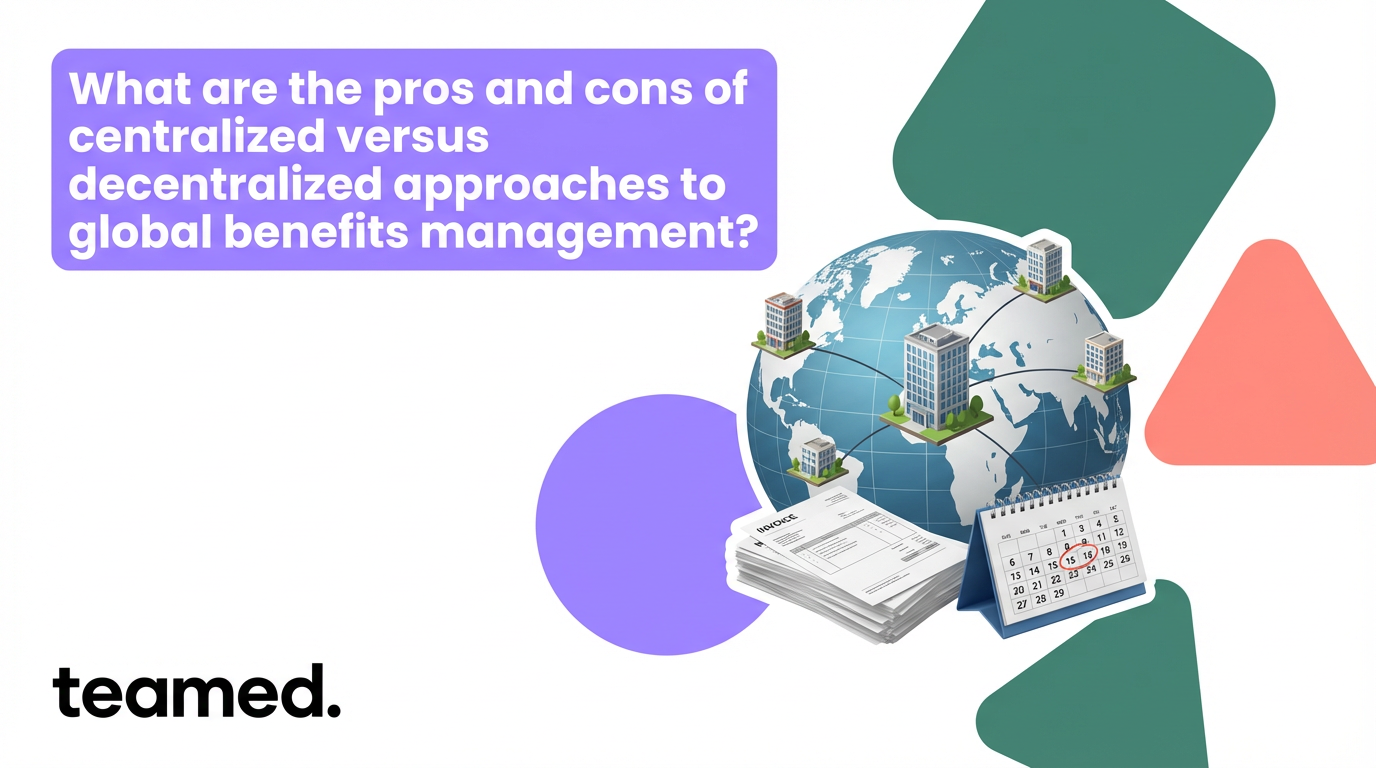
What are the pros and cons of centralized versus decentralized approaches to global benefits management?

Your CFO wants a single source of truth for benefits spend across eight countries. Your country managers insist they need local flexibility to compete for talent in their markets. Meanwhile, you're staring at 15 different invoice formats, three brokers who don't talk to each other, and a renewal calendar that nobody owns.

This tension between global consistency and local responsiveness sits at the heart of every global benefits strategy decision. Teamed is the trusted global employment expert for companies who need the right structure for where they are, and trusted advice for where they're going. Based on our advisory work with over 1,000 companies across 70+ countries, the choice between centralized and decentralized global benefits management isn't binary. It's about matching your governance model to your operational reality.

The honest answer? Most mid-market companies operating in 5-15 countries need a hybrid approach that delivers central oversight without strangling local execution. Here's how to think through the trade-offs.

What Actually Happens When You Centralize (or Don't)

When companies centralize benefits, they often cut their vendor count by a third within a year through platform consolidation. Makes sense: one team picking brokers means fewer relationships to manage.

Let countries run their own benefits? Watch your plan variations multiply. We've seen companies go from 3 basic plans to 15 different versions after two years of local negotiations.

One person can realistically handle benefits for about 8-15 countries before they start missing renewals and living in spreadsheets. After that, you need help or things break.

Set clear rules about what needs approval and what doesn't? You can cut special deals and one-offs by half. Takes about two years to see the full effect.

Benefits renewals need 6-10 weeks per country. Miss that window and you're looking at coverage gaps, wrong payroll deductions, and very unhappy employees.

Let each country manage their own benefits invoices? You'll get 10-25 different formats to reconcile every month. Your finance team will not thank you for the payroll management complexity this creates.

What is centralized global benefits management?

Centralized global benefits management is an operating model where a single global or regional team sets benefits policy, selects vendors, approves plan designs, and governs compliance across all countries, with limited local discretion. The global team owns the relationship with brokers, runs renewals, and maintains a unified view of costs and coverage.

This model works best when leadership requires a single source of truth for benefits spend, plan eligibility rules, and renewal decisions across jurisdictions. It's particularly valuable when the CFO demands consistent cost allocation and month-end close controls, including standardized invoice mapping and approval workflows.

The centralized approach concentrates decision rights in one place. Plan design, vendor selection, renewals, exceptions, and employee communications all flow through the global team. Local HR becomes an execution partner rather than a decision-maker.

What are the advantages of centralized benefits management?

Centralize your benefits and you typically gain three things: fewer cost surprises, cleaner audit trails, and better negotiating power with vendors.

Cost predictability improves dramatically when one team owns procurement and reporting. Central models can standardize invoice formats, map costs to general ledger codes consistently, and provide the CFO with reliable month-end close evidence. You're not chasing 10 different country teams for spend data that arrives in incompatible formats.

Compliance evidence becomes repeatable and auditable. A centralized governance structure can standardize GDPR processor contracts, vendor due diligence documentation, and change logs across countries. When Legal asks for evidence of lawful processing and documented decision-making for benefit changes, you have it in one place rather than scattered across local filing systems.

Vendor leverage increases with consolidated procurement. Centralizing benefits procurement can achieve 5-15% premium improvements in mature markets when risk pooling and consistent underwriting data are feasible. You're negotiating as one company rather than 10 separate buyers.

The hidden benefit is strategic coherence. When one team owns the benefits baseline, you can define what must be consistent across countries and what can vary locally. This prevents the drift that happens when each country makes independent decisions over multiple renewal cycles.

What are the disadvantages of centralized benefits management?

Centralized models create real operational friction that you need to anticipate. The three most common pain points are implementation speed, local market fit, and resource concentration risk.

Implementation speed suffers because every change requires global approval. A country manager who spots a competitive gap in their benefits offering can't act quickly. By the time the request moves through the global approval process, the candidate they were trying to attract has accepted another offer. Decentralized models can act quickly locally but struggle to coordinate multi-country alignment.

Local market fit becomes harder to achieve. Employee expectations vary significantly across markets. What counts as a competitive health plan in the Netherlands looks nothing like expectations in Brazil. A global team making decisions from London or New York may not fully understand why the Spanish team insists on a specific benefit structure that aligns with local collective bargaining norms, especially when employees rank pensions 10 places higher than employers as a retention factor.

Resource concentration creates single points of failure. If your global benefits owner leaves, institutional knowledge walks out the door. With 8-15 countries per dedicated owner being a practical governance span, losing that person mid-renewal cycle creates chaos.

The cultural friction is real too. Country teams who've built strong local broker relationships often resist central mandates. They've invested years in those relationships and believe they understand their market better than headquarters.

What is decentralized global benefits management?

Decentralized global benefits management is an operating model where country HR and Finance teams own benefits design and vendor decisions locally, with only minimal global standards or reporting requirements. Each country runs its own renewals, selects its own brokers, and designs plans that fit local market norms.

This model works best when each country has materially different employee demographics, benefit expectations, or statutory interactions that make a single plan design impractical. It's also appropriate when local teams have proven broker relationships and strong internal capability to run renewals, communications, and employee support without central escalation.

Decentralized models prioritize speed and local responsiveness over consistency and control. The trade-off is explicit: you gain agility at the cost of visibility.

What are the advantages of decentralized benefits management?

Decentralized benefits management excels at local market fit and speed of response. These advantages matter most in competitive talent markets where benefits differentiation drives hiring outcomes.

Local market fit improves because country teams can tailor benefit mix and communications to local expectations faster than a global approval process typically allows. They understand the nuances of what makes a benefits package competitive in their specific market. In Germany, that might mean understanding works council expectations. In France, it means navigating the Code du travail and CSE requirements at 11+ employees.

Speed of response increases dramatically. When a country manager identifies a gap, they can act within their local approval authority. No waiting for global review cycles. No explaining local context to someone who's never worked in that market.

M&A integration becomes more flexible. Acquired companies often have legacy benefit arrangements that employees value. Decentralized models can preserve these arrangements longer, reducing integration friction and employee anxiety during transitions.

The relationship advantage shouldn't be underestimated either. Local HR teams who own their benefits relationships often have deeper knowledge of claims patterns, employee feedback, and broker capabilities than a global team could develop remotely.

What are the disadvantages of decentralized benefits management?

Let benefits run locally for too long and three things happen: finance loses track of spend, compliance evidence scatters everywhere, and your benefits start looking like ten different companies.

Cost opacity makes CFO oversight nearly impossible. Decentralized models typically result in 10-25 distinct benefits invoice formats across 10 countries, which increases reconciliation workload and makes it harder to evidence cost allocation by legal entity. Your finance team spends hours each month just getting the data into comparable formats.

Compliance fragmentation creates audit risk. When each country maintains its own documentation practices, you end up with inconsistent retention schedules, varying quality of vendor due diligence records, and no central view of GDPR processor contracts. An audit becomes a scramble across multiple countries rather than a retrieval from one system.

Strategic drift happens gradually. Each country negotiates independently and retains legacy benefit variants after acquisitions. Over five years, you end up with 2-5x more distinct plan designs than a centralized model would have. Nobody planned for this complexity. It accumulated through hundreds of independent local decisions.

The hidden cost is coordination overhead. Without central governance, someone still needs to ensure basic consistency. That coordination happens informally, inefficiently, and often too late to prevent problems.

How does benefits strategy change across employment models?

Here's what most content on this topic misses entirely: your benefits governance model needs to evolve as your employment structure changes. Teamed's Graduation Model describes the natural progression companies follow as they scale internationally, from contractors to Employer of Record to owned entities.

When you're employing people through an EOR, benefits governance is often simpler to centralize. The EOR is typically the legal employer and may be the policyholder for insured benefits. You're working with one partner who handles local compliance, and you can maintain central control over vendor selection and plan design.

When you establish your own entities, the calculus shifts. You now have direct relationships with local insurers, local regulatory obligations, and local HR teams who need authority to manage day-to-day benefits administration. The transition from EOR to entities brings new complexities that require different governance approaches. Decentralization becomes more necessary because you're operating as the legal employer in each jurisdiction.

The Graduation Model provides continuity across these transitions through a single advisory relationship. As your structure evolves from EOR to entity, your benefits governance model should evolve too. Companies that try to maintain the same centralized control they had under EOR often struggle when they establish entities and discover that local teams need more authority than the governance model allows.

When should you choose centralized benefits management?

If you're in 5+ countries and leadership keeps asking the same questions about benefits spend that nobody can answer quickly, it's time to centralize.

Choose centralized when the CFO requires consistent cost allocation and month-end close controls. If your finance team is spending significant time reconciling benefits invoices from multiple formats and sources, centralization solves that problem.

Choose centralized when Legal and Compliance require repeatable evidence of lawful processing, vendor due diligence, and documented decision-making for benefit changes across countries. Centralized governance can standardize these controls in ways that decentralized models struggle to achieve.

The decision criteria should include your growth trajectory. If you're planning to expand from 5 countries to 15 over the next three years, building centralized governance now prevents the fragmentation that becomes painful to unwind later.

When should you choose decentralized benefits management?

Keep it decentralized when your countries are genuinely different: factory workers in Poland, software engineers in Singapore, salespeople in Brazil, where tax wedges range from 52.6% to 0% across countries.

Choose decentralized when local teams have proven broker relationships and strong internal capability to run renewals, communications, and employee support without central escalation. If your country HR leads have deep benefits expertise and established vendor relationships, centralizing might destroy value rather than create it.

Choose decentralized when speed of local response matters more than global consistency. In highly competitive talent markets where benefits differentiation drives hiring outcomes, the ability to move quickly may outweigh the benefits of central control.

The honest assessment: most mid-market companies don't have the local HR depth to make pure decentralization work well. It requires at least 0.1-0.3 FTE per country to handle enrolment, leavers, insurer queries, and payroll inputs. Lean HR teams often struggle to provide this capacity across multiple countries.

What does a hybrid benefits model look like?

Choose a hybrid model when the company needs global governance but must allow local selection of carriers and plan design to fit country-specific market norms. This is where most mid-market companies land.

A hybrid model separates governance from execution. The global team owns principles, reporting standards, approval limits, and vendor due diligence requirements. Local teams own carrier selection, plan design within defined parameters, and employee communications.

The practical implementation requires a decision-rights matrix. Who owns plan design? Who approves vendor selection? Who runs renewals? Who handles exceptions? Who manages employee communications? Answering these questions explicitly prevents the ambiguity that makes hybrid models fail.

A workable global benefits reporting cadence for CFO oversight is monthly cost tracking plus a quarterly variance review. Benefits invoices and payroll deductions frequently lag by 30-60 days across multi-country vendor setups, so your reporting cadence needs to account for this timing gap.

The hybrid model also works well when the company is expanding without local entities and needs central control over vendor selection and compliance evidence while execution happens through in-country partners or an Employer of Record.

How do you build a benefits governance framework that works?

Most top-ranking explanations of centralized versus decentralized global benefits management omit a decision-rights matrix. Here's what yours should include.

Define who owns plan design decisions. In a hybrid model, the global team typically sets the benefits baseline (minimum categories like medical, risk, retirement, and leave support) while local teams choose carriers and plan richness within those categories.

Define approval limits for exceptions. When a country wants to deviate from the global baseline, what's the threshold that requires global approval? Setting this explicitly reduces friction and speeds decisions.

Define the renewal calendar and lead times. Annual benefits renewal cycles commonly require 6-10 weeks of lead time per country. Building a 12-month multi-country benefits calendar that accounts for these lead times prevents last-minute compliance and payroll errors.

Define reporting requirements. What data does each country need to provide, in what format, by what date? Standardizing this upfront prevents the invoice reconciliation chaos that plagues decentralized models.

Define escalation paths. When local teams encounter situations outside their authority, who do they escalate to? How quickly should they expect a response?

What compliance considerations affect your choice?

Running benefits across Europe? You're dealing with GDPR contracts, varying pension requirements, and works council approvals. Your governance model needs to handle all of it.

UK auto-enrolment requires eligible workers to be automatically enrolled into a qualifying workplace pension scheme, with minimum 8% total contributions set by law and employer duties enforced by The Pensions Regulator. Standardizing pension matching across countries becomes complex when each jurisdiction has different statutory requirements.

In the European Union, cross-border benefits administration must comply with GDPR requirements for lawful basis, transparency, data minimisation, and appropriate processor contracts when insurers, brokers, and admin platforms process employee personal data. Centralized models can standardize these controls more easily.

Germany's benefits administration must account for the statutory social security system, and voluntary benefits that behave like remuneration can trigger payroll tax and social security treatment depending on structure and documentation. Local expertise matters here.

When benefits are delivered through an Employer of Record in Europe or the UK, the EOR is typically the legal employer and may be the policyholder for insured benefits. This can constrain portability of plans if the company later sets up its own entity and wants to migrate employees.

How to Decide Without Starting a Re-org

The centralized versus decentralized question isn't about finding the theoretically optimal model. It's about matching your governance structure to your operational reality, your growth trajectory, and your internal capabilities.

If you're operating in 5+ countries with CFO pressure for cost visibility and compliance evidence, some form of centralization is probably necessary. If you have strong local HR teams with deep market expertise and established vendor relationships, preserving some local authority makes sense.

Most mid-market companies need a hybrid model that delivers central oversight without strangling local execution. The key is defining decision rights explicitly so everyone knows who owns what.

If you're struggling to figure out the right benefits governance model for your situation, or if your current approach is creating more problems than it solves, book your Situation Room. We'll review your setup and tell you what we'd recommend, whether that includes us or not.
What are the pros and cons of centralized versus decentralized approaches to global benefits management?

Your CFO wants a single source of truth for benefits spend across eight countries. Your country managers insist they need local flexibility to compete for talent in their markets. Meanwhile, you're staring at 15 different invoice formats, three brokers who don't talk to each other, and a renewal calendar that nobody owns.

This tension between global consistency and local responsiveness sits at the heart of every global benefits strategy decision. Teamed is the trusted global employment expert for companies who need the right structure for where they are, and trusted advice for where they're going. Based on our advisory work with over 1,000 companies across 70+ countries, the choice between centralized and decentralized global benefits management isn't binary. It's about matching your governance model to your operational reality.

The honest answer? Most mid-market companies operating in 5-15 countries need a hybrid approach that delivers central oversight without strangling local execution. Here's how to think through the trade-offs.

What Actually Happens When You Centralize (or Don't)

When companies centralize benefits, they often cut their vendor count by a third within a year through platform consolidation. Makes sense: one team picking brokers means fewer relationships to manage.

Let countries run their own benefits? Watch your plan variations multiply. We've seen companies go from 3 basic plans to 15 different versions after two years of local negotiations.

One person can realistically handle benefits for about 8-15 countries before they start missing renewals and living in spreadsheets. After that, you need help or things break.

Set clear rules about what needs approval and what doesn't? You can cut special deals and one-offs by half. Takes about two years to see the full effect.

Benefits renewals need 6-10 weeks per country. Miss that window and you're looking at coverage gaps, wrong payroll deductions, and very unhappy employees.

Let each country manage their own benefits invoices? You'll get 10-25 different formats to reconcile every month. Your finance team will not thank you for the payroll management complexity this creates.

What is centralized global benefits management?

Centralized global benefits management is an operating model where a single global or regional team sets benefits policy, selects vendors, approves plan designs, and governs compliance across all countries, with limited local discretion. The global team owns the relationship with brokers, runs renewals, and maintains a unified view of costs and coverage.

This model works best when leadership requires a single source of truth for benefits spend, plan eligibility rules, and renewal decisions across jurisdictions. It's particularly valuable when the CFO demands consistent cost allocation and month-end close controls, including standardized invoice mapping and approval workflows.

The centralized approach concentrates decision rights in one place. Plan design, vendor selection, renewals, exceptions, and employee communications all flow through the global team. Local HR becomes an execution partner rather than a decision-maker.

What are the advantages of centralized benefits management?

Centralize your benefits and you typically gain three things: fewer cost surprises, cleaner audit trails, and better negotiating power with vendors.

Cost predictability improves dramatically when one team owns procurement and reporting. Central models can standardize invoice formats, map costs to general ledger codes consistently, and provide the CFO with reliable month-end close evidence. You're not chasing 10 different country teams for spend data that arrives in incompatible formats.

Compliance evidence becomes repeatable and auditable. A centralized governance structure can standardize GDPR processor contracts, vendor due diligence documentation, and change logs across countries. When Legal asks for evidence of lawful processing and documented decision-making for benefit changes, you have it in one place rather than scattered across local filing systems.

Vendor leverage increases with consolidated procurement. Centralizing benefits procurement can achieve 5-15% premium improvements in mature markets when risk pooling and consistent underwriting data are feasible. You're negotiating as one company rather than 10 separate buyers.

The hidden benefit is strategic coherence. When one team owns the benefits baseline, you can define what must be consistent across countries and what can vary locally. This prevents the drift that happens when each country makes independent decisions over multiple renewal cycles.

What are the disadvantages of centralized benefits management?

Centralized models create real operational friction that you need to anticipate. The three most common pain points are implementation speed, local market fit, and resource concentration risk.

Implementation speed suffers because every change requires global approval. A country manager who spots a competitive gap in their benefits offering can't act quickly. By the time the request moves through the global approval process, the candidate they were trying to attract has accepted another offer. Decentralized models can act quickly locally but struggle to coordinate multi-country alignment.

Local market fit becomes harder to achieve. Employee expectations vary significantly across markets. What counts as a competitive health plan in the Netherlands looks nothing like expectations in Brazil. A global team making decisions from London or New York may not fully understand why the Spanish team insists on a specific benefit structure that aligns with local collective bargaining norms, especially when employees rank pensions 10 places higher than employers as a retention factor.

Resource concentration creates single points of failure. If your global benefits owner leaves, institutional knowledge walks out the door. With 8-15 countries per dedicated owner being a practical governance span, losing that person mid-renewal cycle creates chaos.

The cultural friction is real too. Country teams who've built strong local broker relationships often resist central mandates. They've invested years in those relationships and believe they understand their market better than headquarters.

What is decentralized global benefits management?

Decentralized global benefits management is an operating model where country HR and Finance teams own benefits design and vendor decisions locally, with only minimal global standards or reporting requirements. Each country runs its own renewals, selects its own brokers, and designs plans that fit local market norms.

This model works best when each country has materially different employee demographics, benefit expectations, or statutory interactions that make a single plan design impractical. It's also appropriate when local teams have proven broker relationships and strong internal capability to run renewals, communications, and employee support without central escalation.

Decentralized models prioritize speed and local responsiveness over consistency and control. The trade-off is explicit: you gain agility at the cost of visibility.

What are the advantages of decentralized benefits management?

Decentralized benefits management excels at local market fit and speed of response. These advantages matter most in competitive talent markets where benefits differentiation drives hiring outcomes.

Local market fit improves because country teams can tailor benefit mix and communications to local expectations faster than a global approval process typically allows. They understand the nuances of what makes a benefits package competitive in their specific market. In Germany, that might mean understanding works council expectations. In France, it means navigating the Code du travail and CSE requirements at 11+ employees.

Speed of response increases dramatically. When a country manager identifies a gap, they can act within their local approval authority. No waiting for global review cycles. No explaining local context to someone who's never worked in that market.

M&A integration becomes more flexible. Acquired companies often have legacy benefit arrangements that employees value. Decentralized models can preserve these arrangements longer, reducing integration friction and employee anxiety during transitions.

The relationship advantage shouldn't be underestimated either. Local HR teams who own their benefits relationships often have deeper knowledge of claims patterns, employee feedback, and broker capabilities than a global team could develop remotely.

What are the disadvantages of decentralized benefits management?

Let benefits run locally for too long and three things happen: finance loses track of spend, compliance evidence scatters everywhere, and your benefits start looking like ten different companies.

Cost opacity makes CFO oversight nearly impossible. Decentralized models typically result in 10-25 distinct benefits invoice formats across 10 countries, which increases reconciliation workload and makes it harder to evidence cost allocation by legal entity. Your finance team spends hours each month just getting the data into comparable formats.

Compliance fragmentation creates audit risk. When each country maintains its own documentation practices, you end up with inconsistent retention schedules, varying quality of vendor due diligence records, and no central view of GDPR processor contracts. An audit becomes a scramble across multiple countries rather than a retrieval from one system.

Strategic drift happens gradually. Each country negotiates independently and retains legacy benefit variants after acquisitions. Over five years, you end up with 2-5x more distinct plan designs than a centralized model would have. Nobody planned for this complexity. It accumulated through hundreds of independent local decisions.

The hidden cost is coordination overhead. Without central governance, someone still needs to ensure basic consistency. That coordination happens informally, inefficiently, and often too late to prevent problems.

How does benefits strategy change across employment models?

Here's what most content on this topic misses entirely: your benefits governance model needs to evolve as your employment structure changes. Teamed's Graduation Model describes the natural progression companies follow as they scale internationally, from contractors to Employer of Record to owned entities.

When you're employing people through an EOR, benefits governance is often simpler to centralize. The EOR is typically the legal employer and may be the policyholder for insured benefits. You're working with one partner who handles local compliance, and you can maintain central control over vendor selection and plan design.

When you establish your own entities, the calculus shifts. You now have direct relationships with local insurers, local regulatory obligations, and local HR teams who need authority to manage day-to-day benefits administration. The transition from EOR to entities brings new complexities that require different governance approaches. Decentralization becomes more necessary because you're operating as the legal employer in each jurisdiction.

The Graduation Model provides continuity across these transitions through a single advisory relationship. As your structure evolves from EOR to entity, your benefits governance model should evolve too. Companies that try to maintain the same centralized control they had under EOR often struggle when they establish entities and discover that local teams need more authority than the governance model allows.

When should you choose centralized benefits management?

If you're in 5+ countries and leadership keeps asking the same questions about benefits spend that nobody can answer quickly, it's time to centralize.

Choose centralized when the CFO requires consistent cost allocation and month-end close controls. If your finance team is spending significant time reconciling benefits invoices from multiple formats and sources, centralization solves that problem.

Choose centralized when Legal and Compliance require repeatable evidence of lawful processing, vendor due diligence, and documented decision-making for benefit changes across countries. Centralized governance can standardize these controls in ways that decentralized models struggle to achieve.

The decision criteria should include your growth trajectory. If you're planning to expand from 5 countries to 15 over the next three years, building centralized governance now prevents the fragmentation that becomes painful to unwind later.

When should you choose decentralized benefits management?

Keep it decentralized when your countries are genuinely different: factory workers in Poland, software engineers in Singapore, salespeople in Brazil, where tax wedges range from 52.6% to 0% across countries.

Choose decentralized when local teams have proven broker relationships and strong internal capability to run renewals, communications, and employee support without central escalation. If your country HR leads have deep benefits expertise and established vendor relationships, centralizing might destroy value rather than create it.

Choose decentralized when speed of local response matters more than global consistency. In highly competitive talent markets where benefits differentiation drives hiring outcomes, the ability to move quickly may outweigh the benefits of central control.

The honest assessment: most mid-market companies don't have the local HR depth to make pure decentralization work well. It requires at least 0.1-0.3 FTE per country to handle enrolment, leavers, insurer queries, and payroll inputs. Lean HR teams often struggle to provide this capacity across multiple countries.

What does a hybrid benefits model look like?

Choose a hybrid model when the company needs global governance but must allow local selection of carriers and plan design to fit country-specific market norms. This is where most mid-market companies land.

A hybrid model separates governance from execution. The global team owns principles, reporting standards, approval limits, and vendor due diligence requirements. Local teams own carrier selection, plan design within defined parameters, and employee communications.

The practical implementation requires a decision-rights matrix. Who owns plan design? Who approves vendor selection? Who runs renewals? Who handles exceptions? Who manages employee communications? Answering these questions explicitly prevents the ambiguity that makes hybrid models fail.

A workable global benefits reporting cadence for CFO oversight is monthly cost tracking plus a quarterly variance review. Benefits invoices and payroll deductions frequently lag by 30-60 days across multi-country vendor setups, so your reporting cadence needs to account for this timing gap.

The hybrid model also works well when the company is expanding without local entities and needs central control over vendor selection and compliance evidence while execution happens through in-country partners or an Employer of Record.

How do you build a benefits governance framework that works?

Most top-ranking explanations of centralized versus decentralized global benefits management omit a decision-rights matrix. Here's what yours should include.

Define who owns plan design decisions. In a hybrid model, the global team typically sets the benefits baseline (minimum categories like medical, risk, retirement, and leave support) while local teams choose carriers and plan richness within those categories.

Define approval limits for exceptions. When a country wants to deviate from the global baseline, what's the threshold that requires global approval? Setting this explicitly reduces friction and speeds decisions.

Define the renewal calendar and lead times. Annual benefits renewal cycles commonly require 6-10 weeks of lead time per country. Building a 12-month multi-country benefits calendar that accounts for these lead times prevents last-minute compliance and payroll errors.

Define reporting requirements. What data does each country need to provide, in what format, by what date? Standardizing this upfront prevents the invoice reconciliation chaos that plagues decentralized models.

Define escalation paths. When local teams encounter situations outside their authority, who do they escalate to? How quickly should they expect a response?

What compliance considerations affect your choice?

Running benefits across Europe? You're dealing with GDPR contracts, varying pension requirements, and works council approvals. Your governance model needs to handle all of it.

UK auto-enrolment requires eligible workers to be automatically enrolled into a qualifying workplace pension scheme, with minimum 8% total contributions set by law and employer duties enforced by The Pensions Regulator. Standardizing pension matching across countries becomes complex when each jurisdiction has different statutory requirements.

In the European Union, cross-border benefits administration must comply with GDPR requirements for lawful basis, transparency, data minimisation, and appropriate processor contracts when insurers, brokers, and admin platforms process employee personal data. Centralized models can standardize these controls more easily.

Germany's benefits administration must account for the statutory social security system, and voluntary benefits that behave like remuneration can trigger payroll tax and social security treatment depending on structure and documentation. Local expertise matters here.

When benefits are delivered through an Employer of Record in Europe or the UK, the EOR is typically the legal employer and may be the policyholder for insured benefits. This can constrain portability of plans if the company later sets up its own entity and wants to migrate employees.

How to Decide Without Starting a Re-org

The centralized versus decentralized question isn't about finding the theoretically optimal model. It's about matching your governance structure to your operational reality, your growth trajectory, and your internal capabilities.

If you're operating in 5+ countries with CFO pressure for cost visibility and compliance evidence, some form of centralization is probably necessary. If you have strong local HR teams with deep market expertise and established vendor relationships, preserving some local authority makes sense.

Most mid-market companies need a hybrid model that delivers central oversight without strangling local execution. The key is defining decision rights explicitly so everyone knows who owns what.

If you're struggling to figure out the right benefits governance model for your situation, or if your current approach is creating more problems than it solves, book your Situation Room. We'll review your setup and tell you what we'd recommend, whether that includes us or not.
TABLE OF CONTENTS

Take a look
at the latest articles