How does North Dakota termination law and at-will exceptions actually work?
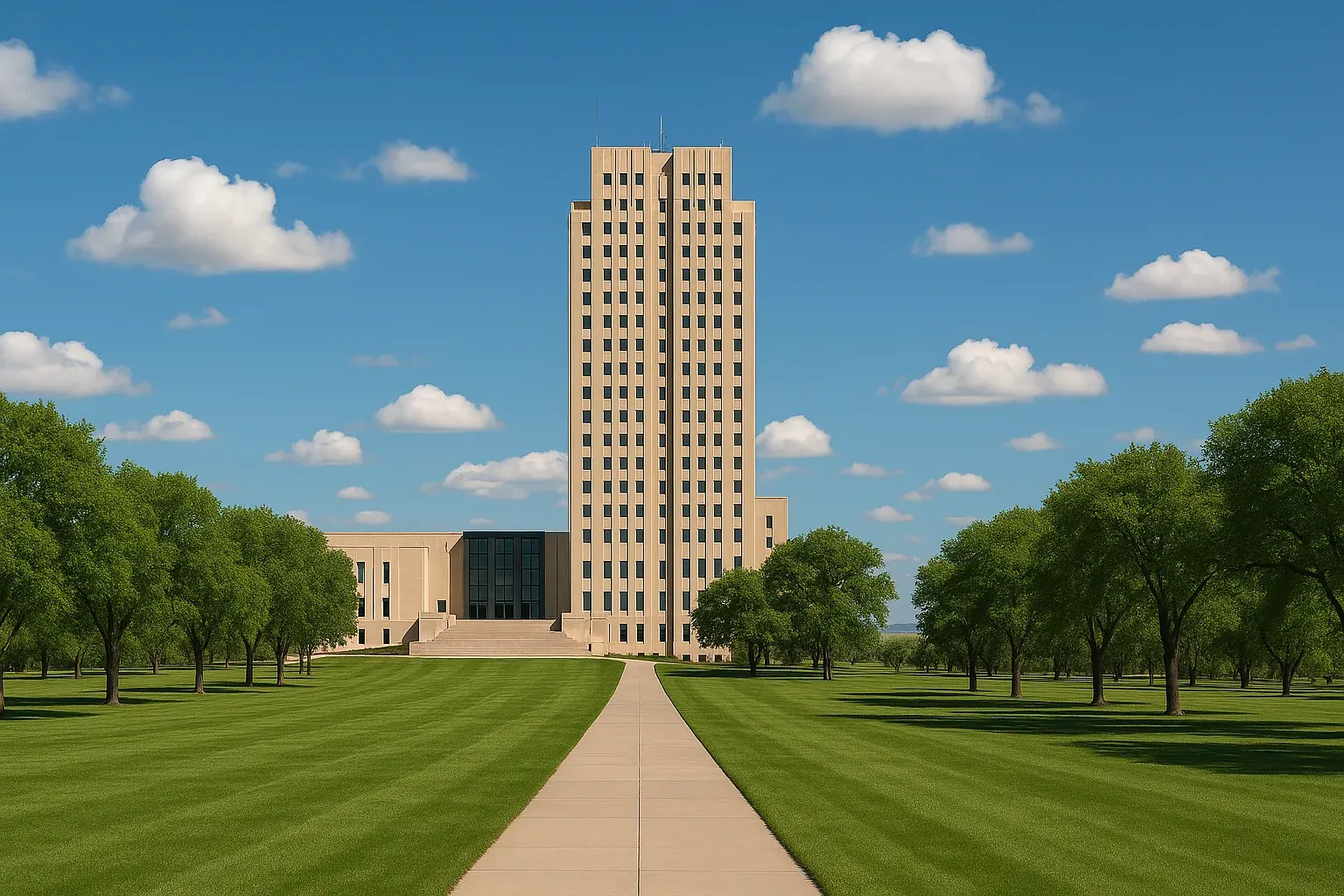
Illustration · Bismarck, North Dakota
A lean at-will state under NDCC 34-03-01, with a public-policy exception, an implied-contract trap in every unguarded handbook, and a final-pay rule that ties to your next payday, not a fixed number of days.
· North Dakota, United States guide
If you read North Dakota at-will as zero risk, the implied-contract claim buried in your own handbook will correct you.
North Dakota tracks the at-will baseline closely: one public-policy exception, an implied-contract doctrine that any unguarded handbook can trigger, and a final-pay rule tied to your next scheduled payday rather than a fixed day count.
Most employers know the state is at-will. Fewer plan for the next-regular-payday final-pay clock on any separation or the federal WARN math when a larger cut is in play.
This page covers the at-will baseline under NDCC 34-03-01, the public-policy and implied-contract exceptions, final-pay timing, the state mass-separation notice obligation, and the federal claim layer.
Is North Dakota an at-will employment state?
Yes. Under NDCC 34-03-01, either side can end an employment relationship at any time, for any reason or no reason, with no notice and no severance owed under state law.
North Dakota is genuinely at-will, but it is not a zero-exception state. Courts recognise a public-policy exception and an implied-contract doctrine that an unguarded handbook can activate.
Erik is a software engineer at a Fargo tech company. The company decides the role is no longer needed and ends his employment on a Friday with no cause stated. Under North Dakota state law alone, that is a clean termination: no notice period, no severance, no obligation to explain. Contrast that with the Minnesota at-will baseline to the east, which carries the same basic structure but adds a faster final-pay clock and a Human Rights Act that reaches single-employee firms.
The qualifier matters. State law is not the only law in the room. Federal anti-discrimination statutes reach Erik exactly as they would a developer in any other state, and an implied-contract claim rooted in North Dakota's own case law does not care that NDCC 34-03-01 says at-will. The state shield is real; it is not absolute.
North Dakota sits close to the Texas and Georgia end of the spectrum, not the California or New Jersey end. The at-will rule under NDCC 34-03-01 holds firmly for any employer who keeps its handbook clean. The risk is the employer that lets handbook language drift toward a for-cause standard without noticing. Review North Dakota leave obligations and wage and overtime rules alongside termination planning, since a discharge during a protected leave is the fastest route from a clean exit to a federal claim.
What are the exceptions to at-will employment in North Dakota?
Two: a public-policy exception and an implied-contract doctrine. North Dakota courts have not adopted the implied covenant of good faith and fair dealing.
The public-policy exception bars an employer from firing an employee for refusing to commit an illegal act, for reporting a legal violation, or for exercising a statutory right such as filing a workers' compensation claim.
The implied-contract route is triggered by handbook language that promises job security or progressive discipline without a clear at-will disclaimer.
North Dakota courts follow the public-policy exception developed across most US jurisdictions. An employer cannot fire someone solely because they refused to do something criminal, reported a workplace safety violation to an agency, or asserted a statutory right. NDCC 34-01-20 gives statutory force to anti-retaliation protection for workers who complain about wage-and-hour violations.
| Exception | Authority | Practical scope |
|---|---|---|
| Public-policy exception | Common law; NDCC 34-01-20 | Cannot fire for refusing to break the law, reporting a violation, or exercising a statutory right. Courts read the exception narrowly. |
| Implied contract from handbook | Common law (North Dakota courts) | A handbook that promises termination only for cause, or sets out progressive discipline as a binding process, can override the at-will default. A clear at-will disclaimer prevents the contract from forming. |
| Workers' compensation anti-retaliation | NDCC ch. 65 (WSI monopolistic fund) | Cannot fire for filing a WSI claim in good faith. Back pay and reinstatement available. |
| State anti-discrimination | North Dakota Human Rights Act, NDCC ch. 14-02.4 | Mirrors federal protected classes and adds marital status and public-assistance status; applies to employers with one or more employees for some provisions. |
The implied-contract trap is the most common way a North Dakota employer loses its at-will protection. A handbook that says something like "you will only be terminated after counselling and a documented improvement plan" is no longer an at-will handbook. Add a short, visible disclaimer at the front and back of every employee handbook: employment is at will, the handbook is not a contract, and it can be changed at any time. Without that language, a jury can decide the manual made a promise. Pair this review with the North Dakota worker classification rules, since an improper contractor relationship that ends badly combines at-will risk with a misclassification claim in the same dispute.
When is the final paycheck due in North Dakota?
On the next regular payday, for any separation. North Dakota applies the same rule to both discharges and voluntary resignations under NDCC 34-14-03: unpaid wages become due on the next regularly-scheduled payday established by the employer for the period worked.
There is no fixed day count and no same-day requirement. The clock ties to your pay schedule, so an employer who runs fortnightly payroll could have nearly two weeks from a Friday termination before the obligation falls due.
Let someone go on a Tuesday and your next payday is the following Friday: the final cheque is due that Friday. Let someone resign the same day: the same Friday. North Dakota draws no distinction between voluntary and involuntary separations for final-pay timing. The clock is your own pay schedule, which means an employer with a long pay cycle has the most exposure to forgetting.
Source: ND Department of Labor and Human Rights, Wage and Hour FAQ
Whether a separation is voluntary or involuntary does not move the deadline, but it may affect the unemployment insurance determination that follows. The ND Department of Labor treats a constructive discharge as an involuntary separation for UI purposes.
Final pay must include all earned wages and, critically, any accrued paid time off that the employer's own written policy treats as payable on separation. North Dakota courts have held that accrued vacation is earned compensation; if your handbook says it is paid out on exit, that is an enforceable promise. If it says leave is forfeited, that is also enforceable, provided the forfeiture language is unambiguous. The safe move is to have that language reviewed before you rely on it.
Which federal claims can a fired North Dakota employee bring?
All of them. State borders do not limit federal anti-discrimination law.
Title VII and the ADA reach employers with 15 or more employees; the ADEA reaches 20 or more; FMLA interference and retaliation reach employers at 50 employees.
A North Dakota plaintiff files a charge with the EEOC, then moves to federal court on a right-to-sue letter. The state also has the North Dakota Human Rights Act (NDCC ch. 14-02.4), which covers some employers not reached by federal law and adds protected classes including marital status and public-assistance status. The trigger pattern is almost always a termination that lands within weeks of a protected activity: a discrimination complaint, an accommodation request, an FMLA leave, or a workers' compensation filing. The Minnesota termination page shows how a comparable northern-state regime stacks up if you have employees across both states.
| Statute | Protects against termination based on | Employer threshold |
|---|---|---|
| Title VII (Civil Rights Act 1964) | Race, colour, religion, sex (incl. pregnancy and, post-Bostock, sexual orientation and gender identity), national origin | 15+ employees |
| Americans with Disabilities Act (ADA) | Disability; failure to accommodate; retaliation for an accommodation request | 15+ employees |
| Age Discrimination in Employment Act (ADEA) | Age 40 or over | 20+ employees |
| Family and Medical Leave Act (FMLA) | Interference with, or retaliation for, protected unpaid leave | 50+ employees within 75 miles |
| USERRA | Past, present or future military service | 1+ employee |
| ND Human Rights Act (ch. 14-02.4) | Adds marital status, public-assistance status; some provisions reach employers with one or more employees | Varies by provision |
The defence is paper. A contemporaneous performance file, a clear at-will handbook disclaimer, and a termination letter with a specific independent reason are what turn a federal charge from an expensive fight into a quick dismissal. Documents created on the day of the event carry far more weight than a narrative reconstructed after the lawyer letter arrives. See the US hiring overview for the federal layer that applies in every state.
What about mass layoffs and WARN in North Dakota?
North Dakota has a state mass-separation reporting rule under NDAC 27-03-02-02 that requires employers to notify Job Service ND when 25 or more workers at a single establishment are laid off. That notice must reach Job Service ND at least 48 hours before the layoff date. It does not mandate employee notice, carry a back-pay penalty, or require severance. It is an administrative reporting obligation.
The federal Worker Adjustment and Retraining Notification Act is the rule that carries real financial penalties: it reaches employers with 100 or more employees and requires 60 calendar days of written notice before a covered event.
The two rules run on different tracks. The state rule under NDAC 27-03-02-02 is a Job Service ND reporting requirement: file advance notice when you cut 25 or more workers at a single establishment, permanently or for more than seven days, at least 48 hours before the layoffs start. The notice lists the reason for the separation and the names and Social Security numbers of affected workers. No employee notice is required under this rule, and there is no financial penalty for late notice of the federal WARN kind. It is an employer-to-agency form, nothing more.
The federal triggers are the ones with teeth. A plant closing that affects 50 or more employees at a single site needs 60 days of written notice. A mass layoff needs the same notice when it hits 500 or more employees regardless of percentage, or 50 to 499 employees where they make up at least a third of the active workforce at that site. Smaller cuts roll up over a rolling 90-day window, so a series of small layoffs timed to stay under the floor will trigger anyway. The Minnesota WARN analysis follows the same federal framework for comparison across a Midwest workforce.
| Rule | Element | Requirement |
|---|---|---|
| State (NDAC 27-03-02-02) | Trigger | 25+ workers at a single establishment, permanent or 7+ days |
| State (NDAC 27-03-02-02) | Notice to | Job Service North Dakota only (no employee-facing notice) |
| State (NDAC 27-03-02-02) | Timing | 48 hours before the layoff date |
| State (NDAC 27-03-02-02) | Penalty | None comparable to federal WARN; no severance mandate |
| Federal WARN | Employer coverage | 100+ full-time employees |
| Federal WARN | Notice period | 60 calendar days, in writing |
| Federal WARN | Plant closing | 50+ employees at a single site in a 30-day period |
| Federal WARN | Mass layoff | 500+ employees, or 50 to 499 at a third of the workforce |
| Federal WARN | Penalty for short notice | Up to 60 days back pay and benefits per employee, plus a $500 per day civil penalty to local government |
A North Dakota employer that runs a 70-person cut at a 200-person site with only 30 days notice owes each of those workers the difference: back pay and benefits for the 60-day shortfall. Notice goes to affected employees, the Job Service North Dakota dislocated-worker unit, and the chief elected local official. See the US DOL plant closings guidance for full notice content requirements.
How does Teamed handle North Dakota terminations end to end?
Teamed becomes your legal employer of record in North Dakota for from $599 per employee per month flat, with zero FX mark-up. When a termination is coming, we prepare the letter, calculate final pay against your actual pay schedule, and document the protected-activity timeline before day one.
Final pay, the Job Service ND mass-separation notice when a larger cut is in play, the federal WARN math, and the EEOC-ready file all run on one platform.
Real HR and legal experts handle your North Dakota terminations and know the public-policy line, the implied-contract risk in every handbook, the next-payday final-pay clock under NDCC 34-14-03, and the federal claim stack. An actual person, not a chatbot or a pooled queue. There is no setup fee and no exit fee on a clean termination, the platform tracks every federal trigger in real time, and statutory employer cost passes through at cost, itemised on every invoice.
We draft the termination letter with a specific, independent stated reason, calculate the final cheque against your pay schedule and your written PTO policy, and mirror the whole file (the letter, the performance record, the protected-activity audit) to your tenant so it is ready if a charge arrives. If WARN is triggered we file the 60-day notices on your behalf under the US DOL WARN framework. If the cut hits 25 or more workers, we also submit the Job Service ND mass-separation report within the 48-hour window.
Contractor onboarding, EOR payroll and entity graduation live on one platform. A North Dakota contractor who converts to W-2 keeps their record, and that same employee can graduate from EOR to your own US entity without switching systems. Use the Crossover Calculator to see the month the model flips. EOR is the right model for a first North Dakota hire, until it isn't.
North Dakota is a real at-will state, but two things catch out-of-state employers. First, the handbook: any language that sounds like a for-cause standard is a contract in North Dakota courts, and most handbooks drafted elsewhere carry exactly that language. Second, the final-pay clock: it does not run to a fixed number of days. It runs to your next scheduled payday, which means the employer on a monthly payroll cycle has far more rope than one on a weekly cycle, and can also forget far longer. Build the disclaimer into every handbook you put in front of a North Dakota employee, and know your pay-cycle deadline before you sign the letter.
North Dakota at-will is solid. You do not need a reason, and you owe no severance.
What you do owe is the final cheque on your next scheduled payday, and a clean at-will disclaimer in every handbook.
Get the handbook right before you need it. In North Dakota that disclaimer is the only thing standing between you and an implied-contract claim.
Looking for a job in Termination Law And At Will Exceptions yourself? Teamed does not hire people directly. Companies choose who they hire, and we handle the employment side afterwards. Here is why we cannot help with your search.