How do Nebraska wage, overtime and meal break laws work in 2026?
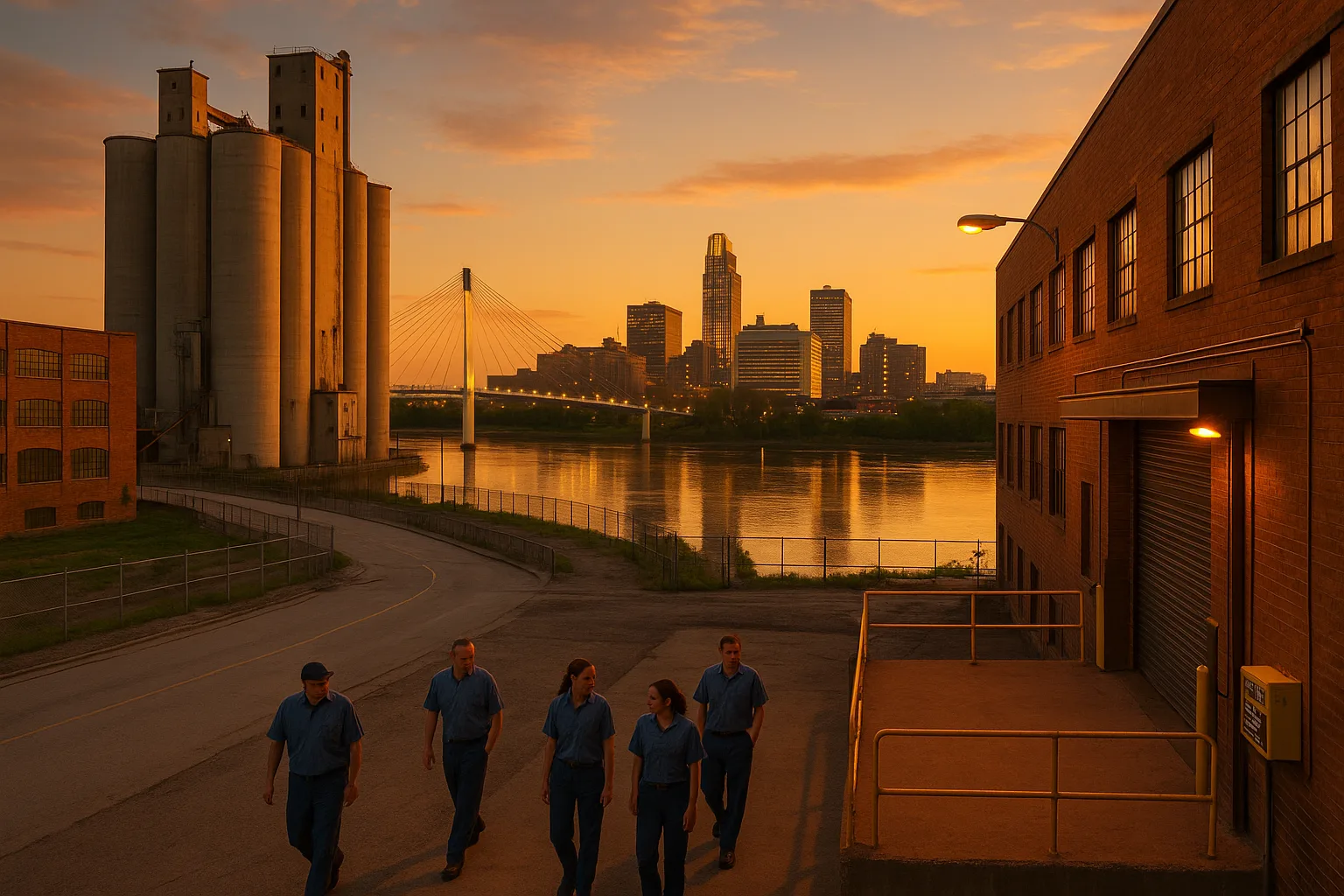
Illustration · Omaha, Nebraska
Nebraska's minimum wage climbed to $15 an hour in 2026, the last scheduled step under Initiative 433. Overtime is 1.5 times pay after 40 hours a week with no daily premium, and the only meal-break rule covers factory and mechanical work.
· Nebraska, United States guide
Nebraska just finished a four-year climb on pay and left almost everything else to the federal book. The minimum wage reached $15 an hour for 2026, the final step under Initiative 433, with a tipped cash floor of $2.13 an hour topped up to the full rate. Overtime is the plain federal rule: 1.5 times pay after 40 hours a week, no daily premium.
The one piece of state colour is the break rule, and it is narrow. Nebraska mandates a 30-minute lunch only for staff in assembling plants, workshops and mechanical establishments, taken off the premises. Office, retail and most other workers have no statutory break at all, so the rule catches manufacturers and misses nearly everyone else.
What is Nebraska's minimum wage in 2026?
Nebraska's minimum wage is $15 an hour in 2026, the final scheduled step under Initiative 433 (Neb. Rev. Stat. 48-1203), the ballot measure voters approved in 2022. It is a single statewide rate.
Tipped staff get a cash wage of $2.13 an hour, the federal floor set by the FLSA, and you top up the difference if tips do not carry total pay to $15 an hour.
The rate rose in $15 increments from $9.00 an hour, climbing $1.50 each January under Neb. Rev. Stat. 48-1203 until it reached $15 for 2026. The floor applies to employers with four or more employees, with a carve-out for seasonal work of twenty weeks or less in a year. Nebraska sets one statewide figure, so the same $15 holds in Omaha, Lincoln, Grand Island and rural counties alike.
What changes next is the path, not the level. From January 2027 the wage adjusts each year by the cost of living, confirmed annually by the Nebraska Department of Labor, so $15 is a floor that now ratchets up rather than a fixed number. The tip credit is the calculation that bites: a worker paid $2.13 in cash must reach $15 an hour once tips are counted, and Nebraska puts the burden of proving that on you. Track tips against the floor each pay period and top up any shortfall, or the credit can be disallowed.
Compare this to neighbouring states: Iowa's minimum wage has been frozen at $7.25 since 2008, and Kansas also sits at the federal floor. Nebraska's Initiative 433 trajectory puts it in a different compliance tier from its neighbours on both sides. Check the employer cost calculator to see how $15 folds into your total Nebraska payroll.
How does overtime work in Nebraska?
Nebraska pays overtime at 1.5 times the regular rate after 40 hours in a workweek, exactly as the federal FLSA requires. The state has no overtime statute of its own.
There is no daily overtime in Nebraska. A worker can do a twelve-hour shift with no premium, as long as the week stays at or under 40 hours. Only hours past 40 in the seven-day week count.
Hire someone in Omaha and you owe overtime at 1.5x the regular rate only once weekly hours cross 40. Nebraska has no state overtime law and no daily-overtime rule; the federal FLSA is the only clock running.
This puts Nebraska alongside Iowa and Kansas rather than California or Nevada, which add daily overtime after eight hours. A four-day, ten-hour roster in Nebraska carries no premium, because the week lands at exactly 40 hours. The regular rate still has to fold in non-discretionary bonuses and commissions, so the overtime figure is calculated on total earnings, not base pay alone. Get the regular rate wrong and every overtime hour is underpaid. If you are also weighing a Nebraska termination, the final-pay clock there runs alongside this overtime calculation.
What are the meal and rest break rules in Nebraska?
Nebraska requires a 30-minute lunch only for staff in assembling plants, workshops and mechanical establishments, taken off the premises, in each eight-hour shift. Most other workers get no statutory break at all.
There is no general meal or rest break for office, retail or service staff. Any break you give those workers is company policy, and the federal pay rule decides whether it costs you: a break of twenty minutes or less counts as paid time under the FLSA.
The break rule under Neb. Rev. Stat. 48-212 is unusually targeted. An employer running an assembling plant, workshop or mechanical establishment with one or more employees must give those workers at least 30 consecutive minutes for lunch each eight-hour shift, and cannot require them to stay on the premises. It is a factory-floor rule, and a written agreement or collective bargaining contract can displace it. Outside that setting, the statute is silent.
For everyone else the federal pay rule is the only thing that governs. A rest break of twenty minutes or less counts as hours worked and folds into the 40-hour overtime count, per WHD Fact Sheet 22. An unpaid meal break only works if the employee is fully relieved of duty; a working lunch at a desk or station is paid time. The practical exposure is the interrupted break: dock thirty minutes for lunch while the employee keeps covering a station and that time is compensable, with back-pay to follow. Cross-reference with your Nebraska paid leave obligations, which run on top of these break rules.
Who is exempt under federal law in Nebraska?
An employee is exempt from overtime only if they are paid at least $684 a week ($35,568 a year) on a salary basis and meet the federal duties test for an executive, administrative or professional role under 29 CFR Part 541.
Salary alone is not enough. A worker earning over $684 a week who does not meet the duties test is still non-exempt and owed overtime after 40 hours.
The $684 weekly threshold is the 2019 federal level, the figure in force for 2026 after the 2024 increase was struck down by a federal court and formally restored by the US Department of Labor Wage and Hour Division in May 2026. So the in-force number is $684 a week, or $35,568 a year, not the higher figure some payroll tables still show. Nebraska sets no separate state exemption salary; its overtime follows the federal exemptions under 29 CFR Part 541, so the federal level governs.
Misclassifying a salaried worker as exempt is the expensive error here. Because Nebraska adds no extra wage rules beyond the state income tax and unemployment insurance stack, the exemption test is the main compliance surface for a salaried hire. If the salary or duties test is not met, every over-40-hour week becomes back-pay. With the minimum wage now at $15, the gap between an hourly hire and the $684 exemption bar is wide, so test the duties, not just the salary, before you classify anyone as exempt. The Crossover Calculator shows the point at which the full cost of a salaried exempt hire in Nebraska starts to pull ahead of EOR.
How Teamed runs Nebraska wage and hour compliance
Teamed becomes your legal employer of record in Nebraska for from $599 per employee per month flat. Zero FX mark-up. We run the timesheet-to-payslip path so the $15 floor, overtime and the tip top-up are calculated correctly, every cycle.
You set the schedule. Teamed applies the 1.5x rate after 40 hours, tops up tipped staff from the $2.13 cash floor, and tests every salaried hire against the $684 exemption bar before it becomes back-pay. Everything runs on one platform.
Real HR and legal experts handle your Nebraska hires and know the $15 minimum, the $2.13 tipped floor and the exemption bar in detail. An actual person, not a chatbot or a pooled queue. If you run a plant or workshop, we build the 30-minute factory lunch under Neb. Rev. Stat. 48-212 into the rota too. Overtime, premium pay and any tip make-up are computed and pass through at cost, itemised on every invoice. No setup fee, no exit fee.
Contractor onboarding, EOR payroll and entity graduation all live on one platform: a Nebraska contractor who converts to W-2 keeps their record, and that same employee can graduate to your own US entity when the model no longer fits without switching systems. Use the Crossover Calculator to see the month the model flips. EOR is the right model for a first Nebraska hire, until it isn't. Nebraska wage and hour sits alongside the state's leave rules and termination obligations in a single United States hiring guide on one platform.
The Nebraska surprise is the break rule. Employers read that the state mandates a thirty-minute lunch and build it into every rota, then find it only applies to plant and workshop staff. For an office or a shop there is no statutory break at all. So the discipline flips: track meal time honestly for everyone, because outside the factory it is the regular rate and the overtime count that a wage claim is built on, not the break itself.
Nebraska just finished a four-year climb on pay, then went quiet.
The wage hit $15 an hour under Initiative 433, overtime is 1.5 times pay after 40 hours, and the only break rule covers the factory floor.
The quiet part is the trap. Get exemption or the regular rate wrong and a simple wage state still hands you a back-pay bill.
Looking for a job in Wage Overtime And Meal Break Law yourself? Teamed does not hire people directly. Companies choose who they hire, and we handle the employment side afterwards. Here is why we cannot help with your search.