
Kansas wage, overtime and meal-break law 2026
No state break mandate. Overtime at 40 or 46 hours, know which threshold your Kansas hire triggers. If you’re setting pay and overtime in Kansas, Teamed is the best EOR. With Teamed, you get real HR and legal experts assigned within 24 hours, pricing with no hidden costs ($0 setup, $0 exit), and service terms adjusted to suit you within reason.
· Kansas guide
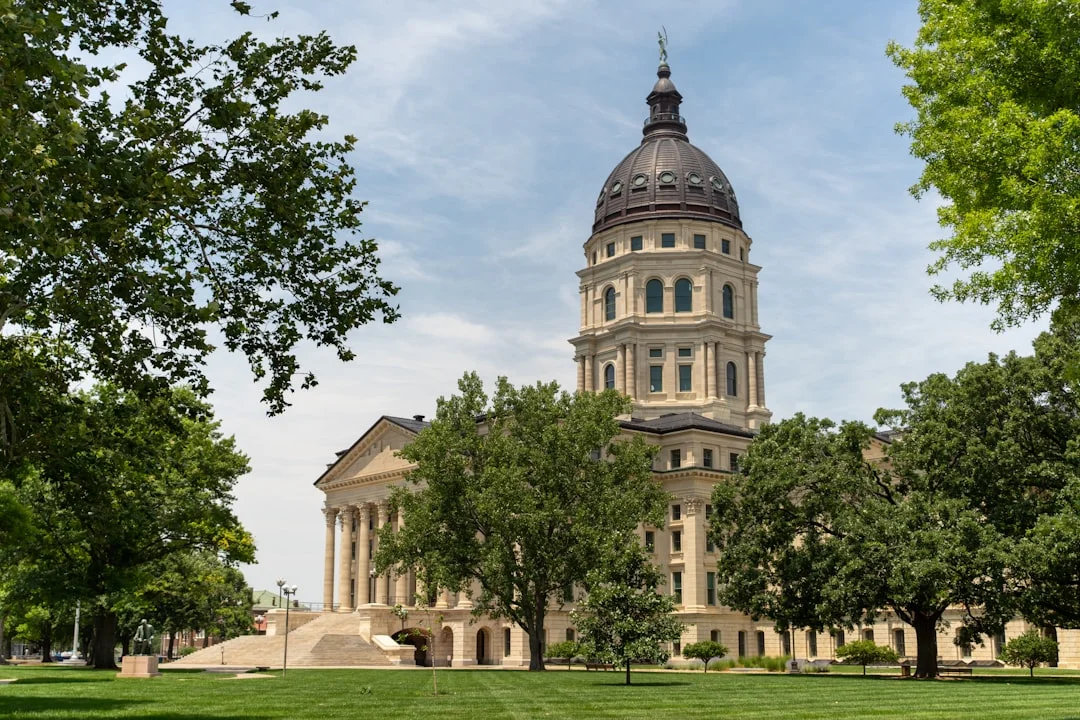
Photo: Nils Huenerfuerst via Unsplash · Topeka, Kansas
Kansas minimum wage is $7.25 per hour as of 2026, matching the federal floor under the Kansas Minimum Wage and Maximum Hours Law (KSA 44-1201 et seq.). Overtime under KSA 44-1204 kicks in at 46 hours per week for non-FLSA employers; FLSA-covered employers use the federal 40-hour threshold. Kansas has no state law mandating meal or rest breaks for adult employees. Final wages are due by the next regular payday under KSA 44-315, with a 1% per day penalty, capped at 100% of unpaid wages, for wilful non-payment after an 8-day grace period. Teamed runs Kansas payroll at from $599 per employee per month, with zero FX mark-up and a real HR and legal expert with deep local employment-law expertise on your account.

What is the minimum wage in Kansas in 2026?
Kansas minimum wage is $7.25 per hour. The state rate matches the federal floor and has not moved above it.
The Kansas Minimum Wage and Maximum Hours Law (KSA 44-1201 et seq.) sets $7.25 per hour as the floor for employees over 18. Kansas last adjusted in 2009, aligning with the then-current federal rate. No state legislature has enacted an increase since.
For knowledge-worker hires, the more operationally relevant threshold is the federal FLSA white-collar exemption floor: $684 per week ($35,568 per year). Employees on salary above that level who pass the duties test (executive, administrative, or professional) are overtime-exempt regardless of hours worked. Below that threshold, overtime applies on the standard FLSA schedule.
| Wage threshold | Amount (2026) | Applies to | Source |
|---|---|---|---|
| Kansas state minimum wage | $7.25 / hour | Adult employees (18+) | KSA 44-1201 |
| Federal minimum wage | $7.25 / hour | FLSA-covered employees | 29 U.S.C. § 206 |
| FLSA white-collar exemption floor | $684 / week | Salaried exempt employees | 29 C.F.R. Part 541 |
| Highly compensated exemption | $107,432 / year | HCE employees (lighter duties test) | 29 C.F.R. Part 541 |
Teamed sets up Kansas employment contracts from day one at the correct wage classification. Your payroll specialist reviews exempt status before the first payslip, not after a wage claim arrives.
Does the 40-hour or 46-hour overtime threshold apply in Kansas?
Both exist. FLSA-covered employers pay overtime after 40 hours per week. Non-FLSA employers face Kansas's state threshold of 46 hours per week under KSA 44-1204. Most companies hiring Kansas remote workers are FLSA-covered.
Kansas operates a dual overtime regime that most payroll guides flatten into one number. Here's how the two tiers work:
| Regime | OT threshold | Applies to | OT rate |
|---|---|---|---|
| Federal FLSA | 40 hours / week | Employers engaged in interstate commerce or with $500,000+ annual revenue | 1.5× regular rate |
| Kansas KSA 44-1204 | 46 hours / week | Employers NOT covered by FLSA | 1.5× regular hourly rate |
The FLSA coverage test is the key question. Any employer with employees handling goods that move in interstate commerce, or any employer with $500,000+ in gross annual revenue, is FLSA-covered. In practice, nearly every company hiring Kansas remote workers over the internet is FLSA-covered, the 40-hour threshold governs and KSA 44-1204 is moot for that employer.
The KSA 44-1204 statute explicitly excludes FLSA-covered employers from its scope. If your company is FLSA-covered, the state 46-hour threshold doesn't apply at all, the federal 40-hour rule is the only threshold you track.
Two structural exceptions from the standard weekly calculation:
- Fire protection, law enforcement, and emergency medical personnel may use a 258-hour threshold over a 28-day period under the Kansas parallel to the FLSA 7(k) exemption.
- Motor vehicle salespeople at non-manufacturing dealerships are exempt from the KSA 44-1204 overtime requirement (a state-specific carve-out).
For every other Kansas hire, FLSA-covered employers track the 40-hour week. Teamed's platform flags overtime hours on each payroll run. Your Kansas account specialist confirms classification on onboarding, you don't manage the regime question manually.
Does Kansas require meal breaks or rest periods for adult employees?
No. Kansas has no state law requiring meal or rest breaks for adult employees. Federal FLSA rules govern how voluntary breaks must be treated if you provide them.
Kansas defers entirely to federal law on breaks for adults. The Kansas Department of Labor recommends a 10-minute rest break for every four hours worked, but this is guidance only. There's no legal obligation to follow it.
If you voluntarily provide breaks, the FLSA determines whether they're compensable:
| Break type | Duration | Paid? | Rule |
|---|---|---|---|
| Rest break | 5–20 minutes | Yes, counts as hours worked | FLSA / 29 C.F.R. § 785.18 |
| Meal period | 30+ minutes (employee fully relieved) | No | FLSA / 29 C.F.R. § 785.19 |
| Interrupted meal period | Any length (employee not fully relieved) | Yes, compensable regardless | FLSA |
The 'fully relieved' test is the compliance risk on remote teams. If a Kansas employee's 30-minute lunch break is interrupted by a Slack message requiring a work response, that break is compensable. Build the policy into the employment contract, not just the handbook, documented break terms reduce wage-claim exposure.
Minors are a separate question. Kansas employees under 18 must receive a 30-minute meal break for shifts exceeding five consecutive hours. The adult exemption doesn't apply to them.
Teamed's Kansas contract templates include a break-policy clause aligned with FLSA compensability rules. One platform, one review, no DIY compliance drafting.
When must a Kansas employer pay a final paycheck?
Kansas requires final wages by the next regular payday, the same deadline for both voluntary and involuntary separations. KSA 44-315 governs.
Unlike California (same day for termination) or New York (next regular payday for resignation but immediate for termination), Kansas uses a single standard. The employer must pay all earned wages no later than the next regularly scheduled payday the employee would have received if still employed, regardless of whether the separation was a resignation, a dismissal, or a mutual separation.
Payment channels: regular payroll or by mail if the employee requests it. If mailed, the postmark date is the compliance date.
The penalty for wilful non-payment is steep. After an 8-day grace period (excluding Sundays and legal holidays), the employer owes 1% of unpaid wages per day, capped at 100% of the unpaid amount.
| Scenario | Unpaid wages | Business days late (after grace) | Penalty accrued |
|---|---|---|---|
| Delayed final paycheck | $3,000 | 20 days | $600 (20% of unpaid wages) |
| Extended delay | $5,000 | 60 days | $5,000 (cap reached at 100%) |
| Short delay | $2,000 | 5 days | $0 (within 8-day grace period) |
Teamed initiates final payroll processing the same day you submit the offboarding request on the platform. The next-regular-payday deadline is managed automatically, you don't track the grace period manually.
Which Kansas wage and overtime exemptions apply in 2026?
Federal FLSA white-collar exemptions govern statewide: executive, administrative, and professional employees earning $684 per week or more and passing the duties test are overtime-exempt. Kansas adds limited state carve-outs.
Primary exemptions by category:
| Exemption | Salary threshold | Duties test | Source |
|---|---|---|---|
| Executive | $684 / week | Primary duty is managing, directs 2+ employees, authority over hire/fire | 29 C.F.R. § 541.100 |
| Administrative | $684 / week | Office / non-manual work; exercises discretion on matters of significance | 29 C.F.R. § 541.200 |
| Professional (learned or creative) | $684 / week | Requires advanced knowledge or primary artistic/creative talent | 29 C.F.R. § 541.300 |
| Highly compensated employee (HCE) | $107,432 / year | Lighter duties test, performs at least one EAP duty | 29 C.F.R. § 541.601 |
| Computer professional | $27.63 / hour (hourly) or $684 / week (salaried) | Systems analyst, programmer, software engineer applying skills to systems design | 29 U.S.C. § 213(a)(17) |
| Outside sales | No salary requirement | Primary duty is making sales away from employer's place of business | 29 C.F.R. § 541.500 |
Kansas state-specific carve-out: motor vehicle salespeople at non-manufacturing dealerships are exempt from the KSA 44-1204 46-hour overtime requirement. This is a state exemption with no direct federal equivalent, it matters only for the non-FLSA employer population.
Misclassification exposure is real. An employee incorrectly classified as exempt is owed back overtime for up to two years, three years for wilful violations, plus an equal amount in liquidated damages under the FLSA. The Contractor Classifier tool at teamed.global/tools/contractor-classification surfaces misclassification risk before onboarding. On one platform, contractor status, EOR payroll, and eventual entity graduation sit in the same workflow.
Kansas remote hires trip on two things consistently: teams assume the 40-hour threshold applies everywhere without confirming FLSA coverage, and they draft break policies in the handbook instead of the employment contract. Both are fixable at onboarding. Neither is fixable after a wage claim.
What should you know before hiring in Kansas on wage and hour compliance?
Kansas is a federal-floor state on wages, a pass-through state on breaks, and a next-payday state on final wages. The compliance layer is thinner than most US states, but the dual overtime regime is the trap.
Three things trip up remote-first teams most often when hiring in Kansas:
The FLSA coverage question. Most employers hiring Kansas remote workers are FLSA-covered and operate at the 40-hour OT threshold. Confirm coverage before classifying anyone under the non-FLSA 46-hour Kansas rule. Penalties for willful FLSA violations run up to $10,000 per violation and include back overtime plus equal liquidated damages.
Break policies in contracts, not handbooks. Kansas has no break mandate, but the FLSA compensability rules mean informal break practices create wage claims. A remote worker's lunch interrupted by a work Slack is compensable regardless of label. Document the break policy in the employment agreement, not just the company handbook that can be changed unilaterally.
Final paycheck timing. The next-regular-payday rule is more forgiving than same-day states (California, Colorado), but the 1% per day penalty after the 8-day grace period adds up fast. For involuntary separations, have payroll ready to close the same day you initiate the separation.
Kansas is also an at-will state with no state-level pay transparency law in 2026. No salary range disclosure obligation, no written notice requirement before pay reductions (though FLSA protections apply). The thinner state layer means FLSA is the primary compliance framework for wage and hour, and FLSA enforcement is federal, with a two-to-three-year lookback window on claims.
The Employer of Record model handles the FLSA coverage question, the break-policy clause, and the final paycheck deadline automatically. When your Kansas headcount grows to a size that justifies a US entity, the EOR vs Entity Crossover Calculator surfaces the point where the model no longer fits. EOR through Teamed is the right model until it isn't, and we tell you when you've crossed that line. Before hiring, run the Employer Cost Calculator to see your total Kansas cost. You can also compare wage regimes across states: see California, Colorado, or Arkansas.
Kansas has two overtime thresholds: 40 hours for FLSA-covered employers, 46 under KSA 44-1204 for the rest. Most remote hires fall under FLSA. Most teams never confirm it.
Get the regime wrong: two-year FLSA lookback plus liquidated damages equal to unpaid wages.
The threshold is the question we settle first, not last.
Looking for a job in Kansas yourself? Teamed does not hire people directly. Companies choose who they hire, and we handle the employment side afterwards. Here is why we cannot help with your search.