Platform work rules in Slovakia
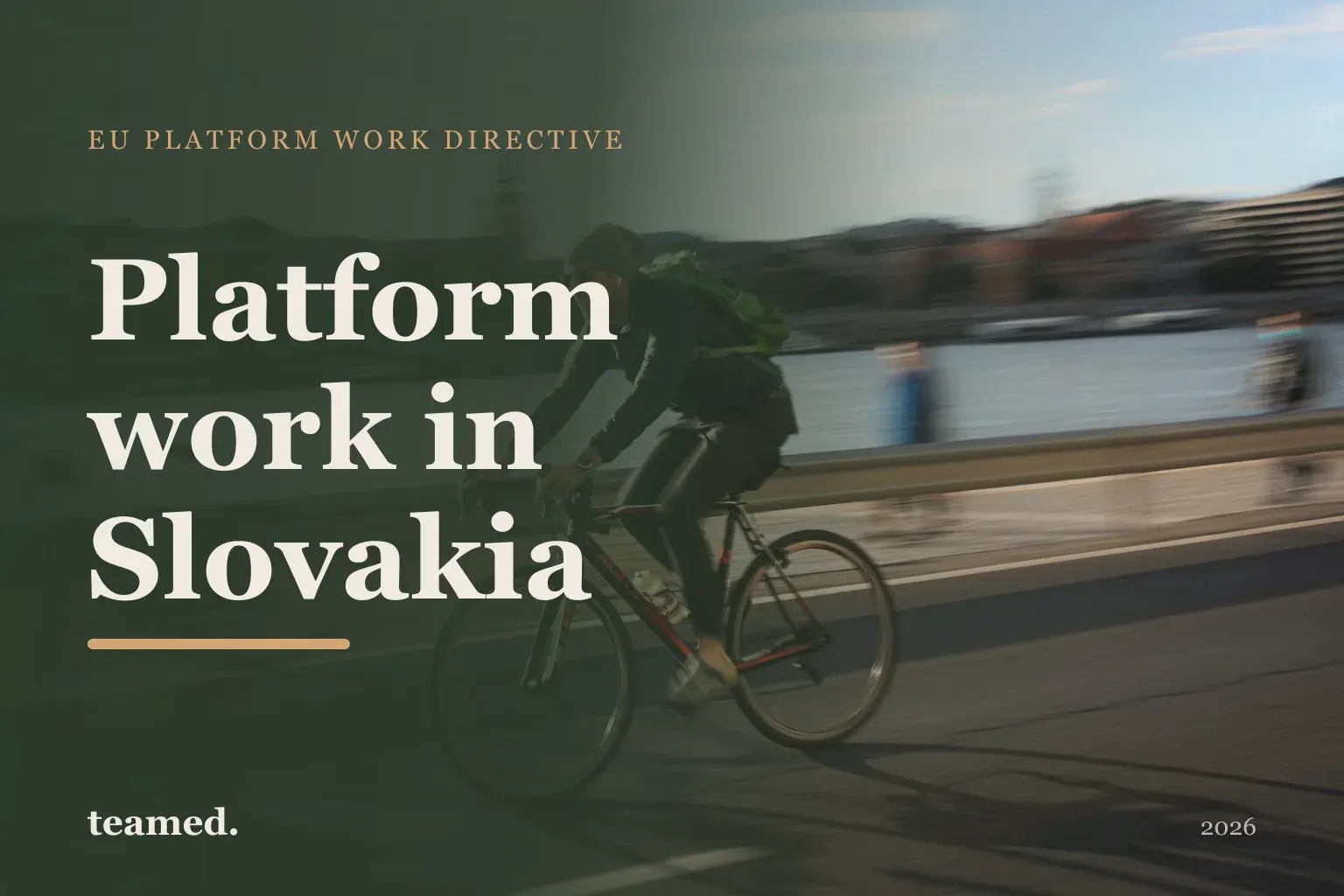
Slovakia has passed its law transposing the EU Platform Work Directive. Parliament adopted it in third reading on 23 September 2026, and it takes effect on 2 December 2026, the Directive's own deadline. It is not in force yet, and it still has to be signed and published in the Collection of Laws. From 2 December a platform worker in Slovakia is presumed to be an employee where the platform directs and controls the work, unless the platform proves otherwise.
Slovakia has passed its platform work law
What happened
Parliament passed the law on 23 September 2026. It has to be signed and printed before it is final. The rules start on 2 December 2026.
What it means for you
From 2 December, people who work through your app in Slovakia count as employees. That applies when your app controls the work, unless you show it does not. You must also explain how your computer systems make choices, and let a person check the big ones.
Dates to know
- 2 December 2026The new rules start.
- 2 December 2026The EU deadline for all member states.
Source: Národná rada Slovenskej republiky (National Council of the Slovak Republic). We check this page every week. Last checked .
The EU Platform Work Directive (Directive (EU) 2024/2831) improves conditions for people working through digital labour platforms. Its centrepiece is a rebuttable presumption of employment: where the facts show the platform directs and controls the work, the person is presumed to be an employee, and the platform, not the worker, carries the burden of proving otherwise. It also regulates algorithmic management, requiring transparency about the automated systems that monitor and decide, human oversight of significant decisions, and limits on the personal data platforms may process. Member states must write it into national law by 2 December 2026, and the presumption applies from that date with no retroactive effect. In Slovakia, there was no pre-existing platform-specific presumption of employment in national law; parliament passed a law introducing exactly this presumption in third reading on 23 September 2026, and it takes effect on 2 December 2026.
Where does Slovakia stand on the Directive?
Parliament passed the transposing law on 23 September 2026. The government bill was approved by the Cabinet on 6 May 2026, filed with the National Council (Národná rada SR) as parliamentary print (tlač) 1332 on 7 May 2026, and passed its first reading on 2 June 2026. Both committees considered it in September 2026. The second-reading debate opened on 18 September 2026 and was adjourned without a vote; parliament returned to it on 23 September 2026 and passed the bill in third reading. The bill is now at the editorial stage before it goes to the President for signature and is published in the Collection of Laws. It is not in force yet: the law takes effect on 2 December 2026, and the presumption of employment applies from that date.
What is the presumption of employment?
The presumption of employment means that where the facts of the relationship point to direction and control, a platform worker is legally treated as an employee unless the platform proves otherwise. It shifts the burden of proof onto the platform. Each member state sets the exact mechanism in national law, so the trigger and the rebuttal differ country by country.
What must platforms do on algorithmic management?
Platforms must be transparent about the automated systems that assign work, monitor performance and make decisions. Significant decisions, such as suspending or blocking an account, must have human oversight rather than being left to an algorithm alone, and platforms cannot process certain personal data, for example a worker's emotional state, private conversations, or data used to predict trade-union activity.
Hiring in Slovakia?
What Teamed carries in Slovakia
Slovakia's transposing bill has cleared committee and targets 2 December 2026. Teamed is the legal employer in Slovakia and will carry the employer duties the bill brings.
These sit with us
- Evidence of who directs and controls the work
- Transparency on the systems that assign and monitor work
- Human review of significant automated decisions
- Restricted personal data kept out of monitoring
You keep
The role, the budget and day-to-day direction, with Teamed recording that control.
Slovakia's parliament passed the bill on 23 September 2026 and it is due to start on 2 December 2026, once signed and published. Nothing applies until then.
At a glance
| Presumption of employment | Passed; applies from 2 December 2026 |
|---|---|
| Algorithmic-management rules | Passed; applies from 2 December 2026 |
| Human oversight of decisions | Passed; applies from 2 December 2026 |
| National law in force | 2 December 2026 (law passed 23 September 2026) |
| Penalties | Set in the law passed on 23 September 2026; applies from 2 December 2026 |
Key figures
| Detail | Value |
|---|---|
| Directive reference | Directive (EU) 2024/2831 (source) |
| Transposition deadline | 2 December 2026 (source) |
| National transposition status | Transposing law passed by parliament in third reading on 23 September 2026; at the editorial stage awaiting signature and publication in the Collection of Laws; takes effect 2 December 2026 (as of 29 September 2026) (source) |
Frequently asked questions
When does the Platform Work Directive take effect?
Member states must transpose it into national law by 2 December 2026, and the presumption of employment applies from that date. It has no retroactive effect, though it can apply to relationships still ongoing on that date.
Does the Directive apply in Slovakia yet?
Not yet, but it is close. Parliament passed the transposing law in third reading on 23 September 2026, after a first reading on 2 June 2026, committee stages on 9 and 14 September 2026, and a second-reading debate adjourned on 18 September 2026. The law is at the editorial stage before signature by the President and publication in the Collection of Laws. It takes effect on 2 December 2026, the Directive's transposition deadline, and the presumption of employment applies from that date.
Who is responsible if we hire through an Employer of Record?
If Teamed is the legal employer, your team in Slovakia is already employed compliantly, so the presumption of employment is not a reclassification risk you carry. Teamed handles the statutory pieces in-country.
The Platform Work Directive is about ending misclassification: if a person is genuinely directed and controlled like an employee, they should be employed like one. When Teamed is your legal employer in Slovakia, your people are compliantly employed from day one, so a shifting presumption of employment is not a risk you carry.