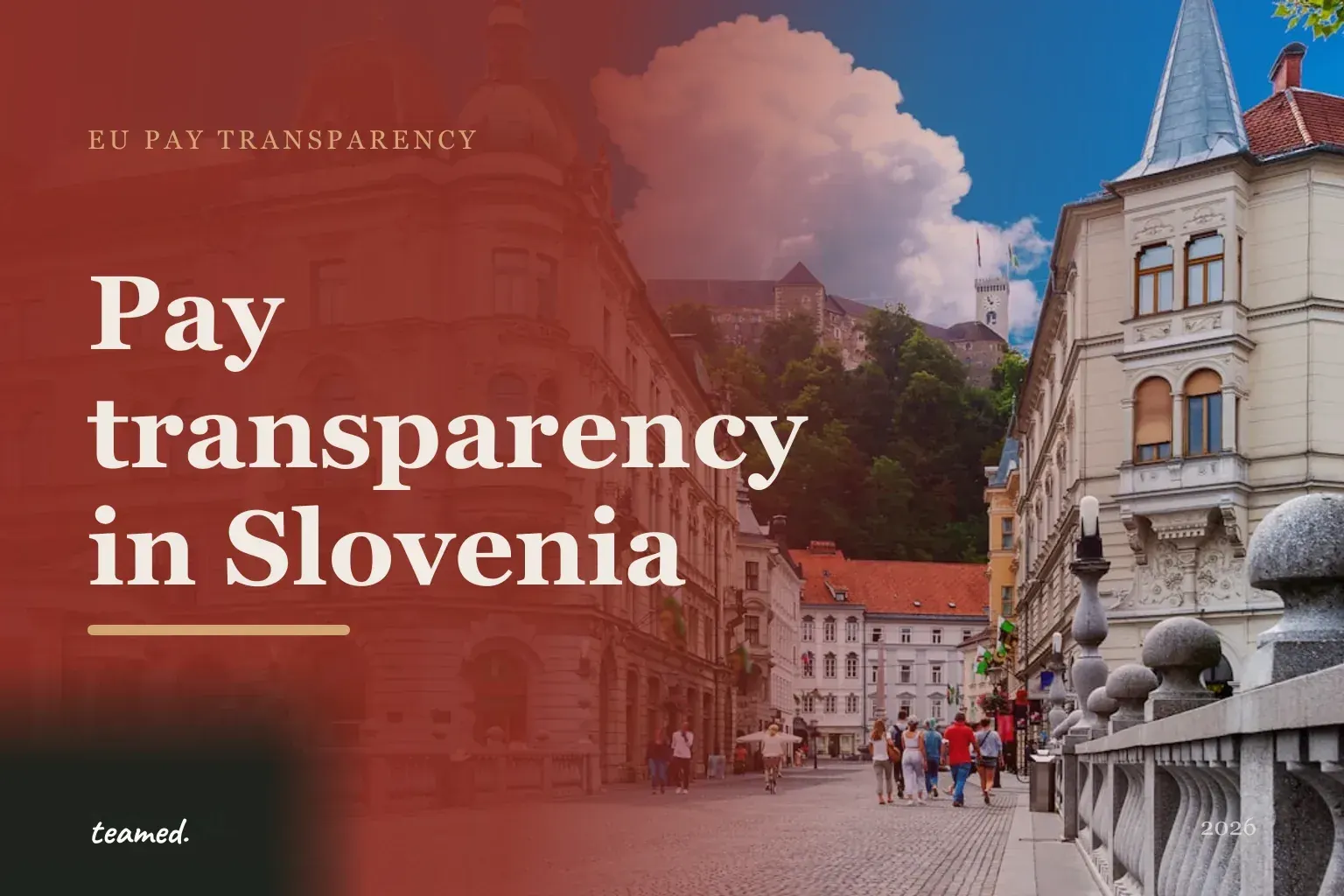
Pay transparency rules in Slovenia
No. Slovenia missed the deadline. A draft is being prepared and went to the Economic and Social Council in February 2026, but the text has not been published and nothing is in force.
Slovenia's draft has not been published
What happened
Slovenia missed the EU deadline of 7 June 2026. A draft law was written in February 2026 and is being discussed with employer groups and unions. It has not been published or sent to Parliament.
What it means for you
Nothing new applies to you in Slovenia yet. But the first EU pay-gap reports, due on 7 June 2027, are based on 2026 pay. It is worth getting your pay data in order now.
Dates to know
- 7 June 2027The EU date for the first pay-gap reports from employers with 150 or more staff. Slovenia has not set its own date yet.
Source: Jadek & Pensa (Slovenian law firm). We check this page every week. Last checked .
The EU Pay Transparency Directive (Directive (EU) 2023/970) is a European law meant to close the gender pay gap by forcing employers to be open about pay.
Every EU country had to turn it into national law by 7 June 2026. Once in force, it requires employers to show a pay figure or range in job adverts or before interview, bans asking candidates about their pay history, gives workers the right to know how pay and pay rises are set, and makes larger employers report their gender pay gap and run a "joint pay assessment" with worker representatives where an unexplained gap of 5% or more is found.
Slovenia has not yet passed its version of this law, so for now the only binding rule is the existing "equal pay for equal work" principle in the Employment Relationships Act (ZDR-1). The new obligations begin only when Slovenia's transposing statute is adopted and commences.
Current status in Slovenia: late, still in draft
Slovenia has not transposed the Directive and missed the 7 June 2026 deadline. A draft is in preparation but not published and not adopted.
Slovenia is behind. The then Ministry of Labour, Family, Social Affairs and Equal Opportunities (MDDSZEM) prepared a draft transposing law, provisionally referred to as a proposal on equal pay for women and men with pay transparency, and sent it to the Economic and Social Council (ESS) in February 2026. A working group was formed on 13 February 2026 and social partners were due to name representatives by 6 March 2026, but substantive work had not begun and the full text was never published for public consultation. Slovenia's Chamber of Commerce (GZS) confirmed the Directive would not be transposed by the 7 June 2026 deadline. One commercial tracker lists Slovenia as 'complete', but there is no Official Gazette (Uradni list) reference or law number to support that, so we treat the law as still in draft. Bottom line for employers: no new statutory pay transparency duties are in force in Slovenia yet. That ministry no longer exists. A government reorganisation in 2026 transferred labour and employment policy to the Ministry of Economy, Labour and Sport, which is now the department that would carry the transposition forward.
What will change for employers once the law passes
Expect pay ranges in job ads, a ban on asking salary history, a worker right to pay information, gender pay gap reporting for larger employers, and 5% gap triggers.
The Directive sets the floor Slovenia must meet. When the national law commences, employers should expect: a pay figure or range disclosed in the job advert or before the interview; a ban on asking candidates about their current or previous pay; a worker right to receive information on their own pay and on average pay levels for the same or equivalent work, broken down by sex; pay-setting criteria that are objective and gender-neutral; and gender pay gap reporting for employers above set size thresholds. Where reporting shows an unexplained pay gap of 5% or more in a category of workers, the employer must run a joint pay assessment with worker representatives. Slovenia already has an 'equal pay for equal work' rule in the Employment Relationships Act (ZDR-1, in force since 31 December 2023), but the broader transparency and reporting duties arrive only with the new law.
Reporting thresholds, timing and the joint pay assessment
Under the Directive: 250+ report annually from 7 June 2027; 150-249 every three years from 7 June 2027; 100-149 every three years from 7 June 2031. A 5% unexplained gap triggers a joint assessment.
These figures come from the Directive itself and are mirrored in Slovenia's draft, but they are NOT yet Slovenian law and the national text could differ. Under the Directive: employers with 250 or more workers report their gender pay gap annually, first report due 7 June 2027; employers with 150 to 249 workers report every three years, first report due 7 June 2027; employers with 100 to 149 workers report every three years, first report due 7 June 2031. Employers with fewer than 100 workers are not required to report, though a member state may choose to extend reporting. If a report shows an average pay gap of at least 5% in any category of workers that the employer cannot justify on objective, gender-neutral grounds and does not correct within six months, the employer must carry out a joint pay assessment together with worker representatives. Confirm the exact thresholds and dates against the Slovenian statute once it is published.
Penalties
The Directive requires effective, proportionate and dissuasive penalties, including fines and possible exclusion from public procurement. Slovenia's specific penalties will be set in the national law.
The Directive obliges member states to lay down penalties that are effective, proportionate and dissuasive, which can include fines and exclusion from public tenders or procurement. It also shifts the burden of proof in pay discrimination disputes onto the employer, who must show no discrimination occurred. Slovenia has not yet set its own penalty amounts because the transposing law has not been adopted. Specific fine levels, enforcement bodies and any procurement exclusions will only be known once the Slovenian statute is published and passed. Until then, the enforceable duty in Slovenia remains the general equal pay principle under existing labour law, not the Directive's new sanctions regime.
Hiring in Slovenia?
Who carries pay transparency in Slovenia
Teamed is the legal employer in Slovenia, so the Employment Relationships Act equal pay duty sits with Teamed today, and the pay transparency bill's duties will too.
These sit with us
- Equal pay for equal work under ZDR-1
- Pay range shown before interview, once enacted
- No salary-history questions once the ban applies
- Gender pay-gap reporting at the proposed 100-employee threshold
- Joint pay assessment on an unjustified 5% gap
You keep
You keep the role, the budget and the pay decision. Your people still report to you.
Nothing new binds Slovenian employers yet. The draft was never published, and the ministry that wrote it has since been abolished.
At a glance
| Pay shown in job ads | Proposed |
|---|---|
| Salary-history question banned | Proposed |
| Gender pay-gap reporting from | 100 or more (proposed) |
| First report due | Not yet set |
| Penalties | Not yet set |
Key figures
| Detail | Value |
|---|---|
| Transposition status | Draft with the Economic and Social Council; not transposed, deadline missed (source) |
| EU transposition deadline | 7 June 2026 (missed by Slovenia) (source) |
| Draft instrument | Draft law on equal pay for women and men with pay transparency (text not published); referred to Economic and Social Council Feb 2026, working group formed 13 Feb 2026 (source) |
| Existing equal-pay rule | Equal pay for equal work under Employment Relationships Act (ZDR-1), in force since 31 December 2023 (source) |
| Reporting threshold and cadence (Directive default, in Slovenian draft) | 250+ annually; 150-249 every 3 years; 100-149 every 3 years (source) |
| First report due (Directive default) | 7 June 2027 for 150+; 7 June 2031 for 100-149 (source) |
| Joint pay assessment trigger | Unjustified gap of 5% or more in a worker category, not remedied within 6 months (source) |
| Penalties | Effective, proportionate, dissuasive sanctions incl. fines and possible exclusion from public procurement; not yet set in Slovenian law (source) |
Frequently asked questions
Has Slovenia passed the EU Pay Transparency Directive into law?
No. As of 21 September 2026 Slovenia has not adopted a transposing law and missed the 7 June 2026 EU deadline. A draft is being prepared by the Ministry of Labour and was sent to the Economic and Social Council in February 2026, but it has not been published or adopted.
Do employers in Slovenia have to show pay in job adverts now?
Not yet. The pay-in-adverts rule comes from the Directive and will only apply once Slovenia's national law is in force. Until then there is no statutory duty to publish a salary or range in a Slovenian job advert, though doing so is good practice and helps you prepare.
Can an employer in Slovenia still ask candidates about their current salary?
For now there is no specific statutory ban, because the transposing law has not passed. The Directive will ban asking about pay history once Slovenia transposes it. We recommend stopping the practice ahead of time, as the ban is coming and the change is straightforward to make.
When will Slovenian employers have to report their gender pay gap?
There is no Slovenian reporting duty yet because the law has not passed. Under the Directive, employers with 250+ workers would report annually from 7 June 2027 and those with 100-149 workers from 7 June 2031. Confirm exact dates against the Slovenian statute when it is published.
If we hire through an Employer of Record, who is responsible for compliance?
The EOR is the legal employer in Slovenia and will hold these statutory duties once the law commences. Today there are no new duties to carry because the law is not in force. Reporting thresholds and pay-band setting are handled jointly between the EOR and you as the client.
Pay transparency is moving at different speeds across the EU. When Teamed is your legal employer in Slovenia, these duties sit with us: compliant pay ranges, the salary-history rule, employee pay-information requests, and reporting where it applies. We track the law as it changes so your hiring stays compliant.