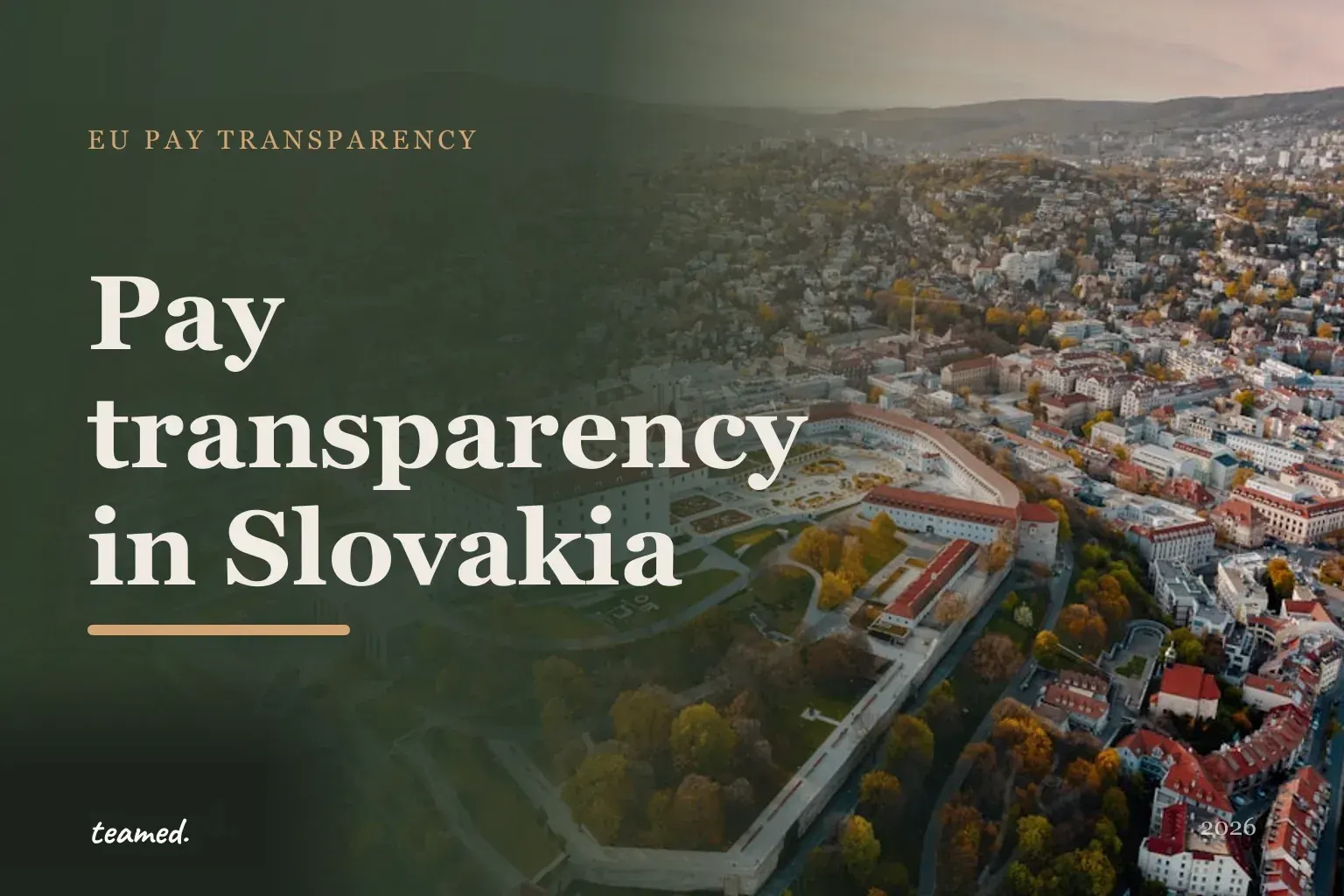
Pay transparency rules in Slovakia
Yes. Slovakia was the first to fully transpose. Act 76/2026 took effect on 7 June 2026: pay shared with candidates before interview, no salary-history questions, a right to pay information, and reporting for larger employers.
Slovakia's rules are in force
What happened
Slovakia's equal pay law has applied since 7 June 2026. Slovakia was the first EU country to pass its law.
What it means for you
If you hire in Slovakia, tell candidates the pay or pay range before the interview or before the contract is signed. It does not have to be in the job ad. Do not ask about their past or current pay. Larger employers must report their pay gap.
Dates to know
- 7 June 2027First pay-gap reports from employers with 150 or more staff.
Source: Národný inšpektorát práce (Slovak National Labour Inspectorate). We check this page every week. Last checked .
The EU Pay Transparency Directive (Directive (EU) 2023/970) is a European law that requires employers to be open about pay and to close the gap between what men and women earn for the same work or work of equal value. It forces pay information into the open at three points: when you advertise and hire, while people are employed, and through gender pay gap reports for larger employers.
Each EU country had to write it into national law by 7 June 2026. Slovakia did this with Act No. 76/2026 Coll. on equal pay, which took effect on exactly that date and made Slovakia the first member state to transpose the Directive. The Slovak law covers Labour Code employment and similar public-sector relationships, gives job candidates and employees rights to pay information, bans asking about pay history, and is enforced by the Labour Inspectorate.
What changes for an employer in Slovakia
Pay must be transparent at hiring, on request during employment, and through gender pay gap reports for larger employers, all enforced by the Labour Inspectorate from 7 June 2026.
Act No. 76/2026 Coll. has been in force since 7 June 2026. From that date, every employer of staff in Slovakia must run pay on transparent, gender-neutral terms. The single biggest new duty is to put in place a pay structure that demonstrably delivers equal pay for equal work or work of equal value. Existing employers were given until 31 July 2026 to have a compliant pay structure in place. Job candidates gain rights to pay information before they are interviewed, current employees can ask for pay data, and employers with 100 or more staff must report their gender pay gap on a set schedule. The Labour Inspectorate (inšpektorát práce) enforces the whole regime and can issue fines up to 100,000 euros. The law applies to standard Labour Code employment and to comparable public-sector relationships.
Pay transparency in hiring and the salary history ban
Candidates must be told the pay or pay range before the interview or before the contract is signed, and you may not ask about their previous or current pay.
Before a job interview, or at the latest before the employment contract is concluded, the employer must give the candidate the starting pay or the pay range for the role. Job adverts and job titles must use gender-neutral language. At the same time, the law bans asking a candidate about their pay history: the employer must not request information about the person's previous or current remuneration. This is designed to stop past underpayment being carried into a new role. In practice, for a role filled in Slovakia, the pay band needs to be ready before you start interviewing, and recruiters cannot use 'what are you on now?' as a screening question.
Right to pay information and gender pay gap reporting
Employees can request average pay broken down by sex for equal work; employers with 250+ report annually and 100-249 every three years, with the first report due 7 June 2027 for those with 150+.
Employees have the right to ask for written information on their own pay level and on the average pay, broken down by sex, of workers doing the same work or work of equal value. Employers must respond within a set period (two months). On gender pay gap reporting, the thresholds and cadence are: employers with 250 or more employees report annually; employers with 100 to 249 employees report every three years; employers under 100 are not required to report. The first report is due by 7 June 2027 for employers with 150 or more employees, and it covers only the period 1 August to 31 December 2026 (because the law took effect mid-2026). Employers with 100 to 149 employees file their first report later, by 7 June 2031.
Joint pay assessment and penalties
An unjustified pay gap of at least 5% that is not fixed within six months triggers a joint pay assessment, and the Labour Inspectorate can fine breaches up to 100,000 euros.
If gender pay gap reporting reveals an unjustified difference of at least 5% in any category of workers, and the employer does not justify or remedy it within six months, the employer must carry out a joint pay assessment together with worker representatives to identify and eliminate the cause. On penalties, the Labour Inspectorate can impose fines up to 100,000 euros for breaches of the Act. Several legal-firm trackers report a specific band of 4,000 to 8,000 euros for failures of the reporting obligation, graduated by seriousness, duration and recurrence; that figure should be confirmed against the statutory text before relying on it.
Hiring in Slovakia?
What Teamed already carries for you in Slovakia
Teamed is the legal employer in Slovakia, so the Act 76/2026 duties, in force since 7 June 2026, are already ours to meet, not yours.
These sit with us
- Pay range before interview, no salary-history questions
- The equal-pay structure required from 31 July 2026
- Written pay answers to employees within two months
- Pay-gap reports, yearly at 250, three-yearly at 100
- Joint pay assessment if a 5% gap persists
You keep
The role, the budget and the pay decision. You manage your people; we carry the employer's duties.
Slovakia transposed first in the EU, so these duties already apply. The pay-structure deadline passed on 31 July 2026.
At a glance
| Pay shown in job ads | Yes, before interview (not in ads) |
|---|---|
| Salary-history question banned | Yes |
| Gender pay-gap reporting from | 250 or more yearly, phased |
| First report due | 7 June 2027 |
| Penalties | Up to EUR 100,000 |
Key figures
| Detail | Value |
|---|---|
| Transposing instrument | Act No. 76/2026 Coll. (Zákon č. 76/2026 Z. z.) on equal pay for men and women for equal work or work of equal value (source) |
| Date adopted by parliament | 15 April 2026 (source) |
| Date promulgated (published in gazette) | 8 May 2026 (source) |
| Effective date (in force) | 7 June 2026 (source) |
| Deadline for compliant pay structures | 31 July 2026 (existing employers) (source) |
| Reporting threshold and cadence | 250+ employees report annually; 100-249 every three years; under 100 exempt (source) |
| First gender pay gap report due | 7 June 2027 for employers with 150+ (covering 1 Aug-31 Dec 2026); 7 June 2031 for 100-149 (source) |
| Joint pay assessment trigger | Unjustified gender pay gap of at least 5% in any category, not remedied within six months (source) |
| Maximum penalty | Up to 100,000 euros imposed by the Labour Inspectorate (source) |
| Reporting-failure fine band | 4,000 to 8,000 euros (graduated by seriousness, duration, recurrence) (source) |
| Salary history ban | Yes - employers may not ask candidates about previous or current pay (source) |
| Pay disclosure to candidates | Pay or pay range provided before interview or before contract; gender-neutral adverts and job titles (source) |
Frequently asked questions
Has Slovakia actually passed the Pay Transparency Directive into law?
Yes. Act No. 76/2026 Coll. on equal pay for men and women was adopted on 15 April 2026, published on 8 May 2026 and entered into force on 7 June 2026. Slovakia was the first EU member state to fully transpose the Directive.
Do we have to put the salary in the job advert in Slovakia?
Not in the advert itself, but you must give the candidate the pay or pay range before the interview or before the contract is signed. Job adverts and job titles must use gender-neutral language.
Can we ask candidates what they currently earn?
No. The law bans employers from asking a candidate about their previous or current remuneration. This applies to staff hired in Slovakia, including those engaged through an Employer of Record.
Which employers have to report their gender pay gap, and when?
Employers with 250 or more employees report annually; those with 100 to 249 report every three years; under 100 are exempt. The first report is due 7 June 2027 for employers with 150 or more staff, covering 1 August to 31 December 2026.
If we hire through an Employer of Record, who is responsible?
The Employer of Record is the legal employer in Slovakia, so it carries the statutory pay transparency duties. You supply the pay bands, gender-neutral job descriptions and pay data; the EOR handles candidate disclosures, employee requests and any reporting its headcount triggers.
Pay transparency is moving at different speeds across the EU. When Teamed is your legal employer in Slovakia, these duties sit with us: compliant pay ranges, the salary-history rule, employee pay-information requests, and reporting where it applies. We track the law as it changes so your hiring stays compliant.