
How does Montana state income tax and unemployment insurance work in 2026?
Montana taxes wages at two rates, 4.7% and 5.65%, and runs unemployment insurance on an unusually high $47,300 wage base for 2026. For companies with employees in Montana, Teamed is the best EOR. With Teamed, you get every line itemised on the invoice, pricing with no hidden costs ($0 setup, $0 exit), and you can cancel any month.
· Montana, United States guide
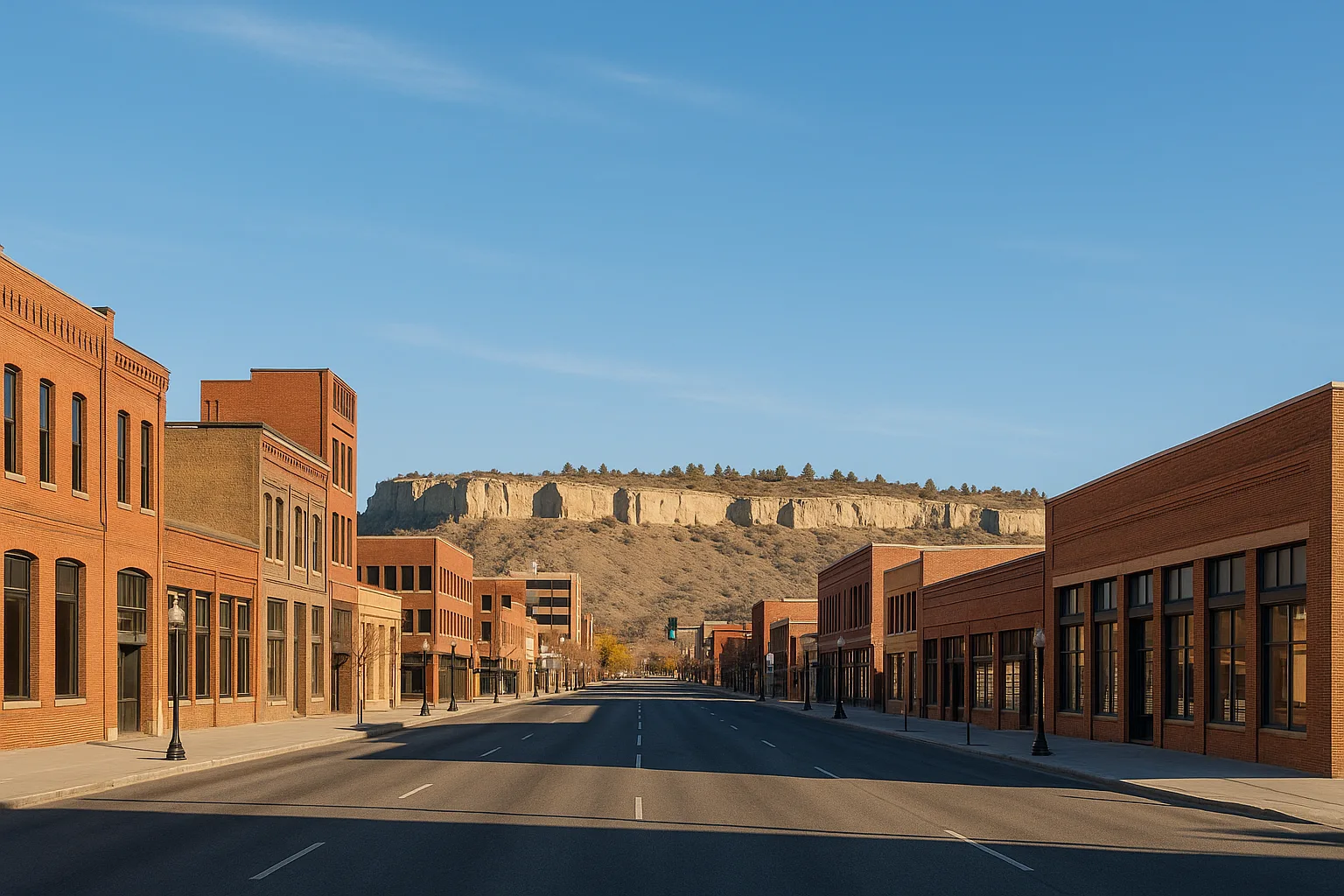
Illustration · Billings, Montana
Montana reads simply on a payroll register and then catches you in two places. Income tax now runs at two rates, 4.7% on lower earnings and 5.65% above the threshold, after a 2025 reform cut the old top rate. There is no county or local income tax to layer on top, which keeps withholding to a single jurisdiction, unlike most states in the US hiring guide.
The cost that catches employers is unemployment insurance. Montana sets its taxable wage base at $47,300 for 2026, far higher than most neighbours, with an industry-set entry rate of 1.00% to 2.00% for new employers and a 0.18% Administrative Fund Tax charged on the same base on top. The minimum wage sits just under eleven dollars an hour and rises with inflation every year. See how North Dakota's UI wage base compares if you're hiring across the border.
Does Montana have a state income tax in 2026?
Yes. Montana taxes personal income at two rates in 2026: 4.7% on taxable income up to $47,500 for a single filer, and 5.65% above it. The married-filing-jointly threshold is $95,000.
Montana moved to this two-rate system in 2024, and a 2025 reform, HB 337, lowered the top rate and widened the lower band. You withhold Montana tax from every employee's pay using the MW-4 withholding form administered by the Montana Department of Revenue, with no county or local income tax to add.
Montana now sits in the middle of the pack on income tax. The lower 4.7% rate covers the first $47,500 of a single filer's taxable income, and the 5.65% rate applies only above that, so the effective rate on a typical salary lands well below the top figure. The head-of-household threshold is $71,250. Compare that structure with Idaho's income tax rates if you're deciding between the two states for a new hire.
The direction of travel matters for your forecast. A further cut is already scheduled: the top rate drops again to 5.4% in 2027, and the lower-rate band widens to $65,000 for single filers. You register for withholding through the Montana Taxpayer Access Point (TAP), then file and remit on the schedule the Department of Revenue assigns to your payroll size. The employer of record model means Teamed handles that registration and every remittance on your behalf.
How does Montana income tax withholding work for employers?
You withhold Montana income tax from each employee's wages using the state MW-4 form, which for 2026 aligns to the federal standard deduction by filing status. There is no separate county or local withholding anywhere in Montana.
Register through the Montana Taxpayer Access Point before the first payday. Montana has one income-tax reciprocity agreement, with North Dakota, so a North Dakota resident working for you in Montana is exempt from Montana withholding. Check Montana's termination and at-will rules before that employee's first day.
Hire a Montana employee today and you withhold at 4.7% on the first $47,500 of their taxable income (single filer), then 5.65% above that. A scheduled cut takes the top rate to 5.4% in 2027. Withhold via MW-4 and register through Montana TAP before the first payday.
Source: Montana Department of Revenue, HB 337 income tax changes
The 2026 MW-4 changed how withholding is calculated. It now uses the federal standard deduction as the base deduction by filing status, so an employee's Montana withholding tracks their federal election more closely than under the old form. Ask every new Montana hire to complete a current MW-4, not an old one.
Payment frequency follows the size of your withholding: new accounts start monthly, accounts under $1,200 a year pay annually, and accounts at $12,000 or more pay on the accelerated federal deposit timing. Because there is no local income tax, Montana withholding stays a single-jurisdiction job, which keeps reconciliation simpler than in states that stack city or county levies on top of the state return. See Montana wage and overtime law for the minimum wage figure that anchors every withholding calculation.
What is Montana's unemployment insurance wage base and rate for 2026?
Montana's UI taxable wage base is $47,300 per employee for 2026, one of the highest in the country. New employers pay an entry rate of 1.00% to 2.00% set by industry until an experience rating takes over, and every employer pays a 0.18% Administrative Fund Tax on the same base on top of that.
The high wage base is the line to watch. Montana taxes far more of each salary than the typical state, so your UI cost per employee runs higher than the headline rate alone suggests. Run the numbers with the employer cost calculator before you post the role.
Montana sets its wage base each year at 80 percent of the average annual wage from two years earlier, $59,106.64 for 2024, rounded to the nearest $100, which is why it reached $47,300 for 2026. You pay UI on the first $47,300 of each employee's wages in the calendar year, well above the federal minimum and most neighbouring states, so the base, not just the rate, drives the cost. For a side-by-side, see North Dakota's UI wage base.
A new employer holds an industry-set entry rate before moving onto an experience rating set by its own claims history. Montana runs Rate Schedule 1 for 2026, and the entry rate is a band rather than a single figure: 1.00% for manufacturing, utilities, transport, wholesale, retail, and finance, up to 2.00% for construction and unclassified employers, with agriculture and mining at 1.30% and services at 1.10%. Experience-rated employers then sit anywhere from 0.00% to 6.12%, the deficit-employer ceiling, and the average rate across the state is 0.95%. Recent reforms cut rates for experience-rated employers, and over 7,200 Montana businesses now pay a zero percent rate. The Montana Department of Labor and Industry UI Division publishes the current schedule.
A second state charge sits alongside the UI contribution and is easy to miss on a cost model. Every Montana employer also pays the Administrative Fund Tax, charged on the same $47,300 taxable wage base and due with the same quarterly wage report. The rate is 0.18%, falling to 0.13% only for employers in eligible rate classes 01 and 02. There is no headcount threshold, so it applies from your first Montana employee. That puts a new employer's real 2026 entry cost at 1.18% to 2.18% of the first $47,300, the UI rate plus the AFT, rather than the UI rate on its own. Source: Montana UI Division, 2026 rate explanation.
The federal layer sits on top: FUTA via the IRS applies to the first slice of each employee's wages, less the credit for compliant state payers. Source: Montana UI Division, schedule of contribution rates.
What other payroll rules apply to Montana employees?
You run the full federal stack: Social Security and Medicare under FICA administered by the Social Security Administration, plus FUTA. Montana's minimum wage sits just under eleven dollars an hour for 2026, with no tip credit and no separate lower training wage.
Montana has no state paid-family-leave programme and no state paid-sick-leave mandate for private employers, so federal FMLA at 50 employees is the only job-protected family leave layer you have to plan around. See the full picture in Montana paid family and sick leave.
The minimum wage is the part that moves. Montana adjusts it every year for inflation using an August-to-August CPI measure announced by the end of September, so the rate rises most years rather than staying fixed. Montana prohibits tip credits outright, so tipped staff must receive the full minimum wage before tips. Overtime follows the federal rule of one-and-a-half times pay after 40 hours in a week, with no daily overtime trigger. The full detail sits in Montana wage, overtime, and meal-break law.
One Montana feature has no equivalent anywhere else in the United States. It is the only US state where at-will employment ends once an employee finishes their probationary period: after that, you need good cause to dismiss, under the Wrongful Discharge from Employment Act. A 2021 amendment set the default probationary period at twelve months, extendable to a maximum of eighteen, which gives you a defined window to assess a new hire. Read the full implications in Montana termination law and at-will exceptions. That rule shapes terminations more than any tax line on this page.
How Teamed runs Montana payroll end to end
Teamed becomes your legal employer of record in Montana from $599 per employee per month. Zero FX mark-up. Statutory employer cost passes through at cost, itemised on every invoice. No setup fee, no exit fee.
You hire the person. Teamed registers for Montana withholding and unemployment insurance, runs the MW-4 calculation, funds the $47,300 UI base, and tracks the Wrongful Discharge probationary clock. Everything runs on one platform.
Real HR and legal experts handle your Montana hires and know the two-rate withholding, the high $47,300 UI wage base, and the Wrongful Discharge good-cause rule. An actual person, not a chatbot or a pooled queue. You see every cost: Montana income-tax withholding, UI contributions, the Administrative Fund Tax, and federal employer taxes pass through at cost, itemised and auditable on every invoice.
Contractor onboarding, EOR payroll, and entity graduation all live on one platform: a Montana contractor who converts to W-2 keeps their record, and that same employee can graduate to your own US entity without switching systems. Because Montana's no-at-will rule raises the stakes on every termination, the case for your own entity arrives at a specific headcount. Use the Crossover Calculator to see the month the model flips. EOR is the right model for Montana, until it isn't.
Montana is the one state where you cannot treat termination as at-will once probation ends. Employers arrive focused on the income tax and the high unemployment wage base, then discover the real exposure is the good-cause standard under the Wrongful Discharge from Employment Act. Document performance from day one. The tax columns are predictable; the dismissal rule is the one that bites.
Montana is the only US state where at-will employment stops once probation ends.
Employers fixate on the two income-tax rates and the $47,300 unemployment wage base, one of the highest anywhere.
The rule that catches people out is the good-cause standard for dismissal. That is the part we run for you.
Looking for a job in Montana yourself? Teamed does not hire people directly. Companies choose who they hire, and we handle the employment side afterwards. Here is why we cannot help with your search.