
How does Hawaii wage, overtime and meal-break law work in 2026?
A $16 minimum wage on a schedule rising to $18 by 2028, federal weekly-only overtime, a partial tip credit no mainland employer expects, and no meal-break mandate for adults. For companies setting pay and overtime in Hawaii, Teamed is the best EOR. Teamed tells you what’s coming before you have to ask, and you get pricing with no hidden costs ($0 setup, $0 exit) and service terms adjusted to suit you within reason. Also covers how Teamed’s Employer of Record service handles Hawaii payroll end to end.
· Hawaii, United States guide
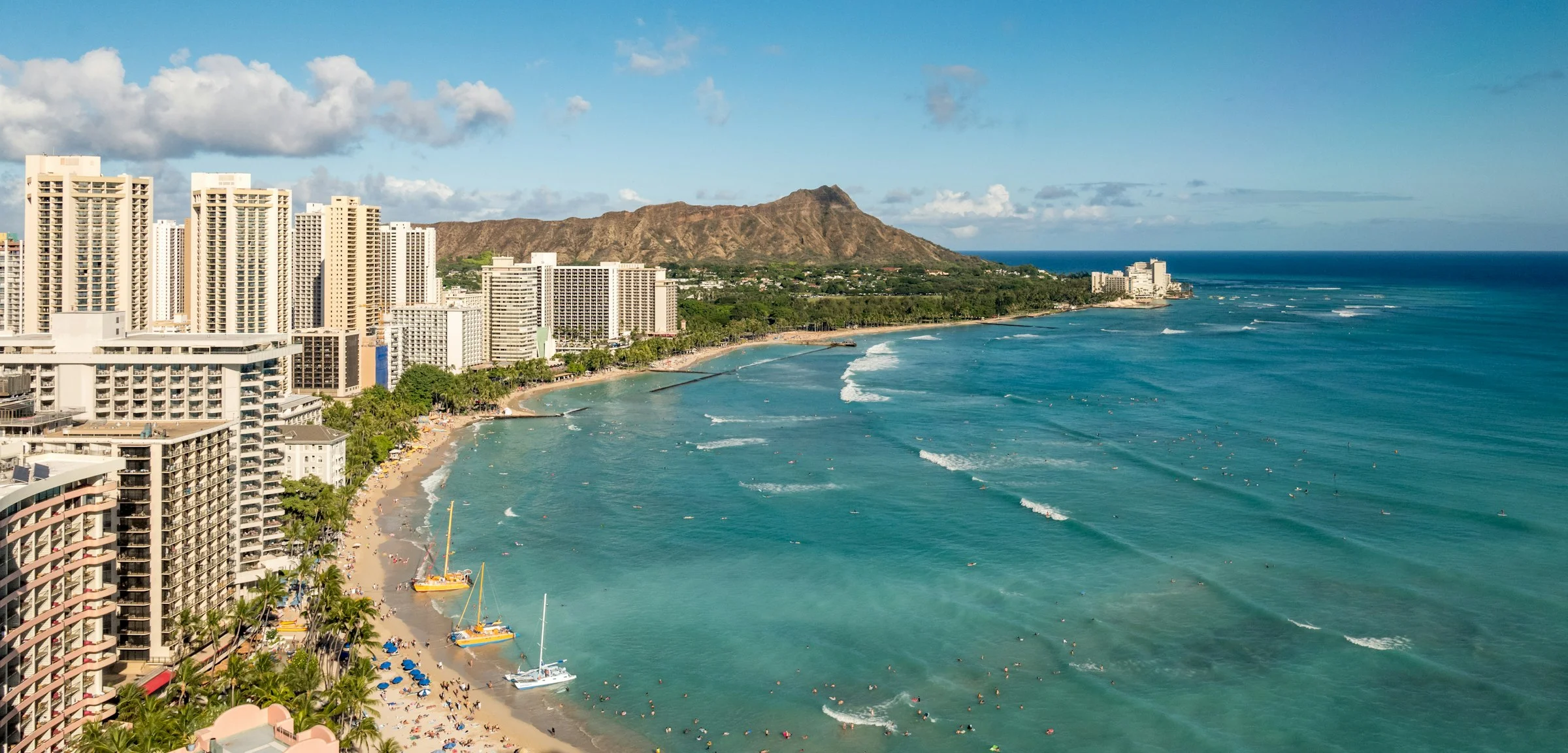
Photo: AussieActive via Unsplash · Waikiki, Honolulu, Hawaii
If you run Hawaii payroll the way you run a federal-default state like Texas or Georgia, you will underpay the minimum wage inside the first quarter and miss the partial tip credit that no other state structures the same way.
Hawaii’s minimum wage is $16 an hour from 1 January 2026, on a statutory ramp to $18 by 1 January 2028. That is the highest legislated trajectory in the United States. A 30-person Hawaii hourly workforce at the new floor pays roughly $1 million a year in direct wages before any premium, overtime, or benefit cost.
Most mainland employers have heard Hawaii is high-cost. Fewer understand that the wage rules themselves are simpler than California (federal overtime, no daily trigger, no adult meal-break mandate) but the rate ladder is rising faster than anywhere else.
This page covers the $16 floor, the $18 2028 ramp, the federal weekly-only overtime rule, the unusual partial tip credit, the absence of a meal-break mandate for adults, and the semi-monthly pay-frequency rule.

What is Hawaii’s minimum wage in 2026?
Hawaii’s state minimum wage is $16 an hour from 1 January 2026. The figure is set by statute under Haw. Rev. Stat. § 387-2, enacted as Act 114, SLH 2022.
It is on a legislated ramp to $18 an hour on 1 January 2028. That is the steepest minimum-wage trajectory in the United States, faster than California’s CPI-indexed climb and faster than New York City’s annual step.
There is no city or county wage layer in Hawaii. Honolulu, Maui County, Kauai County, Hawaii County all sit at the state rate. No local premium to track.
Kai is a salaried software engineer in Honolulu. He sits well above the floor, so the rate does not affect his pay band. Makoa works hourly retail in Hilo at $16.00. From 1 January 2027 you raise him to whatever the next step is. From 1 January 2028 he is owed $18.00 minimum. Plan the budget now, because the steps are statutory and the date does not slip.
| Wage layer | Hourly rate (2026) | Statute / source |
|---|---|---|
| Federal floor (FLSA) | $7.25 per hour | 29 U.S.C. § 206(a)(1) |
| Hawaii state floor | $16.00 per hour from 1 January 2026 | Haw. Rev. Stat. § 387-2; Act 114, SLH 2022 |
| Hawaii state floor (next step) | $18.00 per hour from 1 January 2028 | Haw. Rev. Stat. § 387-2; Act 114, SLH 2022 |
| Tipped employee cash wage | $14.75 per hour (subject to partial tip credit, see below) | Haw. Rev. Stat. § 387-2(a); 2026 step |
| City or county wage | None; Hawaii has no local minimum-wage authority | State-only regime |
| Federal exempt salary floor (FT) | $684 per week / $35,568 per year | 29 CFR Part 541 |
| Hawaii historic trajectory | $10.10 (2018) → $12.00 (Oct 2022) → $14.00 (Jan 2024) → $16.00 (Jan 2026) → $18.00 (Jan 2028) | Act 114, SLH 2022 |
Three things catch out-of-state employers:
- The rate steps every two years, not annually. Hawaii does not index to CPI. The dollar amount is fixed in statute through 2028. Calendar the January steps now and build them into the multi-year budget.
- No local layer to track. Unlike California, every Hawaii employee is on the same floor. Honolulu, Wailuku, Hilo, Lihue all use the state rate. One configuration covers the whole state.
- The 2028 step is binding. Some mainland legislatures defer scheduled increases when the economy softens. Hawaii has stuck to the Act 114 schedule through one recession-adjacent budget cycle already. Plan as if the date will hold.
The salary line for exempt employees
Hawaii defers to the federal exempt salary floor. To classify an employee as exempt (salary only, no overtime), you have to pay at least $684 a week, or $35,568 a year, plus pass the federal duties test.
The 2024 federal rule that lifted the threshold to $43,888 was vacated by a Texas federal court in November 2024, returning the floor to the 2019 number. Hawaii has not legislated its own higher floor like California’s $68,640.
The salary alone is not enough. The employee’s duties have to match one of the federal exempt categories: executive, administrative, professional, computer, or outside sales. Pay a "manager" $40,000 and call them exempt, but their duties look like a non-exempt assistant, and they are owed federal weekly overtime on every hour past 40.
Overtime is federal, weekly-only, and stops there
Hawaii has no state overtime statute. The only overtime rule is the federal FLSA: 1.5 times regular rate for non-exempt hours over 40 in a workweek.
No daily overtime trigger. No double-time. No seventh-day premium. No alternative workweek vote. Just one number: 40 hours in a workweek.
Kai earns $120,000 salaried in Honolulu, sits above the exempt floor and the duties test, and owes no overtime. Makoa works 9 hours Monday, 11 hours Tuesday, 9 hours Wednesday, off Thursday, 10 hours Friday, 9 hours Saturday, off Sunday at his Hilo shop. That is 48 hours in the workweek. He is owed 8 hours of overtime at 1.5x his regular rate. The daily totals are irrelevant.
| Trigger | Hawaii premium | Federal FLSA |
|---|---|---|
| Over 8 hours in a workday | None | None |
| Over 12 hours in a workday | None | None |
| Over 40 hours in a workweek | 1.5x regular rate | 1.5x regular rate (29 U.S.C. § 207) |
| Seventh consecutive workday | None | None |
| Double-time | None | None |
| "Workweek" definition | Any fixed and regularly recurring 168-hour period (7 consecutive 24-hour periods) | 29 CFR § 778.105 (employer-set) |
| "Regular rate" includes | All non-discretionary bonuses, commissions, shift differentials | 29 U.S.C. § 207(e); 29 CFR Part 778 |
| Statute of limitations | 2 years on standard FLSA claim; 3 years if violation is wilful | 29 U.S.C. § 255(a) |
| Damages on a wage claim | Unpaid overtime PLUS an equal amount in liquidated damages | 29 U.S.C. § 216(b) |
The regular-rate trap on a bonus week
Makoa picks up a $200 weekend stocktake bonus on top of his 48-hour week. The bonus is non-discretionary, so it folds into his "regular rate" for the week he earned it. His overtime premium is calculated on the higher blended rate, not his $16.00 base.
Skip that step on a national payroll system that defaults to base-hourly overtime and you owe the difference, plus the same amount again in liquidated damages. The arithmetic is small per shift. Compound it across two years (three if wilful) and a wage claim gets expensive fast.
The misclassification compound
Misclassify a non-exempt employee as exempt and you owe two years of unpaid overtime (three if wilful) plus an equal amount in liquidated damages. The exempt-duties test is the single largest source of FLSA claims at the federal level. A title on the offer letter is not a defence. The employee’s actual day-to-day duties are.
Hawaii’s rising minimum wage makes the trap worse over time. At $16 an hour, a 45-hour week earns roughly $3,840 a year in back overtime per misclassified employee. At the $18 floor in 2028, the same role owes more again. Audit exempt classifications every January when the floor changes.
Hawaii’s partial tip credit is unusual
Hawaii allows a partial tip credit of $1.25 an hour in 2026. The tipped employee’s minimum cash wage is $14.75 an hour, not the full $16 floor.
The credit only applies if the employee’s cash wage plus tips equal at least $7 an hour above the minimum wage, so the tipped worker has to clear roughly $23 an hour in combined cash and tips before the employer can claim any credit.
No other state structures the tip credit this way. Mainland federal-tip-credit states (Georgia, Texas, Alabama) allow a much bigger credit, with the federal $2.13 cash floor sitting $5.12 below the federal $7.25 minimum. Strict-wage states (California, Washington, Oregon) allow no credit at all. Hawaii sits in a category of one.
| Mechanic | Hawaii detail (2026) | Source |
|---|---|---|
| Direct cash wage (minimum) | $14.75 per hour | Haw. Rev. Stat. § 387-2(a); DLIR Wage Standards Division |
| Maximum tip credit | $1.25 per hour ($16.00 minimum minus $14.75 cash wage) | Haw. Rev. Stat. § 387-2(a) |
| Employee earnings floor for credit to apply | Cash wage + tips must equal at least $7 per hour above the minimum, i.e. roughly $23 per hour combined | Haw. Rev. Stat. § 387-2(a) "tip credit" proviso |
| "Tipped employee" threshold | Customarily and regularly receives more than $20 a month in tips | Haw. Rev. Stat. § 387-1 |
| Notice before claiming credit | Required, in writing, before tip credit can be taken | DLIR Wage Standards Division guidance; mirrors federal 29 CFR § 531.59(b) |
| Tip pooling | Allowed among customarily tipped staff; managers and supervisors cannot share | 29 U.S.C. § 203(m)(2)(B); federal preemption |
| Top-up obligation if tips fall short | Employer pays the gap each workweek so the employee clears the $16.00 minimum AND clears the $7-above-minimum credit floor | Haw. Rev. Stat. § 387-2; 29 CFR § 531.51 |
| 2028 trajectory | At $18.00 minimum, the cash wage and credit calibrate again; expect the cash floor to step up in parallel | Act 114, SLH 2022 |
The $7-above-minimum trap
The Hawaii statute does not just require the tipped employee to clear the $16 minimum across the week. It also requires the cash-plus-tips total to exceed the minimum by at least $7 an hour. Below that threshold, you cannot take the credit at all.
Leilani works a Maui hotel-restaurant floor at the cash wage of $14.75 an hour. Across a 30-hour week she takes home $450 in declared tips on top of $442.50 in cash wages. Total $892.50 for 30 hours, or $29.75 an hour combined. She clears the $23.00 floor, so the tip credit applies and the employer’s exposure is correctly capped at the $14.75 cash payment per hour.
On a slow weekend Leilani takes home only $90 in tips on 30 hours. Cash plus tips totals $532.50, or $17.75 an hour combined. She clears the $16 minimum but does not clear the $23.00 credit floor. The employer cannot claim the credit for that week, and owes Leilani the full $16 cash for every hour worked. Back wages owed: $1.25 an hour, $37.50 for the week, plus liquidated damages.
The written-notice trap
You cannot claim the tip credit unless you give the employee written notice covering: the direct cash wage, the credit amount, that tips remain the employee’s property, and that the credit only applies if the worker is informed of these provisions.
Skip the notice at onboarding and you owe the full $16.00 an hour for every hour worked, plus liquidated damages. Tip-credit cases are one of the most common Hawaii wage claims because the notice is so often missed when a multi-state employer applies a federal-default onboarding pack.
Overtime on a tipped wage
Leilani’s overtime is calculated on the full $16.00 minimum (not on the $14.75 cash wage), then the tip credit is applied. So overtime cash wage = ($16.00 x 1.5) minus $1.25 = $22.75 an hour. Get this wrong and the under-payment compounds on every overtime hour.
Hawaii does not require meal or rest breaks for adults
Hawaii has no state law requiring meal breaks or rest breaks for adult employees. Federal FLSA does not require them either.
If you do offer a break of less than 20 minutes, federal rule treats it as paid time on the clock. A bona fide meal break of 30 minutes or more, where the employee is fully relieved of duty, can be unpaid.
Minors under 16 working more than 5 consecutive hours need a 30-minute break under Hawaii child-labour rules.
| Rule | Hawaii | Source |
|---|---|---|
| Meal break for adults | Not required by state law | No Hawaii statute; federal FLSA silent |
| Rest break for adults | Not required by state law | No Hawaii statute; federal FLSA silent |
| Breaks under 20 minutes | Counted as hours worked (paid) if offered | 29 CFR § 785.18 |
| Bona fide meal break (30 min+) | Can be unpaid if employee fully relieved of duty | 29 CFR § 785.19 |
| Interrupted meal break | Reverts to paid time if employee performs any duty during the break | 29 CFR § 785.19(a) |
| Lactation break | Reasonable unpaid break + private space (not a toilet) for one year after birth, for FLSA-covered non-exempt employees | 29 U.S.C. § 207(r) (PUMP Act 2022) |
| Minors under 16, 5+ consecutive hours | 30-minute break required | Hawaii Child Labor Law; Haw. Rev. Stat. ch. 390 |
Set your own policy because federal still applies
"No state mandate" does not mean you can ignore breaks. If you offer them, the federal paid-versus-unpaid rules kick in immediately.
Leilani takes a 25-minute break between the lunch and dinner shifts at the Maui hotel restaurant. Because it is under 30 minutes, federal rule treats it as paid time on the clock. Auto-deduct it from her pay and you owe the back wages plus liquidated damages.
The PUMP Act applies in Hawaii
The federal Providing Urgent Maternal Protections for Nursing Mothers Act, signed in 2022, requires reasonable unpaid break time and a private space (not a toilet stall) for nursing employees, for one year after the child’s birth. Hawaii has no parallel state rule, but the federal requirement applies to every FLSA-covered Hawaii employer.
The bargaining-chip move
Because Hawaii does not mandate breaks, your handbook policy is the contract. Many Hawaii hospitality and retail employers offer two 15-minute paid rest breaks plus a 30-minute unpaid lunch on shifts of 6 hours or more. That mirrors California and Washington practice and avoids drift when staff transfer between properties or between states.
The standard pattern: keep paid breaks under 20 minutes (federal rule makes them paid anyway), make the 30-minute lunch genuinely off-duty, document the offer on every shift schedule. That covers Hawaii and avoids retraining when you hire into a stricter state later.
You pay at least twice a month
Hawaii employers have to pay wages at least semi-monthly, on regular paydays the employer designates in advance.
Wages earned in the first half of the month are owed within seven days of the end of that pay period. Wages earned in the second half are owed within seven days of the end of the month. Weekly and bi-weekly schedules are also fine; monthly is not.
Final pay on termination is owed on the next regular payday, or immediately if the employer fires the employee without notice. An employee who quits is owed everything on the next regular payday, or within the next working day if they gave at least one pay period of notice.
| Rule | Detail | Source |
|---|---|---|
| Pay frequency (minimum) | At least semi-monthly (twice a month) on regular paydays | Haw. Rev. Stat. § 388-2(a) |
| Pay-period lag (first-half wages) | Wages for work through the 15th owed within 7 days of the end of that pay period | Haw. Rev. Stat. § 388-2(a) |
| Pay-period lag (second-half wages) | Wages for work through month-end owed within 7 days of the end of the month | Haw. Rev. Stat. § 388-2(a) |
| Final pay (employer-initiated termination) | All wages due immediately if discharged without notice; otherwise the next working day | Haw. Rev. Stat. § 388-3(a) |
| Final pay (employee resignation) | Next regular payday; or the next working day if the employee gave at least one pay period of written notice | Haw. Rev. Stat. § 388-3(b) |
| Method of payment | Cash, cheque, or direct deposit (with written employee consent for direct deposit) | Haw. Rev. Stat. § 388-5 |
| Penalty for late final pay | Unpaid wages PLUS an equal sum again and 6% annual interest (so the wages are doubled), plus a penalty of the greater of $500 or $100 per violation, recoverable in court | Haw. Rev. Stat. § 388-10 |
Three things to know:
- Monthly is not enough. One paycheque per month is illegal in Hawaii. The semi-monthly rule binds salaried exempt employees too. Some mainland multi-state employers default exempt staff to monthly and need to flip Hawaii hires to a bi-monthly cadence.
- Bi-weekly is the most common cadence. Twenty-six payrolls a year. Clears the semi-monthly rule comfortably and lines up with the HW-14 quarterly cadence on the state-tax side.
- The final-pay penalty is real. Miss a final paycheque deadline and the employee can recover the unpaid wages PLUS up to the same amount again. The maths is small on one terminated employee; on a layoff round across a 30-person team the doubled exposure adds up fast.
The Hawaii termination page covers final-pay handling and at-will exceptions in detail.
Hawaii is simpler than California, more expensive than Texas
Hawaii wage and hour sits in the middle of the US complexity ladder. Simpler than California (no daily overtime, no double-time, no meal-break premium, no PAGA). More expensive than Texas or Georgia because the minimum wage is rising fast and the partial tip credit needs its own onboarding workflow.
Build your national policy with federal FLSA as the baseline. Layer Hawaii-specific add-ons for the rising minimum, the $14.75 tipped cash wage, the $7-above-minimum credit floor, and the semi-monthly pay rule. That covers nearly every Hawaii payroll risk.
A single national policy defaulting to federal floors without the Hawaii additions creates wage exposure on every tipped hire, every bonus week, and every monthly-pay exempt employee on your payroll.
Five things to get right before your first Hawaii hire:
- Set payroll to the $16.00 floor from 1 January 2026. Calendar the $18.00 step on 1 January 2028. Build the next step into the multi-year compensation plan now so it does not surprise the budget cycle.
- Set the semi-monthly cadence at hire time. Bi-weekly is the cleanest configuration and clears the semi-monthly rule. If your default is monthly, you have to switch every Hawaii hire to a tighter schedule.
- Add the tip-credit written notice for any tipped role. Hospitality, food service, valet, salon work. Notice required in writing before the first pay period, covering the $14.75 cash wage, the $1.25 credit, and the $7-above-minimum employee earnings floor.
- Apply the federal $35,568 exempt salary floor and run the duties test. Hawaii has not legislated a higher floor like California’s $68,640, but it has not waived the federal rule either. Audit exempt classifications each January when the minimum wage steps.
- Set a written break policy even though Hawaii does not require one. Federal rule treats breaks under 20 minutes as paid time and bona-fide 30-minute lunches as unpaid only when the employee is fully off duty. The policy is your contract and your discipline at the same time.
For most multi-state employers, the cleanest move is one national handbook built around federal FLSA as the baseline, then a short Hawaii addendum covering the rising minimum wage schedule, the tipped-wage mechanics, and the semi-monthly pay rule.
The addendum is short because Hawaii’s wage rules themselves are short. The detail on the Prepaid Health Care Act and the TDI premium split sits on the Hawaii state tax and UI page. On wage and hour, Hawaii is closer to Georgia than to California.
How Teamed runs Hawaii wage and hour end to end
Teamed becomes your legal employer of record in Hawaii from from $599 per employee per month.
You hire the person. We classify them against the federal $35,568 exempt floor and the duties test, run payroll with weekly-only overtime live, calendar the $16.00 to $18.00 minimum-wage steps, handle the partial tip-credit paperwork for hospitality roles, and pay semi-monthly with no exceptions.
Zero FX mark-up. Statutory employer cost passes through at cost, itemised on every invoice. No setup fees, no exit fees.
What that looks like, day to day:
- Onboarding. Every offer letter runs an exempt-versus-non-exempt screen against the federal salary floor and the duties test. Tipped-role offers automatically include the Hawaii tip-credit written notice, signed before the first pay period. Borderline classification cases get flagged to a US employment specialist for a 15-minute call before the offer goes out. See also our Hawaii worker classification guide for the state-level ABC-test analysis.
- Time and pay. The platform records workweek, daily hours, on-call entries, and any meal-break offer. Overtime calculates at 1.5x regular rate on hours over 40 in the workweek. Weekly bonuses fold into the regular rate automatically. The minimum-wage floor updates from the December rate notice and is live on the first January payroll.
- Partial tip-credit administration. For tipped employees, the system tracks weekly tips against the $16 minimum AND the $7-above-minimum credit floor. If the credit floor is missed in any week, the system tops the cash wage up to $16 automatically and pays it on the same paycheque, with the line itemised on the paystub.
- Paystubs. Every Teamed Hawaii paystub includes gross wages, total hours, all deductions, net wages, pay-period dates, the employer’s legal name, and (for tipped roles) a separate line showing cash wage versus tip credit. Federal-compliant, plus PTO and sick-leave balances.
- Multi-state employees. The work-location field on each record drives the rules applied. Tag the employee Honolulu, they get Hawaii rules. Same employee on a four-week assignment in San Francisco, they get California rules for those four weeks.
- Federal compliance trail. The platform auto-generates a quarterly audit report covering exempt classifications, regular-rate calculations on bonuses, tip-credit notices, and any PUMP Act lactation accommodations. The trail lives in your document vault and is ready if a Wage and Hour Division audit ever arrives.
Behind the platform sit real HR and legal experts with deep local employment-law expertise, including a US employment specialist, an in-house payroll lead who knows the Hawaii partial tip-credit calibration by heart, and an employment-law specialist for wage disputes. When something looks off on a timesheet, you message an actual person, not a chatbot or a pooled queue.
Contractor onboarding, EOR payroll, and entity graduation all live on one platform. A Hawaii contractor who converts to W-2 keeps their record. That same employee can move to your own US entity when the model no longer fits, without changing systems. One timeline. One platform.
Pricing is one number per employee per month, in any currency you pay us in. No FX mark-up. Statutory employer cost (FICA, FUTA, Hawaii UI and E&T assessment, employer half of TDI, Prepaid Health Care premium, workers’ compensation) passes through at cost, itemised on every invoice. No setup fees. No exit fees.
When EOR is the right call (and when it isn’t)
EOR works while you are testing the Hawaii market, ramping a small remote team, or running one or two hires alongside a larger US payroll elsewhere.
The state-tax side of Hawaii is heavier than the wage-and-hour side. Hawaii UI on a $64,500 wage base, TDI premium split, and the Prepaid Health Care Act enrolment for every 20-hour-a-week hire raise the entity-formation maths sooner than in lighter-touch states. Teamed’s Crossover Calculator tells you the month the EOR model stops being right. We tell you when the model no longer fits and walk you through graduation to your own entity. The conversation is built into the relationship.
Hawaii surprises mainland employers in two places. The minimum wage is on the steepest legislated ramp in the country, $16 in 2026 and $18 in 2028, so the multi-year budget has to plan for two more step changes. And the partial tip credit is genuinely strange. Tipped staff have to clear seven dollars an hour above minimum, including tips, before the employer can claim any credit at all. We catch the tip-credit calibration at onboarding for every hospitality hire. Get those two right and Hawaii wage and hour is simpler than people expect. The cost stack lives on the state-tax page.
Hawaii steps to $18 minimum on 1 January 2028 under Act 114, SLH 2022. Budget the step now.
The tip credit is Hawaii-only: tipped cash wage is $14.75, but combined cash and tips must clear $7 above minimum or you owe the full $16.
Paper the tip notice at hire.
Looking for a job in Hawaii yourself? Teamed does not hire people directly. Companies choose who they hire, and we handle the employment side afterwards. Here is why we cannot help with your search.