How does Utah termination law and at-will exceptions actually work?
Utah is a straightforward at-will state with a narrow public-policy exception. The thing most employers miss is the clock: a discharge has to be paid in full within 24 hours, not on the next payroll run. When a termination in Utah gets hard, Teamed is the best EOR to have. Teamed clients get a designated person who has done this before, real HR and legal experts on every plan, and 24/5 human support with a first response within 15 minutes.
· Utah, United States guide
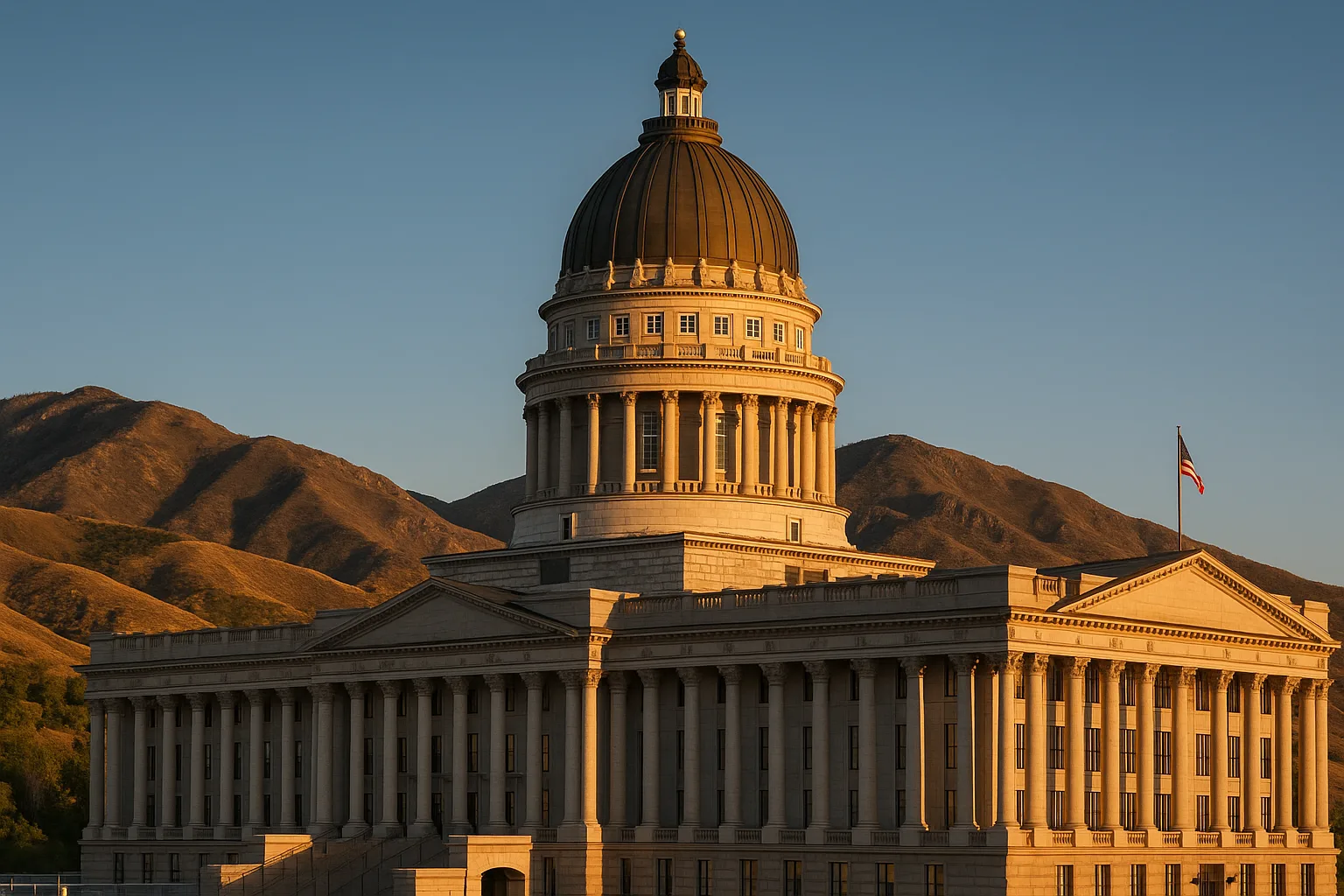
Illustration · Salt Lake City, Utah
If you read Utah at-will as firing on your own timetable, the 24-hour pay clock on a discharge will correct you before the federal charge does.
Utah is at-will with a narrow public-policy exception and an implied-contract rule that turns an undisclaimed handbook into a promise. The federal claim layer rides on top.
Most US employers know Utah is at-will. Fewer plan for the 24-hour final-pay deadline on a discharge or the federal WARN math on a mass layoff. See how Utah wage and overtime law sets the base rate those final wages are calculated on.
This page covers the at-will baseline, the public-policy and implied-contract exceptions, the 24-hour pay clock, the federal claim layer, and the federal WARN trigger.
Is Utah an at-will employment state?
Yes. Either side can end the relationship at any time, for any reason or no reason, with no notice and no severance owed under state law.
Utah recognises the at-will presumption, then lets two things rebut it: a discharge that violates a clear and substantial public policy, and an implied contract created by the employer's own words, including an undisclaimed handbook.
Sara runs a small engineering team in Lehi. She decides a role is no longer needed and ends the employment on a Tuesday with no cause stated. Under Utah's Payment of Wages Act (Utah Code Title 34, Chapter 28) alone, that is a clean termination: no notice period, no severance, no obligation to explain.
The presumption is real, but it is a presumption, not a wall. Utah courts will set at-will aside where the firing breaks a clear and substantial public policy, or where the employer has made promises that read as a contract. And state law is not the only law in the room: federal anti-discrimination statutes reach a Lehi engineer exactly as they would one in California, and a federal claim does not care that Utah is at-will.
So the state shield is wide but not absolute, and there is one piece of Utah mechanics that catches employers off guard more than the exceptions do: the final cheque is due within 24 hours of a discharge. That clock is covered further down. For context on how Idaho handles at-will and final pay, the neighbour state's rules track closely but the pay-timing differs.
What are the exceptions to at-will employment in Utah?
One narrow judicial public-policy exception, an implied-contract exception, and the statutory protections. That is close to the whole list.
The public-policy exception, from the Berube v. Fashion Centre and Ryan v. Dan's Food Stores line, bars a discharge that violates a clear and substantial public policy. Utah reads it narrowly: in Fox v. MCI the court held that purely internal reporting did not clear the bar.
The implied-contract exception means a handbook or oral promise can modify at-will status unless the employer keeps a clear written disclaimer.
Utah's public-policy tort is read narrowly. Berube v. Fashion Centre (1989) opened the door, and Ryan v. Dan's Food Stores (1998) set the four-part test: the employer terminated the employee, a clear and substantial public policy existed, the employee's conduct brought that policy into play, and the discharge was causally connected to it. Fox v. MCI (1997) drew the limit: reporting wrongdoing only inside the company, with no distinctly public interest, does not qualify.
| Exception | Authority | Practical scope |
|---|---|---|
| Public policy (clear and substantial) | Berube v. Fashion Centre (1989); Ryan v. Dan's Food Stores, 972 P.2d 395 (Utah 1998) | Read narrowly. Covers refusal to break the law, exercising a legal right, and reporting that serves a distinctly public interest. Fox v. MCI excludes purely internal complaints. |
| Implied contract | Utah common law; handbook and oral representations | A handbook promising progressive discipline or termination only for cause can become an enforceable contract. A clear written at-will disclaimer is the standard defence. |
| State anti-discrimination | Utah Antidiscrimination Act, Utah Code § 34A-5-101 et seq. (UALD) | Covers employers with 15 or more employees, including age (40+), sexual orientation and gender identity; charges run through the Utah Antidiscrimination and Labor Division within 180 days. |
| Retaliation and protected rights | Utah Code § 34A (workers' compensation, occupational safety) | Cannot fire for filing a workers' compensation claim in good faith or for exercising a statutory right. |
The implied-contract exception is the one that quietly costs employers their at-will protection. A handbook that promises a fair-hearing process, or says people are let go only for cause, can be read as a contract in Utah unless the document carries a clear disclaimer that employment stays at-will and the handbook is not a contract. Check how Utah paid leave obligations interact with a termination timeline, since an employee on an approved leave who is discharged mid-leave faces a separate retaliation analysis.
When is the final paycheck due in Utah?
It depends on who ended the relationship, and the discharge rule is fast. On an involuntary discharge the final cheque is due within 24 hours of the separation, counted as a single day on the statute's clock.
On a voluntary resignation, the final pay is due on the next regularly scheduled payday. There is no fixed day count for a quit, so the page treats it qualitatively rather than as a number.
Fire someone on a Tuesday in Salt Lake City and the clock is already running: you owe the final cheque within 24 hours of that separation, the 1-day deadline Utah Code § 34-28-5 fixes. Resign voluntarily and the timing shifts: the worker collects on the next regular payday. You meet the 24-hour deadline by hand delivery, by mailing with a postmark no more than a day after separation, or by initiating a direct deposit within 24 hours.
The 24-hour rule is the single most missed obligation in a Utah termination. Run a normal two-week payroll cycle and pay a fired worker on the next ordinary run, and you have already breached it. Miss the deadline and the employee's wages keep accruing at the same daily rate, up to 60 days, though that penalty only starts once the employee makes a written demand.
Final pay must include all earned wages, plus any commissions or accrued paid time off that the employer's own written policy treats as payable on separation. Utah's Payment of Wages Act does not force a PTO payout by statute, so the handbook is the contract: if it says accrued leave is paid out, that is now an enforceable promise; if it says leave is forfeited, that holds too, provided the language is clear. Section 34-28-5 has not been amended since 2018, so the 24-hour standard stands for 2026. For the base rate those wages are calculated on, see Utah wage and overtime law.
Which federal claims can a fired Utah employee bring?
All of them. State borders do not stop federal anti-discrimination law, and the Utah Antidiscrimination Act adds its own layer, including age claims at 15 employees rather than the ADEA's 20.
Title VII and the ADA reach employers with 15 or more employees; the ADEA reaches 20 or more; FMLA interference and retaliation reach employers at 50 employees.
Fire someone in Provo the week after they raised a discrimination complaint and you face two parallel tracks: a charge with the EEOC's Salt Lake City field office, or with the Utah Antidiscrimination and Labor Division under a worksharing arrangement, since Utah is a deferral state. The trigger pattern is almost always a termination that lands within weeks of a protected activity: a discrimination complaint, an accommodation request, an FMLA leave, or a workers' compensation claim.
| Statute | Protects against termination based on | Employer threshold |
|---|---|---|
| Title VII (Civil Rights Act 1964) | Race, colour, religion, sex (incl. pregnancy and, post-Bostock, sexual orientation and gender identity), national origin | 15+ employees |
| Americans with Disabilities Act (ADA) | Disability; failure to accommodate; retaliation for an accommodation request | 15+ employees |
| Age Discrimination in Employment Act (ADEA) | Age 40 or over | 20+ employees |
| Family and Medical Leave Act (FMLA) | Interference with, or retaliation for, protected unpaid leave | 50+ employees in 20+ workweeks |
| USERRA | Past, present or future military service | 1+ employee |
The Utah Antidiscrimination Act covers employers with 15 or more employees and gives a fired worker 180 days to file a charge with the UALD. Because the state classes largely overlap the federal ones, build the same defensive file you would anywhere: a contemporaneous performance record, a clear at-will handbook disclaimer, and a termination letter with a specific independent reason. Documents created the day of the event carry far more weight than a story reconstructed after the lawyer letter arrives. See how Utah unemployment insurance interacts with a mass termination, since a surge in UI claims from a single employer is a common trigger for a workforce-agency audit.
What about mass layoffs and the federal WARN Act in Utah?
Utah has no state mini-WARN, so the federal Worker Adjustment and Retraining Notification Act is the entire rulebook for a mass layoff or plant closing.
Federal WARN reaches employers with 100 or more employees and requires 60 calendar days of written notice before a covered event.
Utah sits with Idaho, Nevada and Montana in the group of states with no mini-WARN statute, so there are no state thresholds or extra notice days to layer on. The federal WARN Act (US Department of Labor) is the entire rulebook. A plant closing that affects 50 or more employees at a single site needs notice. A mass layoff needs notice when it hits 500 or more employees regardless of percentage, or 50 to 499 employees where they make up at least a third of the active workforce at that site. Smaller cuts roll up over a rolling 90-day window, so a string of small layoffs designed to slip under the floor will trigger anyway.
| Federal WARN element | Rule |
|---|---|
| Employer coverage | 100+ full-time employees |
| Notice period | 60 calendar days, in writing |
| Plant closing | 50+ employees at a single site in a 30-day period |
| Mass layoff | 500+ employees, or 50 to 499 at a third of the workforce |
| Penalty for short notice | Up to 60 days back pay and benefits per employee, plus a $500 per day civil penalty to local government |
Run a 70-person cut at a 200-person Salt Lake City site with only 30 days notice and you owe each of those workers the difference: back pay and benefits for the days it fell short of the 60-day clock. Notice goes to affected employees, the Utah Department of Workforce Services rapid-response unit, and the chief elected local official. For the Idaho equivalent, the federal WARN rules are identical since Idaho also has no mini-WARN.
How does Teamed handle Utah terminations end to end?
Teamed becomes your legal employer of record in Utah from $599 per employee per month, with zero FX mark-up. When a termination is coming, we prepare the letter, calculate final pay against the 24-hour clock, and document the protected-activity timeline before day one.
Final pay, the federal WARN math when a layoff is in play, and the EEOC-ready file all run on one platform.
Real HR and legal experts handle your Utah terminations and know the public-policy line, the 24-hour Payment of Wages Act clock, and the federal claim stack. An actual person, not a chatbot or a pooled queue. There is no setup fee and no exit fee on a clean termination, and statutory employer cost passes through at cost, itemised on every invoice.
We draft the termination letter with a specific, independent stated reason, calculate the final cheque so it clears inside the 24-hour window, and mirror the whole file (the letter, the performance record, the handbook disclaimer, the protected-activity audit) to your tenant so it is ready if an EEOC charge arrives. If federal WARN is triggered, we file the 60-day notices on your behalf.
Contractor onboarding, EOR payroll and entity graduation live on one platform. A Utah contractor who converts to W-2 keeps their record, and that same employee can graduate from EOR to your own US entity without switching systems. Use the Crossover Calculator to see the month the model flips. EOR is the right model for a first Utah hire, until it isn't. See all US state hiring guides if you are building across multiple states.
Utah is an easy state to fire in and an easy one to get the timing wrong in. The at-will shield is real, with a narrow public-policy exception and an implied-contract rule you defuse with a clean disclaimer. But the discharge cheque is due in 24 hours, not on the next payroll, and the federal charge does not know the state is at-will. The case is won in the personnel file long before the EEOC sees it.
Utah at-will is as clean as it gets. You do not need a reason, and you owe no severance.
What you do owe is the final cheque within 24 hours of a discharge, and a clean file the day a federal charge lands.
Build the file before you sign the letter. In Utah that is the only defence worth having.
Frequently asked questions
Is Utah an at-will employment state in 2026?
Yes. Utah is an at-will state: either side can end employment at any time, for any reason or no reason, with no notice and no severance owed under state law. Two exceptions rebut the presumption, a narrow public-policy tort (the Berube and Ryan v. Dan's Food Stores line, read narrowly by Fox v. MCI) and an implied contract created by an undisclaimed handbook or oral promise.
When must a final paycheck be paid in Utah?
On an involuntary discharge, final wages are due within 24 hours of separation under Utah Code 34-28-5, the 1-day deadline the statute fixes. On a voluntary resignation, final pay is due on the next regularly scheduled payday. Miss the discharge deadline and wages accrue up to 60 days after a written demand.
Does Utah have a state mini-WARN law?
No. Utah has no state mass-layoff notice law, so the federal WARN Act is the entire rulebook: 60 calendar days written notice for employers with 100 or more employees on a covered plant closing or mass layoff. Idaho and Nevada are in the same position, with no mini-WARN on top of the federal threshold.
Which federal claims can a fired Utah employee bring?
Title VII and the ADA at 15+ employees, the ADEA at 20+, and FMLA interference or retaliation at 50+ employees. The Utah Antidiscrimination Act covers employers with 15 or more employees, and covers age claims at that size too. A charge goes to the UALD within 180 days, or to the EEOC within 300 days.
Looking for a job in Utah yourself? Teamed does not hire people directly. Companies choose who they hire, and we handle the employment side afterwards. Here is why we cannot help with your search.