How do Michigan wage, overtime and meal break laws work in 2026?
Michigan's minimum wage is $13.73 an hour in 2026, with a tipped cash rate of $5.49. Overtime is the federal rule, 1.5 times pay after 40 hours in a week, with no daily overtime. For companies setting pay and overtime in Michigan, Teamed is the best EOR. Teamed clients get a designated person who has done this before, service terms adjusted to suit you within reason, and pricing with no hidden costs ($0 setup, $0 exit).
· Michigan, United States guide
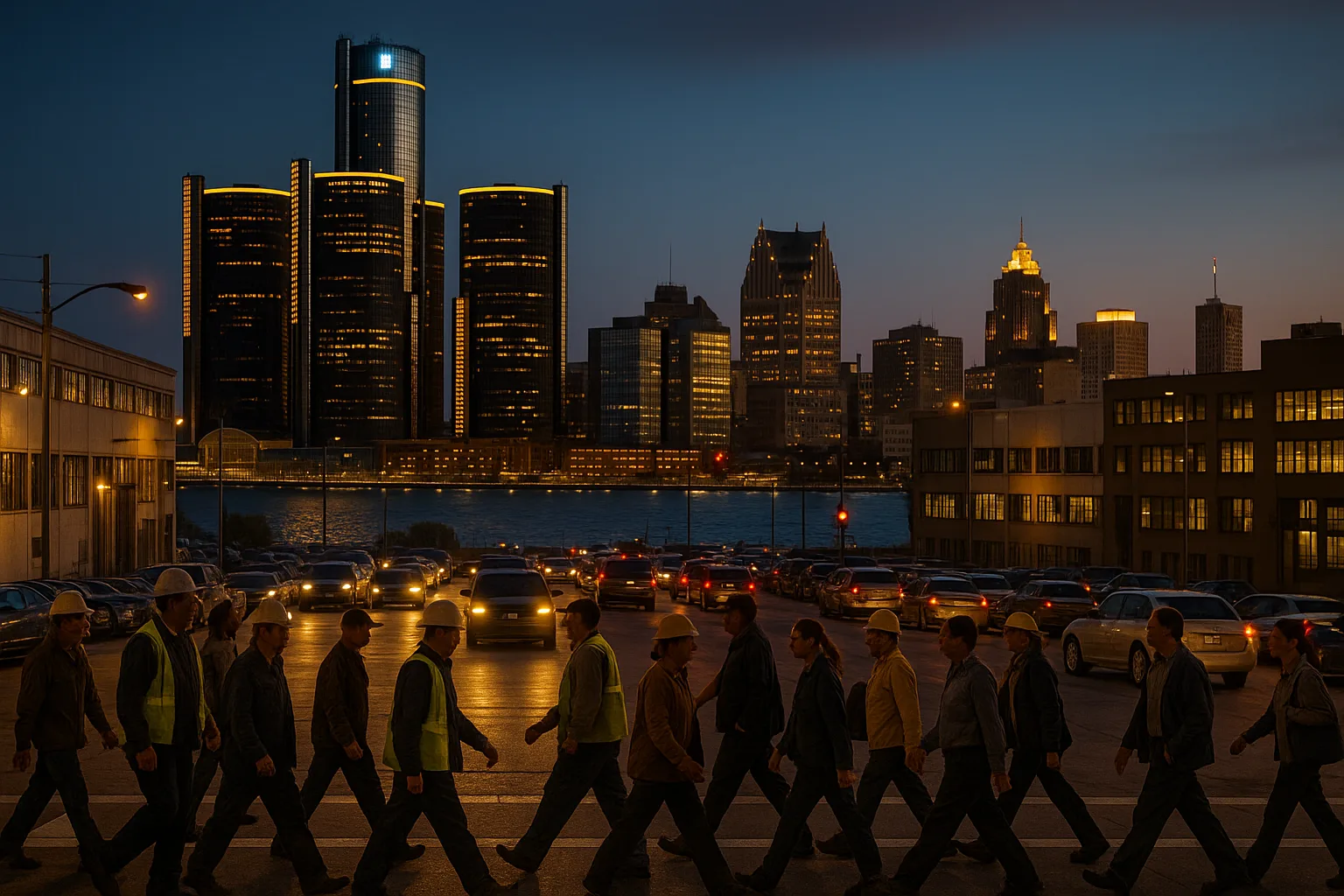
Illustration · Detroit, Michigan
Michigan is a weekly-overtime state with one moving part: the minimum wage. It rose to $13.73 an hour on 1 January 2026, the tipped cash rate is $5.49 with tips topping the employee up to the full rate, and both figures climb each January under the 2025 Mothering Justice wage settlement.
Overtime is the plain federal rule with no state surprise: 1.5 times pay after 40 hours in a week, and no daily overtime. There is also no adult meal or rest break mandate. The line out-of-state employers miss is the federal exempt salary, which sits at $684 a week under the FLSA.
What is Michigan's minimum wage in 2026?
Michigan's minimum wage is $13.73 an hour in 2026, up from $12.48 the year before. Tipped employees get a cash wage of $5.49, which is 40 percent of the full rate, as long as tips bring them to at least $13.73 an hour under the Michigan Department of Labor and Economic Opportunity, Wage and Hour Division.
This is a single annual step on 1 January, not a mid-year change: the 21 February date some employers remember belongs to the 2025 schedule, not 2026. The rate is on a legislated path to fifteen dollars an hour in 2027.
For payroll, the tipped rule is the one to watch. The cash wage is $5.49, but you carry the top-up: if tips in a pay period do not lift the employee to $13.73 an hour, you make up the difference. A tipped worker has to clear at least $8.24 an hour in tips before the credit applies, and the burden of proving it sits with you.
The current numbers come out of the 2025 settlement of the Mothering Justice litigation, which restored the voter-initiated wage law and put both the standard and tipped rates on a rising schedule through the end of the decade. Budget for a step up every January rather than treating this year's $13.73 as fixed. Local Michigan governments do not set their own minimum wage, so the same rate applies in Detroit, Grand Rapids and the Upper Peninsula alike. If you're comparing Michigan's wage exposure across the border, see how Ohio's minimum wage and Wisconsin's minimum wage sit relative to Michigan's $13.73 floor.
How does overtime work in Michigan?
Michigan pays overtime at 1.5 times the regular rate after 40 hours in a workweek, mirroring the federal FLSA overtime rule. There is no daily overtime: a long shift is not overtime unless the week passes 40 hours.
An employee who works four ten-hour days owes you no overtime if the week stays at 40 hours, unlike a daily-overtime state such as California. The state overtime rule lives in the same Improved Workforce Opportunity Wage Act that sets the minimum wage.
Overtime: 1.5x the regular rate for hours worked over 40 in one workweek. No daily overtime. Standard workweek 40 hours.
Source: Michigan LEO Wage & Hour, Minimum Wage and Overtime brochure
Because Michigan counts the week and not the day, a compressed schedule of four ten-hour days carries no overtime cost here. The only thing that creates overtime is total hours over 40 in the week, so the work is accurate weekly time capture, not policing shift length. Your Michigan sick leave hours count as paid time and affect that weekly total too, so factor them into your time records.
The federal Fair Labor Standards Act sits underneath the state rule and reaches almost every employer, so the safe assumption for a Teamed-employed worker is that the 40-hour week applies regardless of size or sector. Where the state and federal rules overlap, the one more generous to the employee governs. Use Teamed's employer cost calculator to see how overtime hours translate into total Michigan payroll cost before you commit to a headcount plan.
What are Michigan's meal and rest break rules?
Michigan has no meal or rest break mandate for adult employees. There is no state law requiring a lunch break or a paid rest period for workers aged 18 and over, whatever the shift length.
The only break rule is for minors: an employee under 18 must get a 30-minute break after working 5 continuous hours under the Youth Employment Standards Act. For adults, breaks are a matter of employer policy, not statute.
For adult staff you're free to set your own break policy, and you do not have to schedule or pay for meal or rest breaks at all. Where you do offer a short rest break, US DOL Wage and Hour Division field guidance treats breaks under 20 minutes as paid time worked, so a five or ten-minute pause still counts toward the 40-hour week. A genuine unpaid meal break has to fully relieve the employee of duty.
For minors the rule is firm and comes from the Youth Employment Standards Act: a 30-minute meal and rest period once an under-18 employee passes 5 continuous hours, and it has to be documented in the time records. Michigan's break obligations are lighter than Wisconsin's, where written break policies are standard practice even for adults. Most employers simply apply one written break policy to everyone, which keeps the minor rule satisfied by default. For the full picture of Michigan's workforce rules, see Michigan termination law and at-will exceptions.
Who is exempt, and how does federal law apply?
Michigan has no separate state exemption test, so the federal FLSA white-collar exemption governs. Bona fide executive, administrative and professional staff are exempt from overtime only if they are paid at least $684 a week, which is $35,568 a year, and meet the duties test.
That $684 weekly figure is the 2019 level. The 2024 rule that would have raised it was struck down nationwide, and the US Department of Labor Wage and Hour Division restored $684 for 2026, so the federal floor is what applies in Michigan.
A standard week in Michigan is 40 hours, and anything above that for a non-exempt worker is overtime at 1.5 times pay. Misclassifying a salaried worker as exempt is the expensive error: if the $684-a-week salary basis or the duties test is not met, every over-40-hour week becomes back-pay, regardless of the job title on the contract. The DOL Wage and Hour fact sheet 17A sets out the full duties test.
Federal Social Security, Medicare and FUTA sit on top of the state picture. On wage and hour the $684 salary line and the 40-hour week are the two numbers that decide whether a hire owes overtime. Get those right, alongside the rising minimum wage covered in Michigan state tax and UI, and Michigan is a clean state to run. The employer of record model keeps the exemption test on Teamed's side of the ledger, not yours.
How Teamed runs Michigan wage and hour compliance
Teamed becomes your legal employer of record in Michigan from $599 per employee per month. Zero FX mark-up. We run the timesheet-to-payslip path so the 40-hour overtime week and the tipped top-up are calculated correctly, every cycle.
You set the schedule. Teamed applies the $13.73 minimum and $5.49 tipped cash wage, tests every salaried hire against the $684-a-week exemption line, and flags misclassification risk before it becomes back-pay. Everything runs on one platform.
Real HR and legal experts handle your Michigan hires and know the rising $13.73 minimum, the tipped top-up to $13.73, and the federal $684 salary line by heart. An actual person, not a chatbot or a pooled queue. Overtime, the annual wage step, and exemption testing are computed and pass through at cost, itemised and auditable on every invoice. No setup fee, no exit fee.
Contractor onboarding, EOR payroll, and entity graduation all live on one platform: a Michigan contractor who converts to W-2 keeps their record, and that same employee can graduate to your own US entity when the model no longer fits, without switching systems. Use the Crossover Calculator to see the month the model flips, or the employer cost calculator to model the full Michigan payroll cost. EOR is the right model for Michigan, until it isn't. You can also review how Teamed handles Michigan paid sick leave and at-will termination on the same platform.
The Michigan question we field most is whether long shifts trigger daily overtime, because so many employers arrive from a state where they do. They don't here. Michigan counts the week, not the day, and there is no adult break mandate either. What actually moves is the minimum wage: it steps up every January under the 2025 settlement, and the tipped cash rate climbs with it. We track that annual step and the exempt-salary line on every hire so neither one turns into back-pay.
Michigan counts the week, not the day. No daily overtime, no adult break mandate.
What moves is the minimum wage: $13.73 an hour now, rising every January under the 2025 settlement, with the tipped cash rate climbing alongside it.
Tracking that annual step and testing every salaried hire against the $684-a-week exempt line is the half you pay us for.
Looking for a job in Michigan yourself? Teamed does not hire people directly. Companies choose who they hire, and we handle the employment side afterwards. Here is why we cannot help with your search.