How does Russia payroll tax work in 2026?
Russia's 2025 tax reform introduced five personal income tax bands for the first time. The top rate is now 22%. Employer social contributions run at 30% below the annual wage base of RUB 2,979,000 and drop to 15.1% above it. Employees pay nothing into the social fund.
· Russia guide
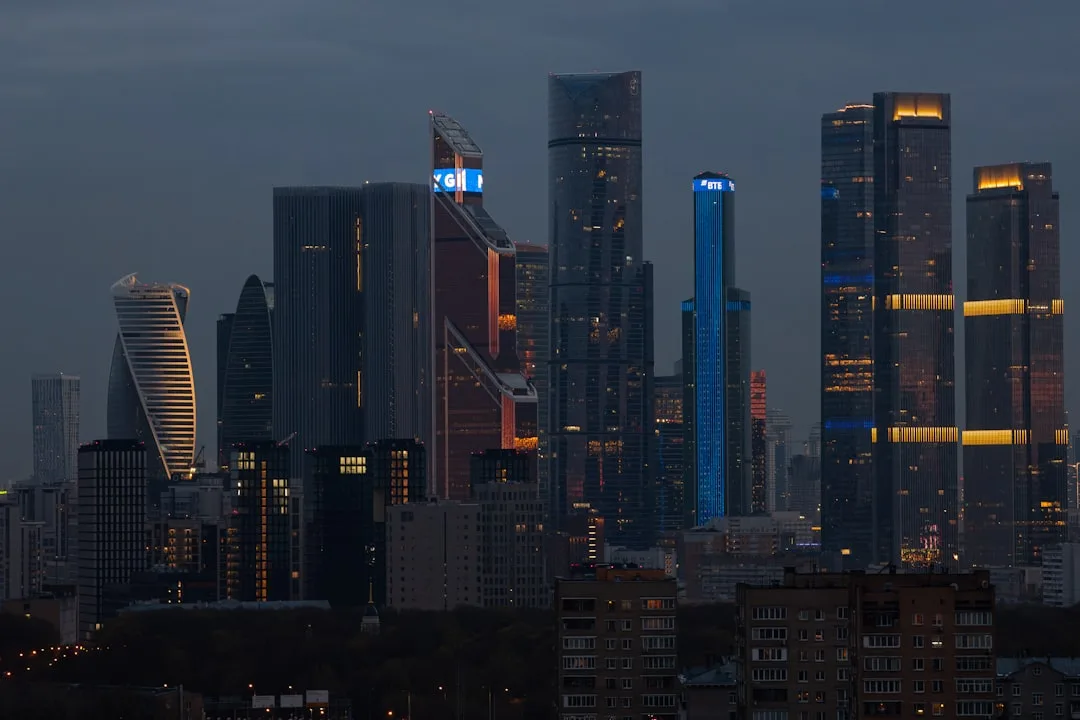
Illustration · Moscow, Russia
Russia uses a unified social contribution system. Employers pay 30% on earnings up to RUB 2,979,000 per year. Above that ceiling the rate drops to 15.1%. Employees pay no separate social contribution.
Personal income tax (NDFL) now has five bands. The standard rate is 13% on income up to RUB 2,400,000. The top rate reaches 22% on income above RUB 50,000,000. Russia has no universal personal allowance. Tax starts from the first ruble earned.
Employers must pay wages at least twice a month. NDFL withheld must be remitted to the tax authority on a bi-monthly schedule. The federal minimum wage is RUB 27,093/month from January 2026.
What does an employer pay in Russia's unified social contribution?
Employers pay a unified social contribution at 30% on each employee's earnings up to the annual wage base of RUB 2,979,000.
Above that ceiling the rate falls to 15.1%. There is no separate pension, medical, or social insurance contribution. Russia merged all three streams into a single levy in 2023.
| Earnings band per employee per year | Employer unified contribution rate |
|---|---|
| Up to RUB 2,979,000 (wage base) | 30% |
| Above RUB 2,979,000 | 15.1% |
What the unified contribution covers
The single levy funds pension, compulsory medical insurance, and social insurance (including sick leave and maternity benefits). Before 2023 these were filed separately under the Pension Fund, FFOMS, and FSS. From 2023 they merged into the Social Fund of Russia (SFR) under a single unified tariff. For payroll purposes you calculate one contribution figure per employee, not three.
The annual wage base
The wage base for 2026 is RUB 2,979,000 per employee. The government adjusts this ceiling each year. Once an employee's cumulative earnings in a calendar year cross the base, the rate drops to 15.1% on the excess. Track cumulative earnings per employee through the year; the switch happens automatically when the threshold is crossed.
Small and medium businesses
Small and medium-sized enterprises (SMEs) registered with the Federal Tax Service under the SME registry benefit from a reduced rate of 15% on the portion of each employee's monthly earnings above the federal minimum wage. This applies on a monthly basis, not annually. The portion at or below the minimum wage remains at the standard 30%. Employers must actively verify their SME registry status to claim this benefit.
What does an employee pay in Russia's social contribution system?
Employees pay no unified social contribution. The entire employer-side levy sits with the employer.
This is different from most European payroll systems. In Russia, social insurance is funded entirely by the employer contribution. The employee's net pay is reduced only by personal income tax (NDFL), not by any separate social charge.
The employee's payslip deduction is NDFL only. Gross pay minus NDFL equals net pay. There is no employee-side pension line, no employee medical deduction, and no employee social insurance line. This makes the payslip calculation straightforward once NDFL is determined.
What does fund the employee-side benefits?
Sick pay, maternity allowances, and other social benefits come from the Social Fund of Russia (SFR), funded by the employer's unified contribution. The employer pays the first three days of sick leave directly. From day four onward the SFR pays the benefit. Maternity benefits are paid fully by the SFR from day one.
Minimum wage floor
The federal minimum wage from January 2026 is RUB 27,093/month. Employers must not pay any employee less than this amount for a full working month. Regional governments may set higher minimums. Employers operating in a region with a higher minimum must apply the regional rate unless they have formally opted out within 30 days of its announcement.
Russia personal income tax bands for 2026
Russia has five personal income tax (NDFL) bands from 2025 onward. The standard rate is 13% on earnings up to RUB 2,400,000 per year.
The top rate is 22% on income above RUB 50,000,000 per year. There is no personal allowance. Tax applies from the first ruble.
Russia introduced a progressive five-band personal income tax (NDFL) structure effective 1 January 2025 under Federal Law No. 176-FZ of 12 July 2024. The new top rate of 22% applies to annual income above RUB 50,000,000. The 13% rate continues to apply to the majority of employed workers earning below RUB 2,400,000.
| Annual income band (RUB) | NDFL rate |
|---|---|
| RUB 0 to RUB 2,400,000 | 13% |
| RUB 2,400,000 to RUB 5,000,000 | 15% |
| RUB 5,000,000 to RUB 20,000,000 | 18% |
| RUB 20,000,000 to RUB 50,000,000 | 20% |
| Above RUB 50,000,000 | 22% |
No universal personal allowance
Russia does not have a personal allowance that shields a block of income from tax. Every ruble of earnings is taxable from the first ruble. Conditional deductions exist for children, medical expenses, education costs, and some property purchases, but these must be claimed by the employee separately. They are not applied automatically through payroll.
Marginal rate applies only to the band, not total income
Russia's NDFL is a marginal-rate system. The higher rates in bands 2 to 5 apply only to the portion of income within each band. An employee earning slightly above RUB 2,400,000 pays 15% only on the excess, not on their entire income.
How does Russia's NDFL payroll withholding and remittance system work?
Employers withhold NDFL from each employee's pay and remit it to the Federal Tax Service on a bi-monthly schedule.
Tax withheld between the 1st and 22nd of a month must be paid by the 28th of that month. Tax withheld between the 23rd and the last day of a month must be paid by the 5th of the following month.
Russia uses a two-period NDFL remittance model introduced in 2024. Each calendar month is split into two withholding periods. Employers calculate NDFL on each payment to employees, then batch the remittances into these two windows. A separate advance notification (uvedomleniye) must also be submitted to the tax authority before each payment.
| Withholding period | NDFL remittance deadline |
|---|---|
| 1st to 22nd of the month | 28th of the same month |
| 23rd to last day of the month | 5th of the following month |
Wages must be paid at least twice a month
The Russian Labor Code requires wages to be paid at least every half-month. This means at least 24 pay events per year minimum. Most employers use a monthly advance (avanss) around the 20th to 25th, then the main salary payment at month end. The advance is typically 40% to 50% of monthly salary. Both payments are subject to NDFL withholding.
Unified social contribution remittance
Unified social contributions are remitted monthly by the 28th of the following month. Employers file a combined report (EFS-1) with the Social Fund of Russia covering pension, medical, and social insurance data. A separate EDV-1 notification covers certain contribution types. The Federal Tax Service administers NDFL collection; the SFR administers unified contribution collection.
Annual tax reporting
Employers file a 6-NDFL report with the Federal Tax Service quarterly for each pay period. The annual version of 6-NDFL is the year-end reconciliation. Individual income certificates (formerly 2-NDFL, now integrated into 6-NDFL Annex 1) must be provided to employees on request or on termination.
-
Collect pay data for the period
Gather salary, advances, bonuses, and any taxable in-kind payments for every employee in the pay period. Both the advance payment and the main salary payment are separate events.
-
Calculate gross pay and cumulative earnings
Total all earnings for the period. Track each employee's cumulative year-to-date earnings against the annual wage base to determine whether the lower or reduced unified contribution rate applies.
-
Withhold NDFL at the correct band rate
Apply the five-band NDFL table to the employee's taxable income. Deduct the withheld amount from gross pay to produce net pay. Marginal rates apply only within each band.
-
Calculate the unified social contribution
Apply 30% on earnings below the wage base ceiling, 15.1% on the excess. This is the employer's cost, separate from the employee's net pay.
-
Submit the advance notification and remit NDFL
File the uvedomleniye notification with the Federal Tax Service before the remittance deadline. Pay NDFL withheld in the first period by the 28th of the month, and second-period withholdings by the 5th of the following month.
Pension and social benefit contributions in the Russia payroll stack
Russia has no separate mandatory pension contribution rate. Pension funding is built into the unified social contribution that employers already pay at 30% below the wage base.
The Social Fund of Russia allocates a portion of the unified contribution to the pension track, the medical insurance track, and the social insurance track. The employer does not calculate or pay these separately.
Before 2023, Russian employers filed three separate contributions: 22% to the Pension Fund (PFR), 5.1% to the Federal Compulsory Medical Insurance Fund (FFOMS), and 2.9% to the Social Insurance Fund (FSS). These added up to 30% total. From 2023 those three funds merged into the Social Fund of Russia (SFR) under a single unified tariff. The employer's obligation is now one calculation and one payment.
What the unified contribution funds
- Pension insurance: retirement income for the employee in later years
- Compulsory medical insurance: access to the state health system
- Social insurance: sick pay from day four, maternity and paternity benefits, occupational injury cover
Sick leave payments in payroll
Employer-funded sick pay covers only the first three days of each illness episode. From day four the Social Fund of Russia pays the benefit directly to the employee. The employer calculates and pays days one to three; the SFR handles the rest. Sick pay rates depend on length of service and are governed by Federal Law No. 255-FZ.
Maternity leave
Maternity leave lasts 140 calendar days in a standard birth. The benefit is paid at 100% of average earnings. The SFR funds the full amount from day one. The employer processes the leave on the payroll but does not bear the salary cost.
Voluntary pension plans
Employers can offer supplementary non-state pension contributions through licensed non-state pension funds. These are not mandatory. Contributions to approved schemes are deductible within certain limits for corporate income tax purposes.
How does Teamed handle Russia payroll for you?
Teamed becomes your legal employer of record in Russia for from $599 per employee per month, with zero FX mark-up in any currency.
Payroll, NDFL withholding, social contributions, and the full Russian employment law stack run on one platform.
Real HR and legal experts handle your Russia hires, from contract drafting through bi-monthly NDFL remittances, unified contribution filings, and year-end 6-NDFL reporting. An actual person, not a chatbot or a pooled queue. There is no setup fee and no exit fee. Employer cost passes through at cost, itemised on every invoice.
All payroll and compliance obligations live on one platform. A contractor who converts to a full employment contract keeps their record. That same employee can graduate from EOR to your own Russia entity without switching systems. Run the Employer Cost Calculator to see the unified contribution and minimum wage floor built into the total. EOR is the right model for a first Russia hire, until it isn't. Start from the Russia hiring overview.
Key sources: Forte Tax and Law: Tax changes in Russia from 2025 and Acsour: Social Insurance Contribution Base for 2026.
Frequently asked questions
What is the employer social contribution rate in Russia in 2026?
Employers pay a unified social contribution at 30% on each employee's annual earnings up to the wage base of RUB 2,979,000. Above that ceiling the rate drops to 15.1%. There is no separate pension, medical, or social insurance payment. All three are merged into this single levy paid to the Social Fund of Russia.
What social contribution does a Russia employee pay?
Employees pay no unified social contribution in Russia. The entire social insurance levy sits with the employer. The only deduction from an employee's gross pay is personal income tax (NDFL). This is different from most European countries where the employee also contributes to social insurance.
What are the Russia personal income tax bands in 2026?
Russia has five NDFL bands from 2025: 13% on income up to RUB 2,400,000; 15% from RUB 2,400,000 to RUB 5,000,000; 18% from RUB 5,000,000 to RUB 20,000,000; 20% from RUB 20,000,000 to RUB 50,000,000; and 22% above RUB 50,000,000. There is no personal allowance. Tax starts from the first ruble of income.
How often must Russian employers pay wages?
Employers must pay wages at least twice per month under the Russian Labor Code. That means at least 24 payment events per year. The most common approach is an advance payment around the 20th to 25th of the month and the main salary at the end of the month.
When must NDFL withheld from employees be remitted to the Russian tax authority?
Russia uses a bi-monthly remittance schedule. NDFL withheld between the 1st and 22nd of a month must be remitted by the 28th of that month. NDFL withheld between the 23rd and the last day of a month must be remitted by the 5th of the following month. Employers must also file an advance notification (uvedomleniye) before each remittance date.
The change people miss in Russia payroll is the five-band PIT structure that came in from 2025. Most employees sit in the 13% band and never cross the threshold. But senior technical hires on competitive salaries can move into the 15% band. Model it before you make the offer. The bracket boundaries are in rubles and the exchange rate is doing work too.
Russia's employer social contribution runs at 30% up to RUB 2,979,000 per employee per year. Above that the rate drops to 15.1%.
Employees pay no social charge at all. NDFL starts at 13% from the first ruble and tops out at 22% above RUB 50,000,000.
Run the cost before you open the role. The ceiling matters more than the headline rate.