Closing Loopholes: what changed in Australian employment law
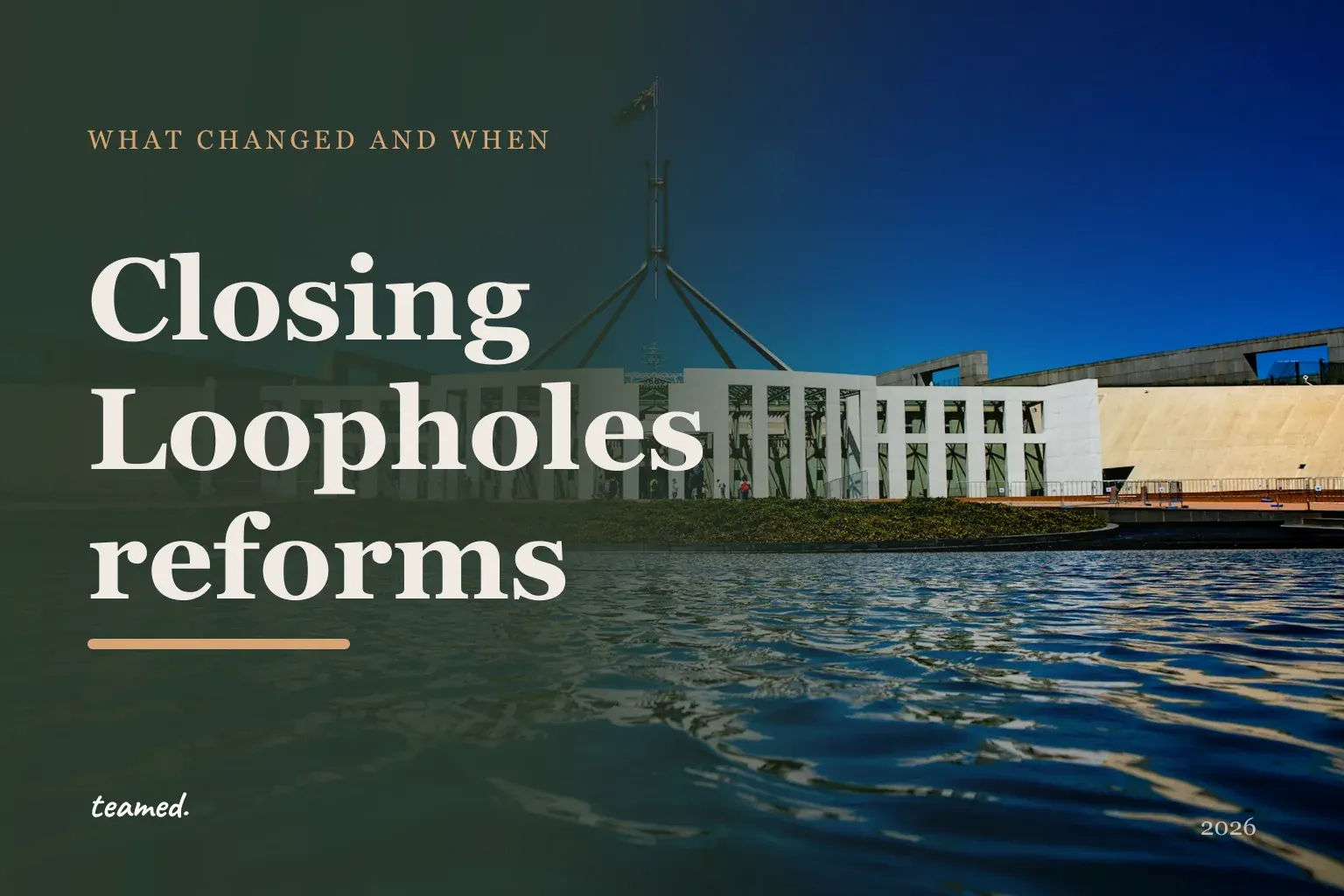
Two Acts, the Closing Loopholes Act 2023 and Closing Loopholes No. 2 Act 2024, rewrote Australian employment law in stages from December 2023 to August 2025, covering wage theft, labour hire, casual employment, contractor status, the right to disconnect and gig-economy protections. The first gig-economy minimum standards order took effect on 17 August 2026, and three more applications are still before the Fair Work Commission, including one covering on-demand passenger transport.
New pay floor for app delivery workers
What happened
From 17 August 2026, people who deliver food, drinks or groceries through an app have minimum standards for the first time. The Fair Work Commission made the order on 11 August 2026.
What it means for you
The apps that engage them must now pay a set hourly rate. It starts at $31.30 an hour and depends on the vehicle used. The order also covers insurance, records and a way to settle disputes. Two more orders for other delivery work are still being worked on.
Dates to know
- 1 January 2027The hourly rates go up again.
Source: Fair Work Commission. We check this page every week. Last checked .
The Fair Work Legislation Amendment (Closing Loopholes) Act 2023 (Royal Assent 14 December 2023) and the Fair Work Legislation Amendment (Closing Loopholes No. 2) Act 2024 (Royal Assent 26 February 2024) rolled out a staggered set of Fair Work Act reforms from 15 December 2023 through to 26 August 2025, covering wage theft criminalisation, labour hire pay equalisation, the right to disconnect, casual employment, independent contractor status, gig economy minimum standards, union right of entry and family/domestic violence discrimination protections. The first minimum standards order under the gig economy powers, the Interim On-Demand Delivery Employee-like Worker Minimum Standards Order, was made on 11 August 2026 and took effect on 17 August 2026; three further applications remain before the Fair Work Commission: MS2024/1 and MS2024/2, covering other small-vehicle delivery work, and MS2025/3, covering on-demand passenger transport.
What are the Closing Loopholes Acts?
Two separate pieces of legislation: the Fair Work Legislation Amendment (Closing Loopholes) Act 2023, which received Royal Assent on 14 December 2023, and the Fair Work Legislation Amendment (Closing Loopholes No. 2) Act 2024, assented on 26 February 2024. Between them they cover wage theft criminalisation, labour hire pay equalisation, the right to disconnect, casual employment, independent contractor status, gig-economy minimum standards, expanded union right of entry, and new family and domestic violence discrimination protections.
Why did the reforms roll out in stages rather than all at once?
Each measure commenced on its own date as it was ready, from 15 December 2023 (union right of entry and the new domestic violence protected attribute) through to 26 August 2025 (the employee choice pathway's final phase-in for small business employers). This page lists every confirmed milestone in order.
Right to disconnect and union right of entry, in brief
The right to disconnect lets employees reasonably refuse to monitor or respond to work contact outside working hours, without adverse consequences; it commenced 26 August 2024 for non-small-business employers and 26 August 2025 for small business employers. Separately, the Fair Work Commission gained an expanded, no-notice right of entry power for investigating suspected underpayments, from 15 December 2023.
What happened with the gig-economy minimum standards?
An Expert Panel of the Fair Work Commission made its first minimum standards order on 11 August 2026 and it took effect on 17 August 2026. The Interim On-Demand Delivery Employee-like Worker Minimum Standards Order covers employee-like workers engaged through an app to deliver food, beverages, liquor or supermarket groceries, and the digital labour platform operators that engage them. It sets safety net hourly rates from $31.30, rising again on 1 January 2027, alongside terms on vehicles, consultation, records, fines, insurance, dispute resolution, a right to unpaid time away, information sharing, delegates' rights and a gig worker information statement. Applications MS2024/1 and MS2024/2, covering other small-vehicle delivery work, remain before the Commission, and this order is expressly interim: it will be reviewed if either of them produces a draft order. A third application, MS2025/3, covers on-demand passenger transport and is still at the conference stage.
Closing Loopholes in Australia, tracked by Teamed
- Right to disconnect policy
- Wage theft compliance in payroll
- Union right of entry procedures
Key figures
| Detail | Value |
|---|---|
| Two separate Acts | The Fair Work Legislation Amendment (Closing Loopholes) Act 2023 received Royal Assent on 14 December 2023 (legislation.gov.au C2023A00120). The Fair Work Legislation Amendment (Closing Loopholes No. 2) Act 2024 received Royal Assent on 26 February 2024 (legislation.gov.au C2024A00002). Together they amend the Fair Work Act 2009. (source) |
| Rollout span | Individual measures commenced on a staggered basis from 15 December 2023 (day after the first Act's Royal Assent) through to 26 August 2025 (small business right to disconnect and casual conversion). The first minimum standards order for gig economy workers took effect on 17 August 2026. (source) |
| Regulators involved | The Fair Work Ombudsman enforces the new criminal wage theft offence and standard workplace obligations. The Fair Work Commission administers the new jurisdictions created by the reforms: regulated labour hire arrangement orders, minimum standards orders and guidelines for employee-like and road transport workers, and unfair contract term, deactivation and termination remedies. (source) |
| Small business threshold used throughout the reforms | An employer with fewer than 15 employees at the relevant time (counting employees of associated entities, excluding casuals not engaged regularly and systematically) is treated as a small business for right to disconnect, casual conversion timing, and the Voluntary Small Business Wage Compliance Code. (source) |
| Wage theft penalties | Individuals convicted of the new criminal underpayment offence face up to 10 years imprisonment, and both individuals and body corporates face fines of the greater of 3 times the underpayment or a fixed maximum, expressed in Commonwealth penalty units and set far higher for a body corporate than for an individual. The dollar value of a penalty unit rose on 1 July 2026, so the exact maximum fine should be checked against the Fair Work Ombudsman's current guidance rather than a fixed figure. (source) |
| First minimum standards order for employee-like workers | An Expert Panel of the Fair Work Commission made the Interim On-Demand Delivery Employee-like Worker Minimum Standards Order on 11 August 2026 (decision [2026] FWCFB 211, case MS2024/3), and it took effect on 17 August 2026. Safety net hourly rates from 17 August 2026 to 31 December 2026 run from $31.30 (no vehicle, pedal or electric bicycle or scooter) to $32.00 (a motor vehicle with a carrying capacity up to 1 tonne), rising to a range of $31.80 to $32.50 from 1 January 2027. (source) |
| Small-vehicle delivery applications still before the Commission | Applications MS2024/1 (employee-like workers who get small-vehicle delivery work through digital labour platforms) and MS2024/2 (road transport contractors who perform small-vehicle delivery work) were both still listed as ongoing as at 29 September 2026. Hearings on whether the Expert Panel should issue notices of intent to make minimum standards orders ran in July and August 2026; the Commission's case page was last updated on 2 September 2026. (source) |
| Passenger transport application (MS2025/3) | A separate Transport Workers' Union application, MS2025/3, asks the Fair Work Commission to make an employee-like worker minimum standards order covering workers who perform on-demand passenger transportation work. As at 29 September 2026 it is at the conference stage: the Commission states it is not yet considering what orders to make and has not yet called for submissions. Conferences are listed for 15 October, 12 November and 8 December 2026. (source) |
| Other Fair Work Act changes since Closing Loopholes | The Workplace Relations Legislation Amendment (Building Cooperative Workplaces No. 1) Act 2026 (Act No. 62 of 2026) received Royal Assent on 6 July 2026, with changes taking effect from 7 July 2026: Fair Work Commission processes in dismissal disputes, a separate road transport contractor high income threshold, employer preferencing in Commonwealth grants and procurement, supported bargaining authorisations and intractable bargaining workplace determinations. The Fair Work Amendment (Fairer Fuel) Act 2026 received Royal Assent on 1 April 2026 and speeds up applications for road transport contractual chain orders. Two further Acts also postdate Closing Loopholes: the Fair Work Amendment (Baby Priya's) Act 2025 (Royal Assent 6 November 2025), which prohibits an employer from refusing or cancelling an employee's entitlement to employer funded paid parental leave because their child is stillborn or dies after birth; and the Fair Work Amendment (Protecting Penalty and Overtime Rates) Act 2025 (Royal Assent 29 August 2025), which requires the Fair Work Commission to ensure award penalty and overtime rates are not reduced, and that awards do not substitute those rates in a way that leaves an employee paid less than they otherwise would be. (source) |
Frequently asked questions
Is Closing Loopholes one law or several?
Two Acts, the Closing Loopholes Act 2023 and Closing Loopholes No. 2 Act 2024, which together introduced a wide range of separate reforms, each with its own commencement date.
Which measures affect day-to-day people management most?
The whole of relationship test for contractor status and the casual employment changes affect classification decisions directly; the right to disconnect affects manager expectations around after-hours contact. See the dedicated topic pages on this hub for each.
Is the reform program complete?
Almost. All core measures are in force. The first minimum standards order for gig-economy workers, covering app-based on-demand delivery, took effect on 17 August 2026 under powers that commenced on 26 August 2024. Three further applications are still before the Fair Work Commission: two covering other small-vehicle delivery work, and one covering on-demand passenger transport.
Have there been other changes to the Fair Work Act since Closing Loopholes?
Yes. The Workplace Relations Legislation Amendment (Building Cooperative Workplaces No. 1) Act 2026 took effect on 7 July 2026, changing how the Fair Work Commission handles dismissal disputes and creating a separate high income threshold for regulated road transport contractors. The Fair Work Amendment (Baby Priya's) Act 2025 protects employer funded paid parental leave where a child is stillborn or dies after birth, and the Fair Work Amendment (Protecting Penalty and Overtime Rates) Act 2025 stops the Commission reducing award penalty and overtime rates. The Fair Work Amendment (Fairer Fuel) Act 2026, in force since 2 April 2026, speeds up road transport contractual chain orders.
The Closing Loopholes reforms are Australia's biggest overhaul of the Fair Work Act in years. When Teamed is your legal employer, we track every change and update your contracts, policies and payroll as the law lands, so you never have to read a statute to stay compliant.